






Bilal Awad, Communication Working Group Member at European Oncology Nursing Society, shared a post on LinkedIn:
“Case Report
I recently managed a challenging case at Beit Jala Governmental Hospital, Palestine.
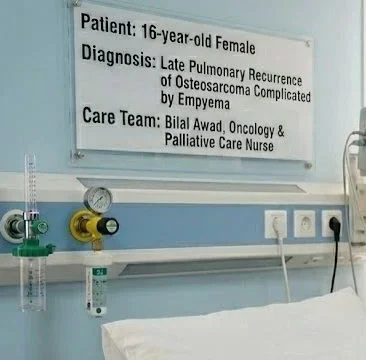
Late Pulmonary Recurrence of Osteosarcoma Complicated by Empyema in an Adolescent Patient
Background
Osteosarcoma is the most common primary malignant bone tumor in adolescents. The lungs are the most frequent site of metastasis and recurrence, which may occur even years after initial treatment.
Case Presentation
A 16-year-old female with a history of osteosarcoma diagnosed in 2018 underwent right humeral resection with prosthetic implantation. Details of her chemotherapy protocol were unavailable.
Years later, she presented with a new large right lung mass involving the middle and lower zones, with a necrotic center on imaging. Tru-cut biopsy confirmed metastatic high-grade sarcoma consistent with her known osteosarcoma.
Shortly after the biopsy, she developed persistent high-grade fever (up to 40°C), tachycardia, and clinical deterioration. Laboratory results revealed markedly elevated inflammatory markers (CRP 284 mg/L). Imaging demonstrated right-sided pleural effusion, and pleural fluid analysis confirmed empyema.
Management
Broad-spectrum intravenous antibiotics (Piperacillin–Tazobactam) were initiated, with Vancomycin added due to persistent fever and concern for resistant organisms. Close monitoring, infection control measures, and multidisciplinary coordination were implemented.
The patient stabilized clinically and was successfully.
Discussion
This case highlights the dual clinical challenge of advanced oncologic disease complicated by severe infection. Necrotic metastatic lung lesions can predispose patients to secondary infections, particularly after invasive diagnostic procedures.
Empyema in oncology patients is a serious complication that requires early recognition, aggressive antimicrobial therapy, and coordinated care to prevent progression to sepsis.
The Role of the Oncology Nurse
This case underscores the critical role of oncology nursing in complex cancer care. Oncology nurses are often the first to detect subtle clinical deterioration. Early recognition of persistent fever, abnormal vital signs, and post-procedural complications can be life-saving.
Beyond clinical monitoring, oncology nurses lead infection surveillance, coordinate multidisciplinary interventions, advocate for timely escalation of care, and provide emotional support to patients and families facing recurrence and acute complications.
In high-risk oncologic cases, vigilance, leadership, and rapid clinical judgment from oncology nurses directly impact patient outcomes.
Conclusion
Late pulmonary recurrence of osteosarcoma can be further complicated by severe infectious events. Early intervention, strong multidisciplinary collaboration, and proactive oncology nursing care were essential in stabilizing this patient and enabling continuation of her cancer journey.”
Other articles featuring Bilal Awad.