
When Novartis agreed on July 6 to acquire UK biotech Myricx Bio for up to $1.5 billion, the number that matters isn’t the headline figure. It’s the $1.1 billion in cash the company committed upfront for two drug candidates that have never been dosed in a human.
Both of Myricx’s lead programs are preclinical. What Novartis is buying is a thesis: that a first-in-class antibody-drug conjugate (ADC) payload built on N-myristoyltransferase (NMT) inhibition (NMTi) can do what the two dominant payload classes cannot. That combination, big pharma paying up, in guaranteed cash, for a mechanism unproven in patients, is what makes this more than a routine bolt-on.
A structure that signals conviction
The terms are simple: $1.1 billion upfront, up to $400 million in milestone payments, with closing expected in the second half of 2026 subject to regulatory approvals. The tell is the split. Roughly three-quarters of the maximum value is guaranteed cash rather than contingent “biobucks.” Early-stage oncology deals are usually milestone-loaded to defer risk, Gilead’s April acquisition of Germany’s Tubulis, at $3.15 billion upfront plus up to $1.85 billion in milestones, is a recent template. Front-loading the payment for assets with no clinical data means Novartis is absorbing nearly all the translational risk itself, an unusually direct vote of confidence.
What NMT inhibition actually does
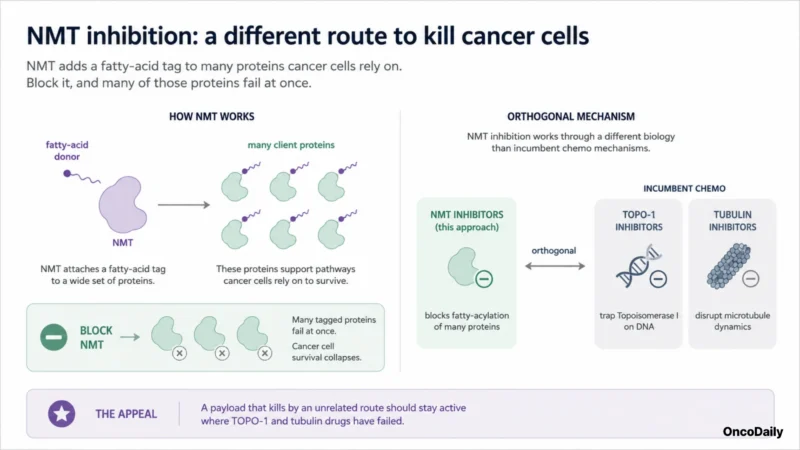
An ADC is an antibody that homes to a tumor antigen, wired by a chemical linker to a cell-killing “payload.” Almost all approved ADCs use one of two payload families: topoisomerase-1 (TOPO-1) inhibitors, the class behind AstraZeneca and Daiichi Sankyo’s blockbuster Enhertu (trastuzumab deruxtecan), and tubulin inhibitors such as auristatins and maytansinoids. Both attack the machinery of cell division.
Myricx’s payload acts elsewhere. NMT is an enzyme that attaches a fatty-acid tag to a wide set of proteins that cancer cells rely on to survive; block it, and many of those proteins fail at once. The companies call the mechanism “orthogonal” to the incumbents. The appeal is twofold: a payload that kills by an unrelated route should stay active where TOPO-1 and tubulin drugs have failed, and should bring a different toxicity profile. Novartis says preclinical models, including TOPO-1-resistant tumors, support the efficacy claim.
Why a differentiated payload matters clinically
The unmet need here is real. ADCs have both a resistance problem and a tolerability problem, and the payload drives much of each. When patients who progress on one ADC receive another carrying the same payload class, responses collapse, Myricx cites a greater-than-50% drop in objective response rate on retreatment with the same payload class. Toxicity is the other ceiling: payload side effects frequently force dose reductions or treatment interruptions, holding tolerable doses below the levels needed for substantial efficacy, and TOPO-1 agents like trastuzumab deruxtecan carry interstitial lung disease risk, seen in roughly 15% of patients in a pooled analysis of nine trials, and serious enough to warrant a boxed warning. A payload with a genuinely different mechanism is one of the few credible routes to treating patients who have exhausted existing ADCs.
Validated targets, unvalidated payload
Novartis hedged its target risk even as it took on payload risk. Both Myricx programs go after the established targets B7-H3 and HER2, the latter the most validated antigen in the field. Pairing a new payload with well-understood biology is textbook de-risking: if a program fails, the payload is the more likely culprit than the target.
The caveats deserve equal billing. Every efficacy and tolerability claim rests on animal and lab data, a famously imperfect predictor of how ADCs behave in people, and the field is littered with payloads that looked clean preclinically and turned toxic in the clinic. A novel mechanism cuts both ways: new biology can mean new, unforeseen toxicities. And “validated” also means “crowded”, B7-H3 in particular is contested, with Daiichi Sankyo and Merck’s ifinatamab deruxtecan and other B7-H3 assets already well ahead of Myricx, deep into Phase 3 with a US filing under review. Notably, ifinatamab pairs that same target with a conventional TOPO-1 payload, which sharpens rather than undercuts Myricx’s pitch, since the whole bet is on the payload, not the target. Novartis is wagering that its payload’s differentiation will matter even if its programs arrive late.
The platform playbook
Fiona Marshall, president of biomedical research at Novartis, framed the deal as:
scale innovative platforms, as we have with radioligand therapies, to deliver more durable, transformative treatments for patients.

Fiona Marshall/Novartis
The reference is to Pluvicto and Lutathera, which Novartis grew into a franchise around a modality rather than a single drug. The logic repeats: if NMTi is clinically validated, it becomes a payload that can be attached to many antibodies and targets, an engine, not two cars. The deal follows Novartis’s roughly $12 billion acquisition of Avidity Biosciences late last year, another bet on a delivery platform rather than a single asset.
A crowded, expensive field
The price reflects an ADC gold rush with no sign of cooling. Since Pfizer’s $43 billion Seagen acquisition in 2023 set the benchmark, ADC platforms have drawn premiums, AbbVie’s $10.1 billion purchase of ImmunoGen, then Gilead–Tubulis. By most market-research estimates, the ADC market was worth roughly $13–15 billion in 2025, spread across some 15 to 19 approved products, with forecasts generally projecting growth to the low-to-mid $30 billions by the early 2030s and more than 200 candidates in active clinical development. With most pipelines chasing the same handful of targets and payloads, differentiation is precisely what acquirers are paying for.
It’s also a marquee European exit. Myricx was spun out of Imperial College London and the Francis Crick Institute in 2019 with support from Cancer Research UK, seeded by Sofinnova Partners and Brandon Capital; it is the highest-value Imperial spinout to date and Sofinnova’s seventh exit in three years.
What to watch
The thesis is unproven until an NMTi-ADC reaches patients, so the catalyst that counts is first-in-human data. Dose escalation will reveal whether the differentiated tolerability survives contact with real patients and whether the mechanism translates at all. Watch the competitive response, too: if NMT inhibition works, other payload-hunting buyers will move on the mechanism quickly. For now, Novartis has bought conviction. The data will decide whether it bought a franchise.
You can read more insights on the ADC Acquisition Wave on OncoDaily.
Read more biotech insights on OncoDaily Biotech.
Written by: Semiramida Nina Markosyan, Editor, OncoDaily Canada