The antibody-drug conjugate land grab isn’t slowing down. Here’s what’s driving pharma’s most expensive shopping habit.
When Gilead closed its acquisition of Munich-based Tubulis on May 21, it added one more name to a list that has grown almost monotonous over the past three years: another big pharma, another antibody-drug conjugate (ADC) specialist, another nine- or ten-figure check. The deal, $3.15 billion upfront and up to $1.85 billion in milestones, is small relative to some of its predecessors, but the pattern it fits is now unmistakable. ADCs have become the most reliably acquired asset class in oncology. The question worth asking isn’t whether the buying will continue. It’s why a modality that spent two decades as a pharmacological curiosity suddenly became the thing every major oncology player feels it cannot afford to miss.
You can read more on Gilead’s Tubulis acquisition on OncoDaily.
A modality that finally works
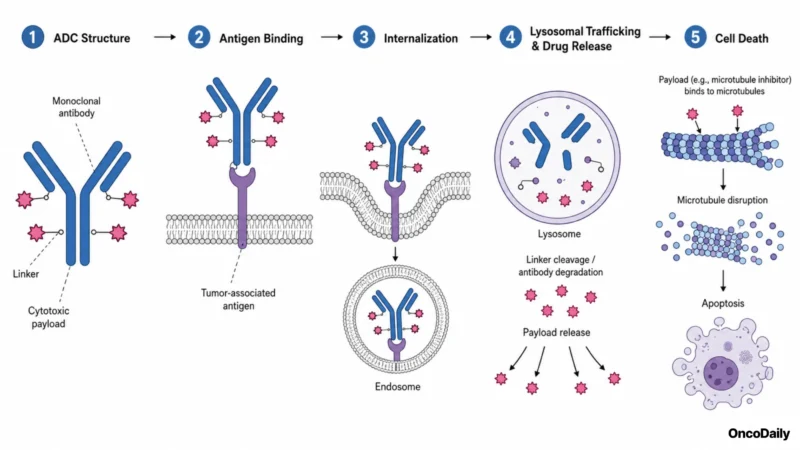
ADCs are deceptively simple in concept: take a monoclonal antibody that homes in on a tumor antigen, attach a potent cytotoxic payload, and connect the two with a chemical linker. The antibody acts as a guided missile, sparing healthy tissue while delivering chemotherapy directly to cancer cells. The idea dates back decades, but the early generations were plagued by unstable linkers, off-target toxicity, and inconsistent drug-to-antibody ratios. What changed is that the technology caught up with the ambition.
The clearest proof point is AstraZeneca and Daiichi Sankyo’s Enhertu, which generated roughly $3.75 billion in 2024 sales and continues to expand into new indications. Behind it sits a commercial tier that would be the envy of most oncology franchises, Adcetris, Padcev, Trodelvy, and Polivy each clear north of a billion dollars annually. Collectively, the top handful of approved ADCs now generate over $10 billion a year. That commercial validation reframed the entire category.
ADCs are no longer a bet on future potential; they are a proven revenue engine, with a global market estimated around $13.5 billion in 2025 and forecast to roughly double over the next decade. With more than 200 candidates in clinical development and close to 20 products already approved, the field has the depth to sustain a long acquisition cycle.
The deals tell the story
The buying spree has unfolded in two distinct tiers. At the top are the franchise-defining megadeals: Pfizer’s $43 billion takeover of Seagen and AbbVie’s $10.1 billion acquisition of ImmunoGen, both in 2023, signaled that ADCs had become a core pillar of large-cap pharma strategy rather than a speculative add-on. But the more telling activity is happening one rung down, where companies are paying premium prices not for marketed drugs but for platforms.
Taiho’s acquisition of Swiss biotech Araris, up to $1.14 billion, with $400 million upfront and as much as $740 million in milestones, was driven almost entirely by Araris’s AraLinQ peptide-linker technology, not by any approved product. Gilead’s Tubulis deal followed the same logic, anchored by the company’s Tubutecan linker-payload platform and a lead candidate, TUB-040, still in early-phase trials for ovarian cancer and non-small cell lung cancer. Licensing deals reinforce the trend. Boehringer Ingelheim’s roughly $1.3 billion Synaffix agreement and Astellas’s $1.54 billion Evopoint pact show that even access to conjugation technology, without owning the company outright, commands serious money.
The linker is the moat
This is the part that explains everything else. In a maturing ADC field, the antibody and the payload are increasingly commoditized. What differentiates a best-in-class ADC from an also-ran is the engineering in between: how stably the linker holds the payload in circulation, how cleanly it releases the drug inside the tumor, and how precisely the payload can be attached to the antibody.
Site-specific conjugation and next-generation linker chemistry are where the therapeutic window is won or lost, and they are genuinely hard to replicate. That makes platform-stage biotechs disproportionately valuable. A buyer isn’t just acquiring one drug; it’s acquiring the ability to generate a pipeline of better-behaved ADCs against many targets. It’s the difference between buying a fish and buying the boat. There is also a payload story underneath the deals. Topoisomerase-I inhibitor payloads, the class used in Enhertu and in Gilead’s newly acquired TUB-040, accounted for more than half the market in 2025, and the chase for differentiated payloads and dual-payload designs is intensifying.
The strategic backdrop
None of this is happening in a vacuum. Large pharmaceutical companies are facing a wave of patent expirations and pricing pressure that threatens established revenue. ADCs offer a way to refill pipelines with assets that have a clear mechanistic rationale, a growing body of clinical validation, and applicability across a broad range of solid and hematologic tumors. For a CFO weighing where to deploy capital, a de-risked modality with blockbuster precedent is an easy story to tell.
What to watch
The near-term test is whether the platform bets pay off in the clinic. Early ADC data often looks promising and then fails to translate into durable, differentiated outcomes against incumbents, and many of the recently acquired assets are still early-phase. ASCO 2026, opening in Chicago this week, will offer the first read on several of these programs now that they sit inside big-pharma portfolios. If the data holds, expect the checkbook to stay open. The ADC consolidation wave has been running for three years, and on current evidence, it looks less like a peak than a plateau with room to climb.
Read more biotech insights on OncoDaily Biotech.
Written by: Semiramida Nina Markosyan, Editor, OncoDaily Canada