
On February 23, 2026, Gilead announced a definitive agreement to acquire Arcellx for $115 per share in cash plus a contingent value right (CVR) of $5 per share, implying equity value of about $7.8 billion. Gilead said it expects to close the transaction in Q2 2026, subject to customary conditions.
Deal mechanics that matter
Unlike milestone-based CVRs tied to regulatory events, the CVR here is tied to commercialization performance: Gilead stated the $5 CVR becomes payable if cumulative global net sales of anito-cel reach at least $6.0 billion from launch through year-end 2029. The company also disclosed it already owns approximately 11.5% of Arcellx’s outstanding common stock and will pursue the acquisition via a tender offer structure.
Regulatory timing: BLA accepted with a December 2026 PDUFA date
Gilead reported that the FDA accepted the BLA for anito-cel as a fourth-line treatment in relapsed/refractory multiple myeloma and set an anticipated PDUFA action date of December 23, 2026. The company stated the filing is supported by its Phase 1 study and the Phase 2 pivotal iMMagine-1 dataset.
Clinical context: iMMagine-1 efficacy and safety snapshot
Arcellx’s disclosed iMMagine-1 update (data cutoff October 7, 2025; N=117; median follow-up 15.9 months) reported an independent review committee–assessed overall response rate of 96%, with 74% achieving CR/sCR and 88% achieving ≥VGPR; among MRD-evaluable patients, 95% achieved MRD negativity at the reported sensitivity threshold. [16] Arcellx also reported that median PFS and OS were not reached at that follow-up, and highlighted a lack (to date) of certain delayed or atypical neurotoxicity patterns that have been closely watched across the BCMA CAR-T class (e.g., delayed movement and neurocognitive syndromes).
What makes anito-cel technically distinct
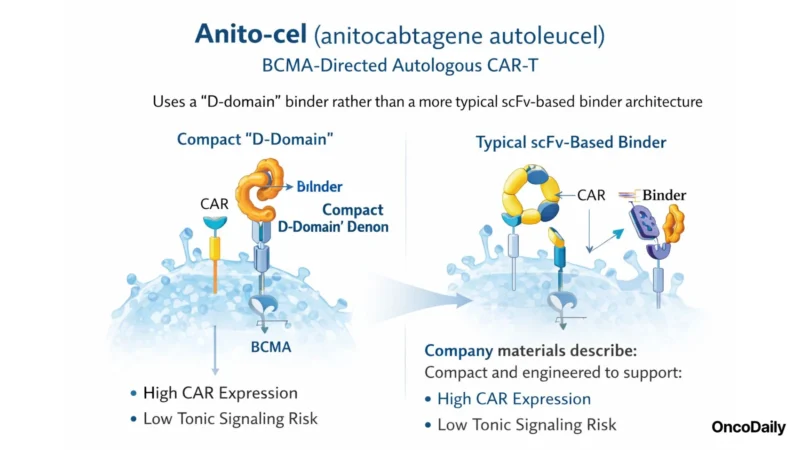
Anito-cel (anitocabtagene autoleucel) is a BCMA-directed autologous CAR-T that uses a “D-domain” binder rather than the more typical scFv-based binder architecture; company materials describe the binder as compact and engineered to support high CAR expression and low tonic signaling risk. Ahead of the acquisition announcement, Arcellx also reported preclinical comparator work suggesting differences in binder-associated tonic signaling and off-target activity across representative BCMA CAR constructs, with its D-domain construct showing no tonic signaling/off-target activity in the described experiments.
Competitive landscape: a crowded but expanding BCMA CAR-T market
The multiple myeloma CAR-T market already includes FDA-approved BCMA products, including idecabtagene vicleucel (ide-cel) and ciltacabtagene autoleucel (cilta-cel). The field has also been moving earlier in the treatment sequence, reflecting both efficacy and the push to treat patients before they become too frail for intensive cell therapy pathways.
Why is this significant?
This is a consolidation move around a late-stage (and now BLA-filed) cell therapy asset: Gilead explicitly framed the acquisition as a way to obtain full control of anito-cel and remove profit-sharing economics embedded in its earlier partnership structure. Operationally, the collaboration had already been stepping toward integration, including manufacturing transfer to Gilead’s cell therapy infrastructure (via Kite Pharma) for later-stage development.
In an oncology market where manufacturing reliability, queue times, and launch execution can materially affect real-world uptake, vertical control over both product economics and operational throughput is likely a key driver of the transaction’s timing.
Read more biotech insights on OncoDaily Biotech.
Written by: Semiramida Nina Markosyan, Editor, OncoDaily Canada