
BioNTech’s BNT323 Delivers Compelling Phase 2 Efficacy in HER2-Expressing Endometrial Cancer, BLA Submission Targeted for 2026
BioNTech has reported Phase 2 clinical data for trastuzumab pamirtecan (BNT323), its HER2-targeting antibody-drug conjugate (ADC), demonstrating a 47.9% objective response rate (ORR) in patients with HER2-expressing endometrial cancer. In HER2 IHC 3+ patients, the highest-expressing subgroup, the ORR exceeded 70%, marking a clinically significant efficacy signal in a disease area with limited targeted options.
The company has announced plans to submit a Biologics License Application (BLA) to the U.S. Food and Drug Administration in 2026, representing one of BioNTech’s most consequential regulatory milestones as it executes its post-COVID pivot toward oncology.
Mechanistic Background: A Next-Generation HER2 ADC
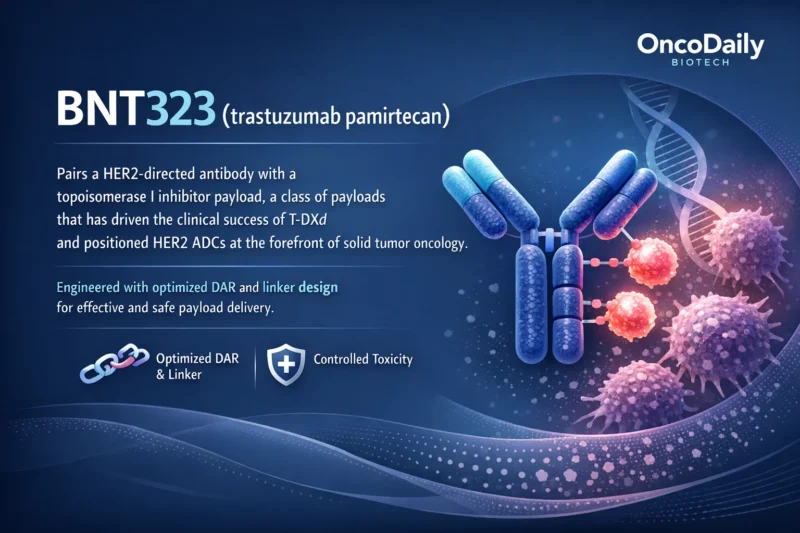
BNT323 (trastuzumab pamirtecan) pairs a HER2-directed antibody with a topoisomerase I inhibitor payload, a class of payloads that has driven the clinical success of trastuzumab deruxtecan (T-DXd) and positioned HER2 ADCs at the forefront of solid tumor oncology. The drug-to-antibody ratio (DAR) and linker design of BNT323 are engineered to optimize payload delivery while managing systemic toxicity exposure.
HER2 overexpression occurs in approximately 20–30% of endometrial cancers and is associated with more aggressive disease and poorer outcomes, establishing a biologically defined patient population with clear unmet need.
Phase 2 Clinical Efficacy
The Phase 2 data reflect a treatment-refractory patient population in which standard therapies offer limited benefit. An ORR of 47.9% across HER2-expressing patients is clinically meaningful in this setting, and the greater than 70% ORR observed in IHC 3+ patients suggests a strong correlation between HER2 expression intensity and treatment benefit, a finding with implications for patient selection and companion diagnostic development.
Durability of response and additional endpoints including progression-free survival and safety will be critical data points as BioNTech advances toward its BLA submission.
Competitive Landscape
The endometrial cancer targeted therapy space has been transformed by the approvals of dostarlimab, pembrolizumab, and lenvatinib combinations in mismatch repair-deficient or PD-L1-expressing populations. However, HER2-directed therapy in endometrial cancer remains an area of active development, and BNT323’s efficacy data in this subgroup positions it as a potentially first-in-indication agent for this biomarker-defined population.
Trastuzumab deruxtecan is also being evaluated in HER2-expressing endometrial cancer, making the competitive dynamics between HER2 ADC programs an important area to monitor.
A Strategic Inflection for BioNTech
The BNT323 BLA filing would mark a defining moment in BioNTech’s oncology transformation. Having generated extraordinary commercial success from its COVID-19 mRNA vaccine, the company has committed substantial capital and pipeline investment to building a durable oncology franchise. A regulatory approval in endometrial cancer would validate that strategy and establish BioNTech as a credible ADC developer alongside the established leaders in the space.
Read more biotech insights on OncoDaily Biotech.
Written by: Semiramida Nina Markosyan, Editor, OncoDaily Canada