Dr. Jerri Nielsen’s extraordinary cancer journey at the South Pole represents one of the most remarkable medical survival stories in modern history, combining self-diagnosis, remote treatment, and unprecedented rescue operations. Her battle spanned from 1999 to 2009, demonstrating exceptional resilience and medical ingenuity under extreme isolation.
Discovery and Self-Diagnosis at the South Pole
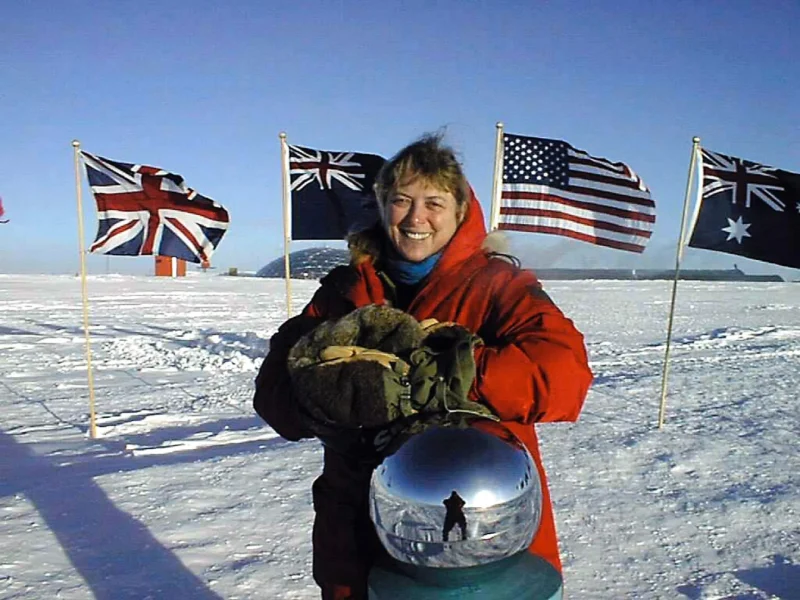
On June 15, 1999, Dr. Jerri Nielsen discovered a palpable lump in her left breast while performing a routine self-examination at the Amundsen-Scott South Pole Station. As the station’s sole physician, she faced an unprecedented medical crisis: with 41 people isolated during the Antarctic winter and temperatures plummeting to -100°F (-73°C), evacuation was physically impossible for months.
The Self-Biopsy Procedure
With no radiologist or surgeon available, Dr. Nielsen orchestrated a crude but life-saving biopsy procedure using the station’s limited medical supplies. She trained two untrained staff members—a carpenter and a mechanic—to assist, as she could not perform the procedure on herself alone. The team utilized:
- Local anesthesia: Lidocaine injected to numb the area
- Surgical instruments: A scalpel and forceps from the station’s medical kit
- Imaging guidance: None available; the procedure was palpation-guided
- Sample collection: Multiple core tissue samples extracted manually
Dr. Nielsen directed the procedure while lying on an examination table, instructing her assistants on where to cut and how to extract tissue from the suspicious mass.
Remote Pathology Consultation
The tissue samples were preserved in alcohol and placed in a container designed to withstand extreme cold during transport. Since no physical shipment could leave the pole until summer, Dr. Nielsen relied on emerging telemedicine technology:.
Digital imaging was performed using a webcam to capture images of the biopsy slides. These images, along with the patient’s clinical data, were then transmitted via satellite internet for email consultation with pathologists at Indiana University Medical School. Through this remote analysis, specialists were able to confirm the diagnosis of invasive ductal carcinoma, an aggressive form of breast cancer that required immediate medical intervention.
Remote Treatment Protocol: The “South Pole Regimen“
Dr. Jerri Nielsen’s treatment plan was a logistical and medical marvel, devised collaboratively with Dr. Edward Winer and the oncology team at Indiana University. The protocol had to balance aggressive cancer control with the stark reality of limited resources, no backup support, and the physiological stresses of the Antarctic environment.
The Chemotherapy Regimen: FAC Protocol
The Indiana team selected a standard but robust combination chemotherapy regimen known as FAC, modified for remote administration:
- 5-Fluorouracil (5-FU): An antimetabolite that interferes with DNA synthesis.
- Doxorubicin (Adriamycin): An anthracycline antibiotic that damages DNA in cancer cells; known for its cardiotoxicity and severe nausea potential.
- Cyclophosphamide (Cytoxan): An alkylating agent that prevents cancer cell reproduction.
Dosage and Schedule
The team prescribed a “dose-dense” schedule adapted for the station’s capabilities: three consecutive days of treatment every three weeks for a total of six cycles. This schedule was chosen to maximize tumor kill while allowing recovery time, but it required precise timing that Dr. Nielsen had to enforce on herself and her untrained assistants.
The Airdrop: Operation “Santa Claus”
The chemotherapy drugs, anti-nausea medications (ondansetron/Zofran), and growth factors were not available at the station. They had to be flown in from Christchurch, New Zealand, to the edge of the Antarctic continent, and then airdropped directly to the South Pole.
- The Mission: On July 10, 1999, a U.S. Air National Guard LC-130 Hercules ski-plane executed a perilous night flight into the polar darkness. Temperatures were approximately -100°F (-73°C), and visibility was near zero.
- Guidance by Fire: With no runway lights or instrument landing systems, the pilot relied on flares lit by station personnel arranged in a makeshift “T” shape on the ice to guide the drop. The cargo was ejected in a specialized container with parachutes to prevent impact damage.
- Retrieval: Dr. Nielsen, despite her condition and the freezing temperatures, was part of the team that retrieved the crate. Inside were the vials of chemotherapy, carefully packed with insulation to prevent freezing, which would have rendered them useless or dangerous.
Hormone Therapy Integration
To suppress estrogen-driven tumor growth, the protocol included ovarian suppression:
Leuprolide (Lupron), a GnRH agonist administered via injection, was used to shut down ovarian function, inducing a temporary medical menopause. This was critical for Dr. Nielsen, as her pre-menopausal estrogen production could fuel the cancer. Additionally, Tamoxifen (Nolvadex), an oral selective estrogen receptor modulator (SERM), was prescribed to be taken daily. This medication blocks estrogen receptors on any remaining cancer cells and was planned as a long-term maintenance therapy following chemotherapy.
Self-Administration and Team Training
The most harrowing aspect of the protocol was the administration. Dr. Nielsen could not insert her own IV lines reliably, especially as her veins deteriorated from the drugs.
The “Chemo Crew”: She trained two station members: Sarah Clark (a carpenter) and Lisa Gorman (a mechanic). They had no medical background. Dr. Nielsen created a step-by-step “cookbook” for them, detailing exactly how to mix the drugs, prime the IV lines, and monitor for reactions.
The Procedure: Every three weeks, the team would gather in the station’s medical clinic. Dr. Nielsen would lie on the exam table, directing the procedure while her colleagues inserted the needle and hung the bags. She monitored her own vital signs and instructed them on when to slow or stop the infusion if side effects became severe.
Side Effect Management
The regimen caused profound nausea, fatigue, and hair loss. With no anti-emetics stronger than what was dropped, Dr. Nielsen had to endure significant suffering. She also had to monitor for signs of infection (neutropenia) without the ability to run blood counts, relying instead on clinical symptoms like fever.
Dramatic Rescue Operation: The Winter Evacuation
By October 1999, after completing three cycles of the FAC chemotherapy regimen, Dr. Nielsen’s condition had stabilized but not fully resolved. While the tumor had shrunk, the Indiana University team determined that she required advanced imaging, potential surgery, and radiation therapy that were impossible to provide at the South Pole. Furthermore, there were concerns that the cancer might be developing resistance to the limited drugs available, necessitating a change in protocol that could only be managed in a fully equipped hospital.
The Unprecedented Winter Rescue Mission
Evacuating a patient from the South Pole during the austral winter (October) had never been attempted in history due to the extreme cold, perpetual darkness, and unpredictable weather, which made flight operations lethally dangerous. However, the National Science Foundation (NSF) and the U.S. Air Force authorized a high-risk rescue mission, prioritizing Dr. Nielsen’s life over the safety of the flight crew. This decision marked a paradigm shift in Antarctic logistics, proving that winter evacuations were feasible under dire medical emergencies.
The mission was assigned to the 109th Airlift Wing of the New York Air National Guard, the only unit equipped with ski-equipped LC-130 Hercules aircraft capable of landing on polar ice. Two planes were deployed: one as the primary rescue aircraft and the other as a backup. The journey involved a multi-leg trek from McMurdo Station to the South Pole, covering roughly 800 miles of treacherous terrain. The pilots faced temperatures near -100°F and the risk of fuel freezing in the lines.

Photo: Depositphotos
The Landing and Extraction
On October 16, 1999, the LC-130 successfully landed at the Amundsen-Scott South Pole Station, marking the first winter landing in the continent’s history. Station personnel had spent days clearing snow and marking the ski-way with flares and reflectors. Despite being weakened by chemotherapy, Dr. Nielsen, determined to survive, prepared her medical records and remaining tissue samples for transport.
The departure was tense as Dr. Nielsen boarded the aircraft with a flight medic. The heavy plane struggled to gain lift in the thin, cold air but successfully cleared the ice runway, leaving behind her colleagues and the station where she had fought for her life for four months. After refueling at McMurdo Station, she was flown to Christchurch, New Zealand, and then immediately transferred to a commercial flight to the United States. She arrived at Indiana University Medical Center on October 20, 1999, where she was greeted by the team that had guided her treatment via satellite.
“The Best Year of My Life”
Despite the trauma of a cancer diagnosis and the grueling self-treatment, Dr. Nielsen famously described her time at the South Pole as “the best year of my life”.
In interviews and her book Ice Bound, she explained that the extreme isolation stripped away life’s trivialities, leaving her with a profound sense of purpose. The daily struggle for survival created a unique bond with her colleagues and a clarity of focus she had never experienced in civilian life.
Professional Fulfillment: As the sole physician, she was responsible for the health of 41 people. This immense responsibility, coupled with her own battle, gave her a sense of utility and heroism that transcended her fear. She continued to perform her medical duties for the station crew right up until the moment of her evacuation, refusing to let her illness compromise her work.
The successful operation paved the way for future winter evacuations in Antarctica, changing NSF policy permanently. It demonstrated that no patient needed to be left behind due to seasonality if the medical need was critical.
Upon her arrival in the U.S., Dr. Nielsen underwent a mastectomy, further chemotherapy, and radiation. The winter rescue mission remains a defining moment in both polar exploration history and the story of human resilience against cancer.
Photo: Depositphotos
Remission and Recurrence: The Second Battle (2005–2009)
Following her dramatic rescue and definitive treatment in the United States, Dr. Jerri Nielsen achieved a complete clinical remission, enjoying six years of disease-free survival. However, her story took a tragic turn in 2005 when the cancer returned as metastatic disease, initiating a second, public battle that highlighted the relentless nature of advanced breast cancer.
The Six-Year Remission (1999–2005)
After her evacuation in October 1999, Dr. Nielsen underwent aggressive standard-of-care treatment at Indiana University Medical Center.
Dr. Nielsen underwent a modified radical mastectomy, confirming a positive response to her remote chemotherapy. The pathology reports indicated significant tumor necrosis, though some residual disease remained in the lymph nodes. Following surgery, she received radiation therapy to the chest wall and regional lymph nodes to eradicate any microscopic disease. Her systemic therapy was escalated to include paclitaxel, a taxane not available in the initial South Pole airdrop, followed by continued hormone suppression with tamoxifen and ovarian suppression.
For six years, Dr. Nielsen lived as a cancer survivor, becoming a sought-after speaker, author of the bestseller Ice Bound, and an advocate for both polar research and breast cancer awareness. During this period, she was clinically free of evidence of disease (NED), a testament to the efficacy of the bridge therapy she administered in the South Pole.
Metastatic Recurrence and Life with Cancer
In 2005, seven years after her initial diagnosis, Dr. Nielsen experienced a recurrence of Stage IV metastatic breast cancer. The disease had spread to distant organs, specifically the brain, liver, and bones. The brain metastases were particularly aggressive, necessitating stereotactic radiosurgery or whole-brain radiation. Liver metastases indicated systemic progression, which required an adjustment in her systemic therapy to include newer agents. Bone metastases, common in breast cancer, caused pain and increased the risk of fractures, requiring bisphosphonate therapy and palliative radiation.
Despite the grim prognosis associated with brain and liver metastases, Dr. Nielsen refused to let the diagnosis limit her life. Adopting a philosophy of “living with cancer” rather than “dying from it,” she continued to travel globally, speaking about resilience, leadership, and her unique medical journey. In a poignant full-circle moment, she returned to Antarctica multiple times after her recurrence, visiting research stations and reconnecting with the environment that had tested her limits.
Clinical Insights from Her Recurrence
Dr. Nielsen’s recurrence pattern highlights several critical oncology concepts. Her case underscores the risk of late recurrence in breast cancer, particularly hormone receptor-positive subtypes, even after five years of disease-free survival. This illustrates the need for long-term vigilance, as dormant micrometastases can reactivate years later. Additionally, the metastatic clones that emerged in 2005 likely possessed different biological characteristics, which may explain their resistance to previous therapies and their aggressive spread to the brain and liver.
Throughout this period, Dr. Nielsen likely used a combination of systemic therapies and palliative interventions, allowing her to maintain both her quality of life and professional activities. Her ability to thrive for four years with metastatic disease remains a remarkable example of patient resilience and the evolving capabilities in metastatic breast cancer management.
The Final Decline and Personal Choices
In October 2008, Dr. Jerri Nielsen faced her third and final cancer crisis when the disease recurred as a brain tumor, signaling widespread metastatic progression. Despite the severity of central nervous system involvement, which often carries a poor prognosis and limited treatment options, she maintained her public commitments and delivered speaking engagements through March 2009, just three months before her death. Brain metastases can cause seizures, cognitive decline, and motor deficits, yet Dr. Nielsen managed to preserve her cognitive function and public presence for several months, a testament to both her physiological resilience and likely aggressive palliative interventions such as stereotactic radiosurgery or whole-brain radiation.
Even as her health deteriorated, she refused to retreat from public life, demonstrating her commitment to using her remaining time to inspire others and reinforcing her belief that purpose could coexist with terminal illness. She ultimately chose to spend her final days at home in Southwick, Massachusetts, surrounded by family rather than in a hospital setting, a decision that reflected her lifelong preference for autonomy and dignity in the face of medical adversity. Dr. Nielsen passed away on June 23, 2009, at the age of 57, with metastatic brain disease cited as the cause of death.
Literary and Cultural Impact
Dr. Nielsen’s story was immortalized in her 2001 bestselling memoir, Ice Bound: A Woman’s Incredible Battle for Survival in the Antarctic, co-authored with journalist Maryanne Vollers. The book provided a gripping, first-person account of her self-diagnosis, remote treatment, and rescue, captivating readers with its blend of medical thriller and survival narrative to become a New York Times bestseller that translated her personal ordeal into a global phenomenon.
Her journey reached an even wider audience through a 2006 Lifetime Television movie adaptation starring Susan Sarandon, which cemented her status as a cultural icon of resilience. Despite this fame, Dr. Nielsen often described herself as an “unwilling celebrity” who viewed her platform not as an end in itself but as a vehicle to advocate for cancer research, polar science, and the strength of the human spirit.
Enduring Contributions to Medicine and Exploration
Dr. Nielsen’s legacy extends far beyond her personal survival story, as she fundamentally altered protocols in both polar logistics and remote medicine. Her 1999 evacuation shattered the long-standing taboo against winter flights to the South Pole, establishing a new precedent through the success of the 109th Airlift Wing’s mission that no patient would be left behind due to seasonality if a critical medical emergency existed. This policy shift has since facilitated numerous winter medical evacuations, saving countless lives in the Antarctic program.
Her case remains the most extreme documented example of tele-oncology, where the successful administration of chemotherapy under remote guidance validated the potential for telemedicine to deliver complex care in resource-limited settings and influenced modern strategies for rural and isolated healthcare delivery. Perhaps her most profound legacy is the inspiration she provided to cancer patients worldwide by framing her battle as a journey of purpose rather than pity, offering a powerful model for coping with adversity that continues to resonate with those facing terminal diagnoses. Dr. Jerri Nielsen’s life and death remind the oncology community that while medicine can treat disease, it is the human spirit that defines the journey.
You Can Also Read Gold After Cancer: Winter Olympic Legends on the Road to Milano-Cortina 2026 by OncoDaily

Written by Aharon Tsaturyan, MD, Editor at OncoDaily Intelligence Unit
FAQ
How did Dr. Jerri Nielsen diagnose her own cancer at the South Pole?
Readers are fascinated by the mechanics of the self-biopsy. This question allows you to detail the use of a mirror, scalpel, and untrained assistants, satisfying curiosity about the "how" of her survival.
What chemotherapy drugs did Dr. Nielsen use in Antarctica?
Specific drug names (5-FU, Doxorubicin, Cyclophosphamide) are highly searched. Detailing the "FAC regimen" and the dramatic airdrop operation provides the technical depth your oncology audience expects.
How were medical supplies delivered to the South Pole in winter?
The "Operation Santa Claus" airdrop is a key plot point. Explaining the LC-130 Hercules flight, the use of flares for guidance, and the parachute drop answers a major logistical question.
Did Dr. Jerri Nielsen survive her initial cancer battle?
Users often want a quick spoiler on the outcome. Clarifying that she achieved remission for six years before a later recurrence manages expectations and sets up the second act of her story.
What caused Dr. Jerri Nielsen’s death?
There is often confusion between her initial diagnosis and her eventual passing. Explicitly stating she died from metastatic brain disease in 2009, ten years after her initial diagnosis, provides factual closure.
Was Dr. Nielsen the only doctor at the South Pole?
This highlights the stakes of her isolation. Confirming she was the sole physician for 41 people emphasizes the impossibility of her situation and the burden of her continuing to work while treating herself.
How did she communicate with doctors in the United States?
The telemedicine aspect is crucial for modern readers. Describing the use of satellite internet, email, and a webcam to transmit biopsy images to Indiana University showcases the pioneering nature of her case.
Why couldn’t she be evacuated immediately after diagnosis?
Readers often ask why rescue wasn't instant. Explaining the Antarctic winter conditions (-100°F, perpetual darkness) and the historical "no winter flight" policy clarifies the life-or-death constraints.
Did Dr. Jerri Nielsen write a book about her experience?
Yes, Ice Bound is a bestseller. This question drives interest in her memoir and the subsequent TV movie, connecting your article to broader cultural touchstones.
How did her story change Antarctic rescue policies?
This addresses her legacy. Detailing how her evacuation broke the taboo on winter flights and saved future lives adds a layer of historical significance beyond her personal struggle.