These inspiring profiles showcase Winter Olympic medalists from snowboarding phenom Max Parrot eyeing slopestyle defense at Milano-Cortina 2026 (Feb 6-22 schedule includes Feb 17 women’s slopestyle final) to hockey icons Mario Lemieux and Brian Boyle who conquered lymphoma, leukemia, and tumors, returning to podiums while championing NCCN-aligned survivorship exercise. Scott Hamilton’s triple-cancer resilience endures as he commentates upcoming Games; non-survivors like Ludmila Engquist add resilience contrasts ahead of Italy’s alpine, snowboard, and hockey events.

Photo: Depositphotos
Max Parrot’s Epic Snowboard Comeback
Canadian snowboarder Max Parrot, a prodigy with five X Games golds by age 20, claimed slopestyle silver at the 2018 PyeongChang Winter Olympics, landing triple corks in tough winds for Canada’s 13th snowboarding medal. Months later, in September 2018, itchy skin signaled trouble, escalating to a neck lump by November; a December 21 biopsy diagnosed stage IIA classical Hodgkin lymphoma, a lymphatic blood cancer common in young adults like the 23-year-old Quebec native, with about 990 annual Canadian cases.
He underwent surgery followed by 12 biweekly chemotherapy rounds over six months at Sherbrooke’s hospital, battling total energy loss, muscle wasting, zero cardio, and indoor isolation feeling like a “lion in a cage” denied snowboarding, his passion since age nine. Declared cancer-free in July 2019, Parrot shocked with X Games big air gold in Norway just two months later, added World Cup and Aspen victories, and earned the 2021 Laureus World Comeback of the Year award, later reflecting that cancer “reshaped my life for the better” by building unmatched mental strength.
Selected for Beijing 2022 despite the odds, he dominated slopestyle qualifying on February 5, then unleashed his career-best final run on February 6 a triple cork 1620, switch butter double cork 1080, and cab double cork 900 for a 94.00 score and gold, edging teammate Mark McMorris’s bronze. Tearfully on the podium in Team Canada red, Parrot declared cancer his “contest of the year” that he had to win, proving “anything is possible.” As of 2026, the now-32-year-old eyes Milano-Cortina defense while advocating early detection and exercise aligning with NCCN guidelines for lymphoma survivors through social media, documentaries, and youth inspiration.
Hockey’s Unbreakable Superstar: Mario Lemieux’s Dual Cancer Battle and Olympic Gold Glory
Mario Lemieux, the Pittsburgh Penguins icon dubbed “Le Magnifique,” conquered Hodgkin lymphoma and chronic myeloid leukemia (CML) while etching his name in Olympic hockey history.
A walnut-sized tumor on his neck, ignored for 18 months, prompted diagnosis on January 12, 1993—stage I Hodgkin lymphoma, a lymphatic cancer with 90-95% cure rate for young adults like the 27-year-old NHL scoring leader (104 points in 40 games). He underwent surgery to remove the node, followed by 22 radiation sessions over four weeks (five weekly) starting February 1 across Pittsburgh and Beaver County, causing hair loss, skin marks, arm weakness, and fatigue yet side effects were milder than expected due to his fitness.
On March 2, hours after final treatment, Lemieux flew to Philadelphia, scored a goal and assist in a 5-4 loss, earning a standing ovation from rival Flyers fans; he tallied 30 goals and 26 assists in 20 games to win the Art Ross Trophy by 12 points (160 total), sparking Pittsburgh’s 17-game win streak.
In 1997, CML a rarer blood cancer forced retirement at 31 after flu-like symptoms and tests; brother Marc’s near-perfect 97% bone marrow match enabled a life-saving transplant that December, yielding full remission. Lemieux staged a miraculous 2000 NHL return at 35 (76 points in 43 games), then captained Canada at the 2002 Salt Lake City Winter Olympics.
Registering three assists in seven games, including the tournament-ending 5-2 gold-medal clincher over USA on February 24, he led a star-studded roster (Gretzky, Yzerman, Sakic) to end Canada’s 50-year Olympic hockey gold drought—his vision and leadership pivotal despite hip ailments. Playing until 2006, Lemieux’s survivorship underscores targeted therapies’ evolution, now advanced at the UPMC Mario Lemieux Center for Blood Cancers he helped fund.
Scott Hamilton Backflip Gold to Triple Cancer Triumph
Scott Hamilton, the U.S. figure skating legend, secured Olympic gold at Sarajevo 1984 with his signature backflip before facing serial cancer battles that fueled his advocacy.
At age 38 on March 17, 1997 mere weeks shy of his mother’s 20th cancer death anniversary a routine check revealed a walnut-sized testicular tumor; stage I seminoma diagnosis prompted immediate orchiectomy (removal of one testicle and mass) followed by four rounds of bleomycin, etoposide, cisplatin (BEP) chemotherapy over two months at Nashville’s Vanderbilt-Ingram Cancer Center. Side effects hit hard hair loss, nausea, fatigue—but elite fitness accelerated recovery; by May 1997, tumor markers normalized, scans clean, allowing Stars on Ice tour return that summer, where fans gave standing ovations amid visible changes.
You Can Also Read Scott Hamilton and Brain Tumor: How He Went Against, How He Survived, and More by OncoDaily
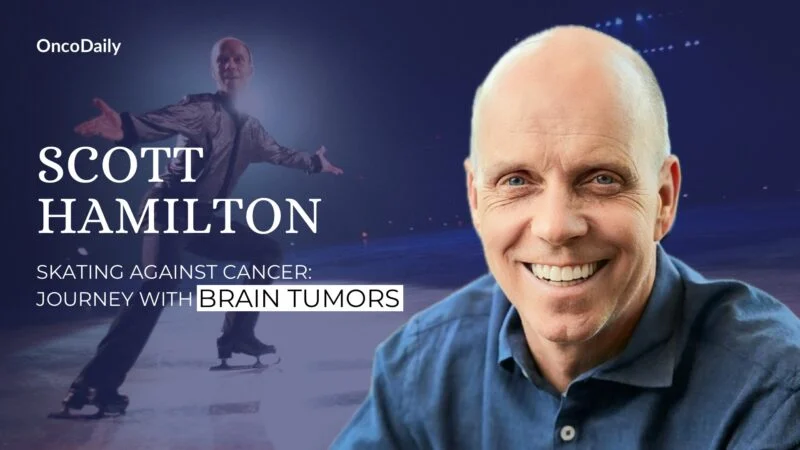
Dizziness, vision loss, and fatigue unmasked a congenital craniopharyngioma pituitary brain tumor (benign but recurrent) in 2004 first surgery at 1.5cm removed 90%, but regrowth hit 2010 (complicated by stroke-risk aneurysm repair) and 2016 at golf-ball size; opting against fourth surgery/radiation due to risks, it shrank naturally by 2025 scans (now walnut-sized, stable), which Hamilton attributes to faith, plant-based diet, cryotherapy, hyperbaric oxygen, and cardio aligning with NCCN survivorship exercise protocols. As Olympic broadcaster (Nagano 1998-2018), he founded Scott Hamilton CARES/Slaystation Foundation funding precision imaging for early detection, skating exhibitions into 2026 while preaching “cancer chose the wrong guy,” inspiring oncology patients on immunotherapy-era resilience.
Brian Boyle’s Fight With Leukemia and Olympic Return
Brian Boyle, a hard-nosed NHL forward known for playoff grit, uncovered chronic myeloid leukemia (CML) a Philadelphia chromosome-driven bone marrow cancer affecting 1 in 100,000 adults via a routine blood test at New Jersey Devils’ 2017 training camp on September 15; at 32, symptoms were subtle (fatigue, Haddonfield bruising), but elevated white cells and genetic confirmation demanded immediate action.
Prescribed daily oral tyrosine kinase inhibitor imatinib (Gleevec) pioneered 2001, turning fatal CML into chronic management—he skipped just 10 games, returning October 30 vs. Edmonton with a goal in a 5-2 win; over 62 regular-season games, he posted 10 goals/13 assists despite side effects like nausea, leg cramps, and monitoring every three months. Ringing the bell at Tampa Bay’s Hockey Fights Cancer night, Boyle reached full molecular remission October 2018 (undetectable BCR-ABL via PCR, 12 months ahead of average), earning the 2018 Bill Masterton Memorial Trophy for perseverance; he played until 2023 retirement (915 NHL games, 138 goals), crediting fitness and mindset.
As U.S. captain for 2018 PyeongChang Winter Olympics first without NHL stars post-2014 so Boyle led a college-heavy squad to 7-2 record, 5th place amid brutal Gangneung cold; key contributions included physical forechecking vs. Canada (3-2 loss in semis) and Slovakia quarterfinal win, embodying leadership despite daily pills mid-tournament. Now a youth coach and advocate, Boyle highlights CML’s 95% five-year survival via targeted therapy per NCCN guidelines, inspiring oncology patients on lifelong monitoring and exercise.
Written by Aharon Tsaturyan, MD,Editor at OncoDaily Intelligence Unit.
FAQ
What cancer did Max Parrot have, and how did he beat it to win Olympic gold?
Max Parrot was diagnosed with stage IIA Hodgkin lymphoma in 2018 after a neck lump and itchy skin. He beat it with surgery and 12 chemo rounds, returning cancer-free in 2019—then won slopestyle gold at Beijing 2022 with a career-best run including a triple cork 1620.
Did Mario Lemieux play hockey during his cancer treatment?
Yes diagnosed with stage I Hodgkin lymphoma in 1993, Lemieux had surgery and 22 radiation sessions, then scored immediately after his last treatment. He won the Art Ross Trophy that season and captained Canada to 2002 Olympic gold despite later CML.
How many cancers has Scott Hamilton survived, and what's his brain tumor status?
Scott Hamilton beat testicular cancer (1997, stage I seminoma via orchiectomy and BEP chemo), then faced recurrent craniopharyngioma brain tumor (diagnosed 2004, surgeries in 2004/2010/2016). By 2025 scans, it's stable (walnut-sized) thanks to diet, exercise, and NCCN-aligned cardio.
What is Brian Boyle's leukemia story and Olympic achievement?
Brian Boyle had chronic myeloid leukemia (CML) diagnosed in 2017 via routine bloodwork. Managed with daily imatinib (Gleevec), he reached full remission in 2018, won the Bill Masterton Trophy, and captained the U.S. to 5th place at 2018 PyeongChang Olympics.
Milano Cortina 2026: When is Max Parrot's slopestyle event?
Max Parrot eyes slopestyle defense February 17, 2026 (women's final that day; men's likely prior). Games run Feb 6-22 in Italy, highlighting alpine, snowboard, and hockey perfect stage for his Hodgkin lymphoma comeback story.
Can exercise help cancer survivors like these Olympic athletes?
Absolutely NCCN guidelines recommend survivorship exercise for lymphoma, CML, and more. Parrot, Lemieux, Hamilton, and Boyle credit fitness for recovery, mental strength, and returns to elite competition; start with cardio per your oncologist.
What are NCCN guidelines for Hodgkin lymphoma survivors like Max Parrot?
NCCN emphasizes early detection, surveillance scans, exercise, and mental health support post-treatment. Parrot aligns by advocating cardio and youth inspiration; 90-95% cure rate for young adults with stage I-II.
How did Mario Lemieux's brother help save his life from leukemia?
After CML diagnosis in 1997 forced retirement, Lemieux got a near-perfect bone marrow transplant from brother Marc in December 1997, achieving remission. He returned to the NHL in 2000 and led Canada's 2002 Olympic gold.
Is Scott Hamilton commentating Milano Cortina 2026 Olympics?
As a veteran broadcaster (Nagano 1998-2018) and triple-cancer survivor, Hamilton often covers figure skating and events. His CARES Foundation pushes early detection; watch for his resilience insights amid Italy's alpine and hockey action.