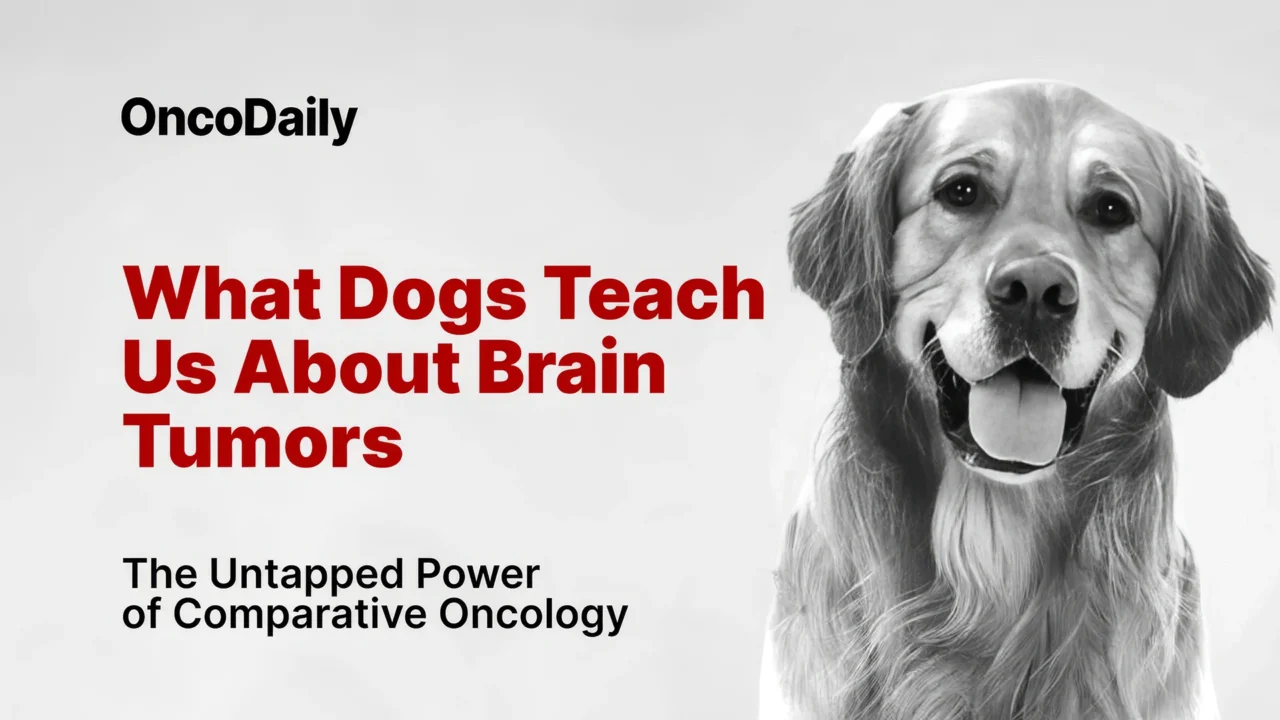
A patient lies immobilized under a thermoplastic mask, prepared for high-precision radiotherapy targeting a brain tumor. The workflow is indistinguishable from that of a human oncology department.
Except — the patient is a dog.
Over the past two decades, comparative oncology has emerged as a powerful translational bridge, leveraging naturally occurring cancers in animals particularly dogs to refine our understanding of tumor biology and therapeutic response in humans.
Biological Fidelity: Why Canine Gliomas Are Clinically Relevant
Unlike murine models, which rely on induced or genetically engineered tumors, canine cancers arise spontaneously, within an intact immune system and shared environmental exposures. This confers a level of biological fidelity that is increasingly recognized as critical for translational success.
Canine gliomas closely recapitulate human high-grade gliomas in multiple domains:
- Histopathology: presence of necrosis, microvascular proliferation, infiltrative growth
- Molecular alterations: dysregulation of RTK/PI3K/AKT pathway, TP53 mutations, PDGF signaling
- Tumor microenvironment: immunosuppressive milieu, macrophage/microglia interactions
- Imaging phenotype: contrast enhancement, edema, and perfusion characteristics similar to human GBM
Importantly, large-scale genomic analyses have demonstrated cross-species conservation of oncogenic drivers.
Radiotherapy in Veterinary Neuro-Oncology
Radiotherapy constitutes a cornerstone of treatment for canine brain tumors, particularly when surgical resection is not feasible.
Modern veterinary centers employ:
Linear accelerators (LINACs), 3D conformal radiotherapy (3D-CRT), intensity-modulated radiotherapy (IMRT), and stereotactic radiotherapy (SRT/SBRT) are commonly used techniques in veterinary radiotherapy. Typical fractionation regimens range from conventional schedules (e.g., 45–54 Gy in 15–20 fractions) to hypofractionated approaches (e.g., 24–30 Gy in 3–5 fractions), reflecting the need to balance therapeutic benefit with anesthesia-related risks.
A defining feature of veterinary radiotherapy is that each fraction requires general anesthesia, which introduces cumulative anesthetic exposure, logistical constraints, and ethical considerations regarding overall treatment burden
Dosimetric planning mirrors human practice, with delineation of GTV/CTV/PTV and attempts to respect organs at risk (OARs), including optic pathways and brainstem. However, standardized dose constraints remain less well established.
Translational Impact: Accelerating Clinical Innovation
Comparative oncology provides a real-world intermediate model between preclinical experimentation and human clinical trials.
Canine glioma cohorts provide a valuable platform to evaluate hypofractionation strategies, explore dose escalation, and validate stereotactic radiotherapy approaches.
In terms of combined modality treatments, studies have examined the integration of radiotherapy with temozolomide, targeted agents, and immunotherapy, including checkpoint inhibitors.
Advanced imaging biomarkers are also being increasingly incorporated into research and clinical practice. Diffusion tensor imaging (DTI) allows assessment of white matter tract disruption, perfusion MRI provides insight into tumor vascularity, and functional MRI (rs-fMRI) enables evaluation of network-level alterations.
These tools are directly aligned with emerging human research questions, particularly: early prediction of treatment response and tumor progression
Comparative models allow for longitudinal, high-resolution observation of these dynamics in a clinically relevant context.
Ethical Framework: Patients, Not Models
A critical distinction of comparative oncology lies in its ethical structure. Unlike experimental animal models, canine patients present with naturally occurring disease, are treated with genuine therapeutic intent, and are managed according to established veterinary clinical standards.
Owners provide informed consent, and endpoints often include quality of life metrics, not solely survival. This creates a dual-benefit system that both advances scientific knowledge and improves patient care in veterinary medicine.
Future Directions
The integration of comparative oncology into mainstream cancer research is expanding.
Key future avenues include:
- Radiogenomics: linking imaging features with molecular profiles across
species - AI-driven analysis of imaging and outcomes
- Adaptive radiotherapy strategies based on early response
- Cross-species clinical trial design
Within neuro-oncology, where progress remains limited, these models may prove particularly impactful. The future of cancer research is unlikely to be defined by a single discipline or species. Instead, it will emerge from convergence — of biology, technology, and collaboration. In this evolving landscape, dogs are not merely companions. They are biological partners in discovery.
Written By Eftychia Tataridou, MD