





When patients hear about cancer treatments or clinical trial results, they often come across different survival terms such as overall survival and progression-free survival. Among these, progression-free survival (PFS) is one of the most commonly used endpoints in modern oncology research and clinical practice.
Although the term may sound complex, its meaning is actually quite practical. Progression-free survival focuses on how long a treatment can keep cancer from growing or spreading, rather than how long a patient lives overall. This makes it especially important in advanced cancers, where multiple treatment lines may be used over time.
What Is Progression-Free Survival?
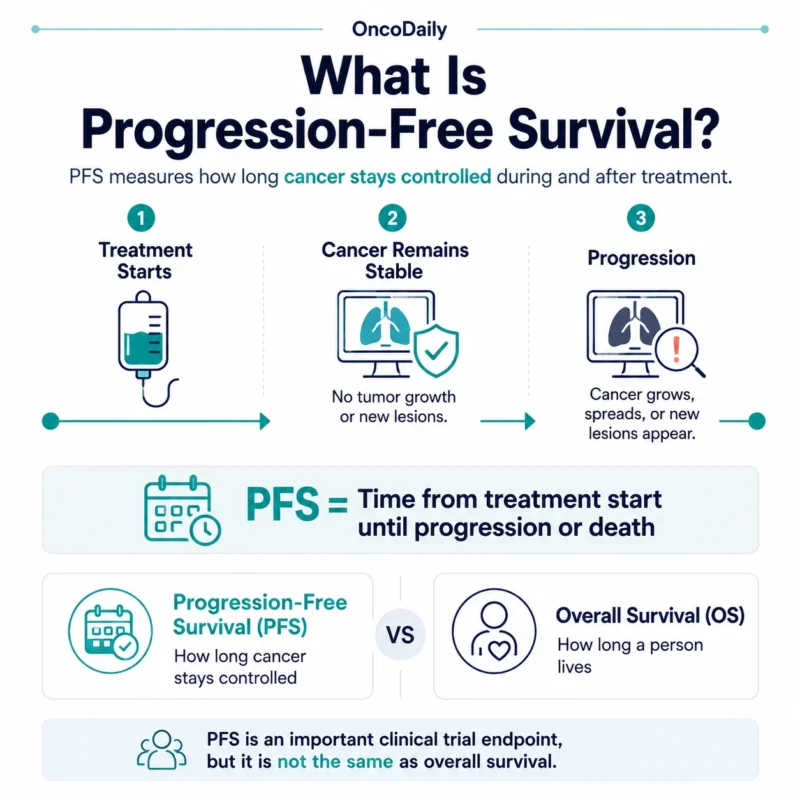
Progression-free survival refers to the length of time during and after treatment in which a patient is alive and the cancer does not grow or spread.
In clinical oncology research, progression is typically defined using standardized imaging criteria such as RECIST, which identify tumor growth, new lesions, or disease worsening on scans.
Progression-free survival is defined as the time from randomization or treatment start until disease progression or death, whichever occurs first (Duffaud & Therasse, 2000, Annals of Oncology)
In simple terms, PFS answers one key question:
How long does the treatment keep the cancer under control before it starts growing again?
Why Is Progression-Free Survival Important?
Progression-free survival is important because it provides earlier evidence of treatment benefit compared to overall survival.
In many cancers, especially metastatic disease, overall survival may take years to measure because patients often receive multiple lines of therapy over time. PFS allows researchers to evaluate whether a treatment is effective much earlier in the disease course.
Clinical trials frequently use PFS as a primary endpoint because it can accelerate drug development and provide faster access to potentially effective treatments (Broglio & Berry, 2009, Journal of Clinical Oncolog).
What Does Progression Mean?
Progression refers to the point at which cancer begins to grow again, spread to new areas, or develop new lesions after a period of stability or response to treatment.
Progression is usually identified through imaging studies such as CT or MRI scans, following standardized response criteria like RECIST.
Importantly, progression does not always correlate immediately with symptoms. In some cases, radiologic progression may occur before a patient feels any clinical change, which is why regular monitoring is essential in oncology care.
Progression-Free Survival vs Overall Survival
Progression-free survival and overall survival measure different aspects of cancer outcomes.
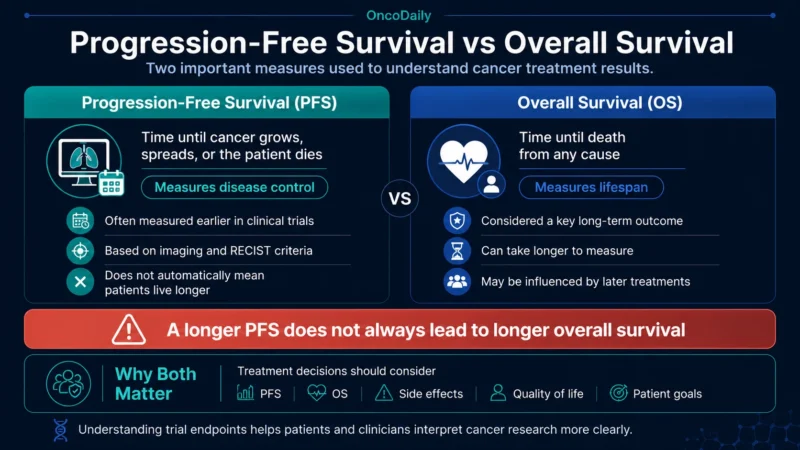
Progression-free survival measures how long the cancer remains controlled without growth. Overall survival measures how long patients remain alive, regardless of disease status or cause of death.
A key systematic review published in The Lancet Oncology showed that improvements in PFS do not consistently predict improvements in overall survival across different cancer types and therapies (Kim & Prasad, 2015, The Lancet Oncology).
This means that while PFS is useful, it should not be interpreted as a direct substitute for survival.
Why PFS Does Not Always Translate Into Longer Survival
There are several reasons why improvement in progression-free survival may not always lead to longer overall survival.
One major reason is subsequent therapies. After disease progression, patients often receive additional effective treatments that prolong life, reducing differences between study groups.
Another reason is that PFS captures only the first phase of disease control, while overall survival reflects the entire treatment journey.
Additionally, imaging-based assessment can introduce variability in determining the exact timing of progression.
Because of these factors, PFS is considered a surrogate endpoint, meaning it is a substitute measure that may not fully reflect overall survival outcomes (Rocchi et al., 2013, Journal of the National Cancer Institute).
When Is Progression-Free Survival Most Useful?
Progression-free survival is particularly useful in situations where:
- The cancer is advanced or metastatic
- Multiple treatment options exist
- Long-term survival data take years to mature
- The goal is disease control rather than cure
In these settings, PFS provides meaningful insight into whether a treatment is delaying disease progression.
For many patients with metastatic cancer, maintaining stable disease for longer periods can improve quality of life, even if it does not immediately extend overall survival.
How Is Progression-Free Survival Measured?
Progression-free survival is measured through regular follow-up imaging assessments, typically using CT, MRI, or PET scans.
At each time point, doctors compare current tumor size and disease burden with previous scans. If tumor growth exceeds predefined thresholds or new lesions appear, progression is recorded.
Patients who remain alive without progression continue contributing data until progression or death occurs. This makes PFS a time-to-event endpoint, meaning it measures time until a defined event occurs.
Advantages of Progression-Free Survival
One of the main advantages of PFS is that it provides early insight into treatment effectiveness.
This is particularly important in drug development, where faster results can lead to earlier regulatory decisions and patient access to new therapies.
Another advantage is that PFS directly reflects disease control, which can be clinically meaningful in terms of symptom stabilization and functional preservation.
A review published in Nature Reviews Clinical Oncology highlights that PFS is particularly valuable when delaying disease progression itself is a meaningful clinical benefit (Prasad et al., 2016, Nature Reviews Clinical Oncology).
Limitations of Progression-Free Survival
Despite its value, PFS has important limitations.
First, it does not measure survival directly. A treatment may improve PFS without improving overall survival.
Second, PFS depends on imaging schedules and interpretation, which may vary between studies and institutions.
Third, PFS does not always reflect patient experience. A patient may have stable scans but still experience side effects or reduced quality of life.
For this reason, PFS is always interpreted alongside other endpoints such as overall survival, toxicity, and patient-reported outcomes.
Progression-Free Survival in Modern Oncology
In modern oncology, progression-free survival is one of the most widely used endpoints, especially in targeted therapy and immunotherapy trials.
Many cancer drugs are initially approved based on improvements in PFS before overall survival data mature. This allows earlier access to promising therapies while long-term outcomes are still being evaluated.
However, regulatory agencies increasingly emphasize confirming whether PFS benefits translate into meaningful clinical improvements over time.
What Patients Should Understand About PFS
For patients, progression-free survival can be understood as the period during which cancer remains controlled under treatment.
It does not necessarily mean cure, and it does not guarantee longer life. Instead, it reflects how effectively a treatment is delaying disease progression.
When interpreting clinical trial results, PFS should always be considered alongside overall survival, side effects, and quality of life.
Conclusion
Progression-free survival is a key concept in oncology that describes how long cancer remains stable during treatment. It provides early evidence of treatment activity and plays an important role in clinical trials and drug development.
However, PFS does not measure lifespan and should not be interpreted as equivalent to overall survival. It reflects disease control rather than long-term survival outcomes.
Understanding progression-free survival helps patients better interpret clinical data and engage more confidently in discussions about cancer treatment options.
Written by Armine Sargsyan, MD