
The 2026 ASCO Annual Meeting delivered a series of landmark results across GI Oncology, with several phase 3 trials redefining standards of care in pancreatic, gastroesophageal, colorectal, hepatobiliary, and gastric cancers. Below are the most important updates from the meeting.
Practice-Changing Trials
The biggest updates at ASCO 2026 came from trials that tackled longstanding challenges in pancreatic, gastroesophageal, colorectal, hepatocellular, and gastric cancers.
RASolute 302: Daraxonrasib in Previously Treated Metastatic Pancreatic Cancer
The RASolute 302 trial was presented in the plenary session and simultaneously published in the New England Journal of Medicine. Daraxonrasib is an oral RAS(ON) multi-selective inhibitor that targets GTP-bound mutant RAS across G12, G13, and Q61 variants as well as wild-type RAS — covering more than 90% of pancreatic cancers driven by oncogenic RAS signaling.
In 500 previously treated patients with metastatic pancreatic ductal adenocarcinoma, daraxonrasib nearly doubled overall survival compared with investigator’s choice chemotherapy: median OS was 13.2 versus 6.7 months with a hazard ratio of 0.40. Progression-free survival was also nearly doubled at 7.2 versus 3.6 months, and the objective response rate was 31.6% versus 11.2%. Importantly, daraxonrasib was not only more effective but better tolerated, with grade 3 or higher treatment-related adverse events in 43.6% versus 57.5% of patients, and treatment-related discontinuations of only 1.2%.
Patient-reported outcomes significantly favored daraxonrasib, with delayed deterioration in pain and global health status. The presentation concluded that these results support daraxonrasib as a new standard of care for patients with previously treated metastatic PDAC.
Read more about RASolute 302 trial on OncoDaily.
HERIZON-GEA-01: Zanidatamab Surpasses Trastuzumab in HER2-Positive GEA
For fifteen years, trastuzumab plus chemotherapy has been the first-line standard for HER2-positive advanced gastroesophageal adenocarcinoma, with no HER2-targeted therapy able to surpass it. The phase 3 HERIZON-GEA-01 trial, published in the New England Journal of Medicine, changed this.
Zanidatamab is a bispecific antibody that simultaneously binds two distinct extracellular domains of HER2, inducing receptor clustering and more potent immune-mediated cytotoxicity than single-epitope antibodies. In 914 patients randomized to zanidatamab plus chemotherapy, zanidatamab plus tislelizumab and chemotherapy, or trastuzumab plus chemotherapy, both zanidatamab-containing regimens significantly improved progression-free survival — median 12.4 months in both zanidatamab arms versus 8.1 months with trastuzumab, with hazard ratios of 0.63 and 0.65. The triplet combination further demonstrated a significant overall survival benefit: median 26.4 versus 19.2 months, hazard ratio 0.72, with benefit consistent regardless of PD-L1 status.
This is the first HER2-targeted regimen to demonstrate superior overall survival over trastuzumab in this setting, representing the most significant advance in first-line HER2-positive gastroesophageal cancer since the TOGA trial.
Read more about HERIZON-GEA-01 trial on OncoDaily.
BREAKWATER Cohort 3: Encorafenib plus Cetuximab and FOLFIRI in BRAF V600E-Mutant mCRC
BRAF V600E-mutant metastatic colorectal cancer has historically been one of the most difficult molecular subsets to treat, with poor outcomes on standard chemotherapy. Building on previous BREAKWATER data with encorafenib plus cetuximab and mFOLFOX6, Cohort 3 showed that FOLFIRI can also be used as a chemotherapy backbone with encorafenib plus cetuximab in the first-line setting.
In 147 previously untreated patients, encorafenib plus cetuximab and FOLFIRI achieved a confirmed objective response rate of 64.4% versus 39.2% with FOLFIRI with or without bevacizumab. Median progression-free survival was 15.2 versus 8.3 months, with a hazard ratio of 0.44, and median overall survival was not estimable versus 20.3 months, with a hazard ratio of 0.56. Toxicity was generally comparable between arms, with grade 3 or 4 events reported in 70% versus 81% of patients.
These results, together with previous BREAKWATER data, supported the FDA approval of encorafenib plus cetuximab with fluorouracil-based chemotherapy in BRAF V600E-mutant metastatic colorectal cancer and expand chemotherapy backbone options for these patients.
EMERALD-3: STRIDE Regimen with TACE in Unresectable Embolization-Eligible HCC
Transarterial chemoembolization has long been the standard local treatment for unresectable embolization-eligible hepatocellular carcinoma. EMERALD-3 is the first phase 3 trial to demonstrate that adding an immunotherapy-based regimen to TACE can improve outcomes in this setting.
The STRIDE regimen — single-dose tremelimumab followed by regular-interval durvalumab — combined with lenvatinib and TACE significantly improved progression-free survival versus TACE alone: median 13.0 versus 9.8 months with a hazard ratio of 0.70. At the interim overall survival analysis, STRIDE plus lenvatinib plus TACE showed a favorable OS trend, with median OS of 39.5 versus 34.7 months and a 24-month OS rate of 66.9% versus 61.5%. The STRIDE plus TACE arm without lenvatinib also showed clinically meaningful improvements, with median PFS of 12.9 versus 8.1 months, median OS not calculable versus 32.9 months, and a 24-month OS rate of 68.0% versus 57.8%.
EMERALD-3 is the first phase 3 study to demonstrate that a STRIDE-based regimen improves clinical outcomes when combined with TACE, supporting its role as a potential new treatment option in unresectable embolization-eligible hepatocellular carcinoma.
Read more about EMERALD-3 at ASCO 2026 on OncoDaily.
Neo-CRAG: Neoadjuvant Chemoradiotherapy in Locally Advanced Gastric Cancer
The optimal perioperative strategy for locally advanced gastric cancer has long been debated, with neoadjuvant chemoradiotherapy proposed as a way to improve local control beyond chemotherapy alone, but with limited phase 3 evidence confirming survival benefit. Neo-CRAG, a multicenter phase 3 trial conducted in China, enrolled 620 patients with stage cT3N2/N3M0, cT4aN+M0, or cT4bNanyM0 gastric or gastroesophageal junction adenocarcinoma and randomized them to neoadjuvant chemoradiotherapy or neoadjuvant chemotherapy, followed by D2 gastrectomy and adjuvant XELOX.
With a median follow-up of 69.7 months, the primary endpoint of disease-free survival was met: median DFS was 52.7 versus 24.4 months with a hazard ratio of 0.75, and the 3-year DFS rate was 55.6% versus 42.4%. Overall survival also significantly favored chemoradiotherapy, with median OS of 67.5 versus 37.6 months, a hazard ratio of 0.781, and 5-year OS rates of 50.1% versus 44.2%. Pathological response rates were notably higher with chemoradiotherapy: pCR 14.8% versus 6.2%, ypN0 56.1% versus 36.4%, and locoregional recurrence 9.4% versus 18.3%.
Grade 3 or higher postoperative complications were comparable between arms, supporting the tolerability of this approach. Neo-CRAG provides phase 3 evidence that adding preoperative radiotherapy to perioperative chemotherapy can improve survival in locally advanced gastric cancer.
MATTERHORN: Perioperative Durvalumab plus FLOT in Resectable Gastric and GEJ Cancer
MATTERHORN established durvalumab plus FLOT as a new global standard of care for resectable gastric and gastroesophageal junction adenocarcinoma, with primary EFS results presented at ASCO 2025 and final overall survival data confirmed at ESMO 2025.
In 948 patients, perioperative durvalumab plus FLOT significantly improved event-free survival, with a hazard ratio of 0.71 and 2-year EFS rates of 67% versus 59%. Final overall survival analysis confirmed a statistically significant OS benefit — hazard ratio 0.78, with median OS not reached in either arm. The pathological complete response rate was 19.2% with durvalumab versus 7.2% with placebo.
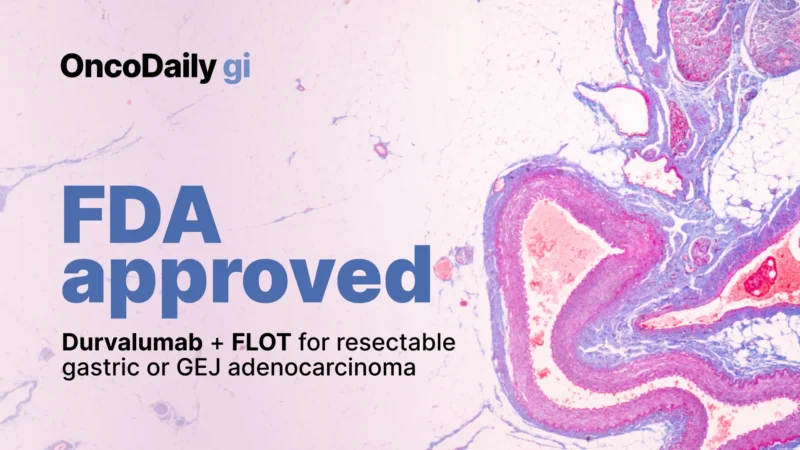
Crucially, the OS benefit was consistent regardless of PD-L1 status, supporting the use of this regimen in all eligible patients. The FDA approved durvalumab plus FLOT for resectable gastric and GEJ cancers in November 2025. An ASCO 2026 subanalysis further confirmed that the EFS benefit of durvalumab was consistent across all treatment periods, with manageable tolerability in the adjuvant monotherapy phase.
You can read about FDA approval of Durvalumab plus FLOT for resectable gastric or GEJ adenocarcinoma on OncoDaily.
Trials with Promising Results
ASCO 2026 also brought important results in neoadjuvant immunotherapy for esophageal cancer, ctDNA-guided treatment decisions in colorectal cancer, and first-line targeted therapy in cholangiocarcinoma.
SCIENCE: Neoadjuvant Chemoradiotherapy plus Sintilimab in Resectable ESCC
The optimal neoadjuvant strategy for resectable locally advanced esophageal squamous cell carcinoma remains an active area of investigation. The phase 3 SCIENCE trial compared three approaches in 307 evaluable patients: neoadjuvant chemotherapy plus sintilimab, neoadjuvant chemoradiotherapy plus sintilimab, and neoadjuvant chemoradiotherapy alone. The pathological complete response results were striking.
Neoadjuvant chemoradiotherapy plus sintilimab achieved a pCR rate of 57.3%, compared with 49.0% with chemoradiotherapy alone and only 18.0% with chemotherapy plus sintilimab. R0 resection was achieved in over 98% of patients across all arms. The trial also incorporated longitudinal ctDNA monitoring, showing that on-treatment ctDNA status after cycle 1 was associated with pathological response, and that preoperative ctDNA clearance was strongly associated with pCR, occurring in 84.8% of pCR patients versus 12.5% of non-responders.
Event-free survival data are still maturing and will be the key endpoint to watch in the next readout, but the magnitude of the pCR improvement — particularly the near-tripling versus chemotherapy plus sintilimab — is among the most impressive neoadjuvant signals seen in this disease.
GALAXY/CIRCULATE: ctDNA-Guided Adjuvant Chemotherapy Duration in CRC
The CIRCULATE-Japan GALAXY study continues to inform how ctDNA dynamics may guide adjuvant chemotherapy decisions in resected colorectal cancer. An ASCO 2026 analysis of 1,028 patients who received adjuvant chemotherapy examined whether ctDNA dynamics at 3 months of treatment could help inform optimal treatment duration.
The findings were clinically meaningful and pointed in two directions. Patients with sustained ctDNA negativity or ctDNA clearance — representing nearly 80% and 15% of patients, respectively — showed no apparent benefit from longer adjuvant chemotherapy. In contrast, patients with partial molecular response, where ctDNA was decreasing but still detectable, showed directional benefit from longer chemotherapy with a hazard ratio of 3.64 favoring extended treatment.
Patients with rising ctDNA on treatment showed no benefit from continuation, suggesting chemotherapy-refractory disease requiring a change in strategy. These findings support ctDNA dynamics during adjuvant treatment as a promising tool for individualizing treatment duration, while further investigation is needed, particularly in the small partial molecular response subgroup.
FIGHT-302: Pemigatinib in First-Line FGFR2-Rearranged Cholangiocarcinoma
Pemigatinib, a selective FGFR1-3 inhibitor, was the first FGFR inhibitor approved in the second-line setting for cholangiocarcinoma with FGFR2 rearrangement, based on the phase 2 FIGHT-202 trial. FIGHT-302 is the first phase 3 randomized trial of a targeted therapy in the first-line setting for FGFR2-rearranged cholangiocarcinoma.
In 167 randomized patients, pemigatinib significantly improved progression-free survival over gemcitabine plus cisplatin — median 8.3 versus 6.8 months with a hazard ratio of 0.58 — and tripled the objective response rate at 47% versus 15.5%. Median duration of response was also notably longer at 14.2 versus 6.3 months. Overall survival was similar between arms at 24.4 versus 25.0 months, but this is heavily confounded by the fact that half of the patients in the chemotherapy arm (42 of 84) crossed over to pemigatinib after progression.
The study closed early due to slow accrual, a reflection of the rarity of FGFR2 rearrangements after prescreening more than 4,000 patients. The results confirm the current management paradigm of pemigatinib administration after disease progression on chemotherapy.
The full abstracts are available on the official ASCO website.

You can also read about 15 Posts Not To Miss From ASCO 2026: GI Edition on OncoDaily.