TQB2102, a first-in-class HER2 biparatopic antibody-drug conjugate, showed a manageable safety profile and preliminary antitumor activity in patients with advanced solid tumors, according to preclinical characterization and phase 1 results reported by Ruan, Lin, Huang, and colleagues.
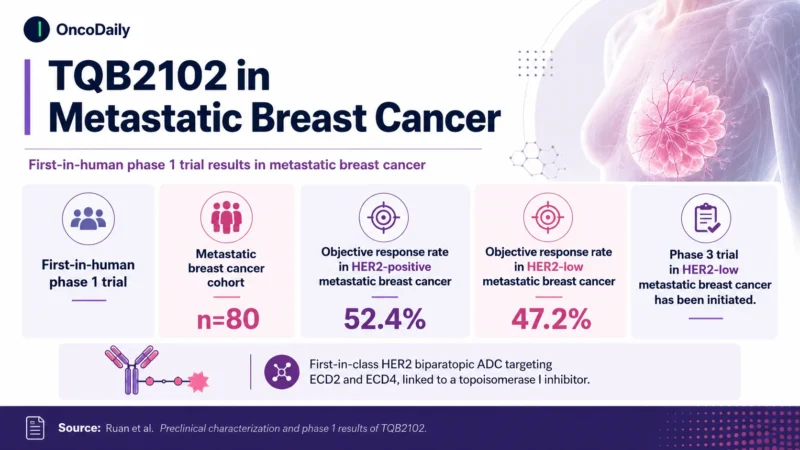
The study evaluated TQB2102, a next-generation ADC designed to bind two distinct HER2 extracellular domain epitopes, ECD2 and ECD4, and deliver a topoisomerase I inhibitor payload through an enzyme-cleavable linker. This biparatopic design may allow broader or stronger HER2 targeting compared with conventional HER2-directed antibody approaches, although clinical validation in later-phase trials remains essential (Ruan et al.).
Why TQB2102 Matters
HER2-directed antibody-drug conjugates have changed treatment expectations across several tumor types, particularly breast cancer, gastric cancer, and HER2-altered solid tumors. However, resistance, heterogeneous HER2 expression, and variable activity in HER2-low disease continue to shape the need for newer ADC platforms.
TQB2102 is being developed as a HER2-targeted biparatopic ADC, meaning it recognizes two HER2 epitopes rather than one. In theory, this strategy may improve binding, internalization, and payload delivery in tumors with HER2 expression. The phase 1 data provide the first clinical signal for this agent across a large cohort of patients with advanced solid tumors (Ruan et al.).
Study Design
This was a phase 1, multicenter, first-in-human trial conducted across 12 centers in China. Patients with advanced solid tumors received intravenous TQB2102 once every three weeks.
The trial included both dose-escalation and dose-expansion parts. Dose escalation evaluated 1.5, 3.0, 4.5, 6.0, 7.5, and 9.0 mg/kg, while dose expansion focused on 6.0 and 7.5 mg/kg. The primary objectives were to assess safety and determine dose-limiting toxicities, maximum tolerated dose, and the recommended phase 2 dose (Ruan et al.).
Between March 8, 2023, and February 1, 2025, 195 patients were enrolled. The main tumor groups included metastatic breast cancer, colorectal cancer, and gastric or gastroesophageal junction adenocarcinoma.
Safety Findings
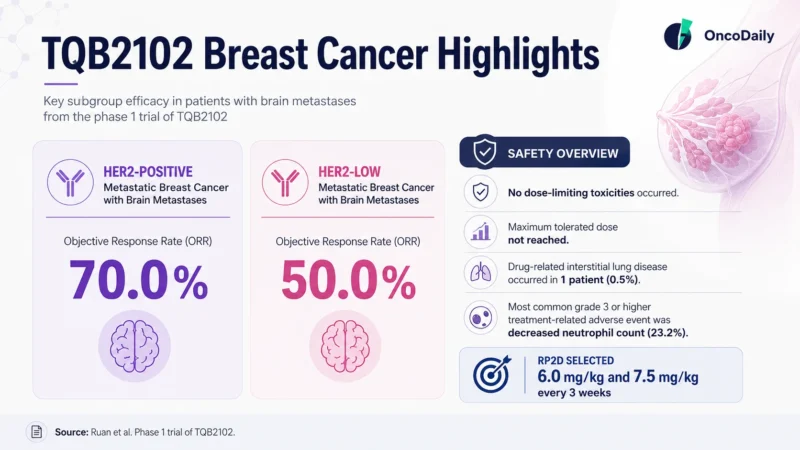
No dose-limiting toxicities were reported, and the maximum tolerated dose was not reached. Based on the phase 1 findings, the recommended phase 2 doses were selected as 6.0 mg/kg and 7.5 mg/kg every three weeks.
The most common grade 3 or higher treatment-related adverse events were hematologic. These included neutrophil count decrease in 23.2%, white blood cell count decrease in 10.8%, anemia in 8.8%, and lymphocyte count decrease in 8.2% (Ruan et al.).
A notable finding was the low reported rate of drug-related interstitial lung disease. Only one patient, representing 0.5% of the cohort, experienced drug-related ILD. Given the clinical importance of ILD with some HER2-directed ADCs, this safety signal will require continued monitoring in larger trials and longer follow-up.
Antitumor Activity
TQB2102 showed preliminary antitumor activity across several HER2-positive solid tumors. In patients with HER2-positive metastatic breast cancer, the objective response rate was 52.4%. In HER2-positive colorectal cancer, the ORR was 38.7%, and in HER2-positive gastric or gastroesophageal junction adenocarcinoma, the ORR was 40.0% (Ruan et al.).
One of the most clinically interesting findings was activity in HER2-low metastatic breast cancer, where the ORR reached 47.2%. This supports further development of TQB2102 in HER2-low disease and aligns with the broader movement toward treating HER2 expression as a spectrum rather than a binary biomarker.
The study also reported activity in patients with brain metastases. Among metastatic breast cancer patients with brain metastases, the ORR was 70.0% in HER2-positive disease and 50.0% in HER2-low disease (Ruan et al.). These findings are promising, although they need confirmation in larger cohorts with dedicated intracranial efficacy endpoints.
Clinical Meaning
The phase 1 results suggest that TQB2102 may have clinically relevant activity across HER2-positive and HER2-low tumors, with a safety profile that appears manageable at the tested doses. The absence of dose-limiting toxicities and the fact that the maximum tolerated dose was not reached support continued dose optimization and expansion.
For breast cancer, the HER2-low signal is especially important. An ORR of 47.2% in HER2-low metastatic breast cancer provides a rationale for larger studies in this subgroup. The initiation of a phase 3 trial in HER2-low metastatic breast cancer indicates that the development program is already moving into a more definitive testing stage (Ruan et al.).
For colorectal and gastric or gastroesophageal junction cancers, the early activity also supports further investigation, particularly in biomarker-selected HER2-positive populations.
Conclusion
TQB2102 is an emerging HER2 biparatopic ADC with encouraging early clinical activity across advanced solid tumors. In this phase 1 study, the agent showed no dose-limiting toxicities, the maximum tolerated dose was not reached, and the recommended phase 2 doses were selected as 6.0 mg/kg and 7.5 mg/kg every three weeks.
The strongest early signals were seen in HER2-positive metastatic breast cancer, HER2-low metastatic breast cancer, HER2-positive colorectal cancer, and HER2-positive gastric or gastroesophageal junction adenocarcinoma. While these results remain early, they support continued development of TQB2102, particularly as a potential new option in HER2-low metastatic breast cancer.