
If you read only one breast oncology roundup this week, make it this one.
The strongest theme running through this week’s literature is not simply progress. It is correction. Correction of undertreatment in older patients with triple-negative breast cancer. Correction of complacency in inflammatory breast cancer. Correction of outdated thresholds in radiation oncology. Correction of overconfident biomarker interpretation. Correction of the idea that precision medicine is only about having a new drug, rather than also having the right test, the right patient, and the right timing.
Several of these papers should change conversations immediately. Some should change referral patterns. At least one should trigger an audit of local pathology practice. And a few should make clinicians uncomfortable enough to ask whether their current habits are evidence-based or just familiar.
Here are the 10 most important breast cancer papers from this week, ranked from highest immediate clinical relevance downward, using the key data from this week’s newsletter and the updated HER2 concordance paper you flagged.
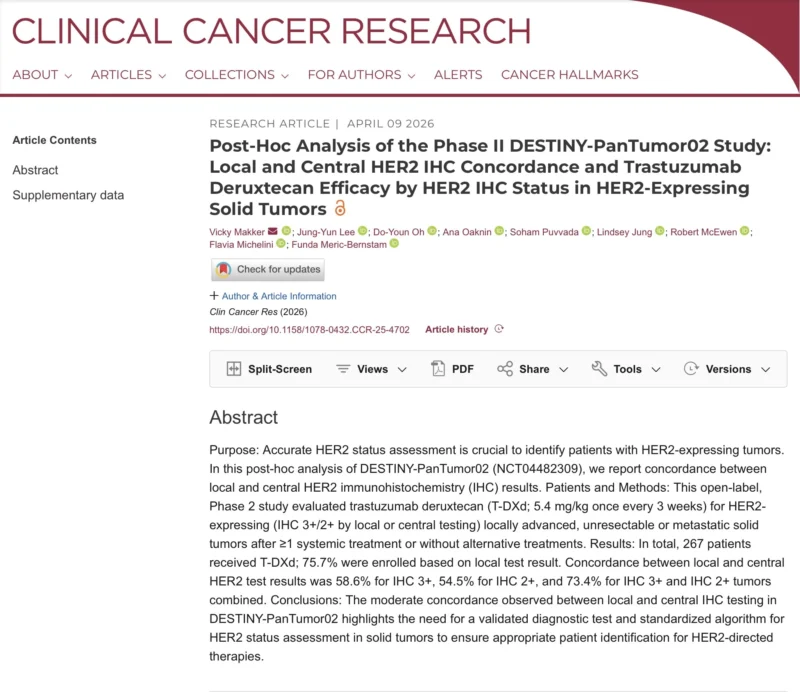
1. DESTINY-PanTumor02 Shows That Access to T-DXd Is Only as Good as the HER2 Test
This is the paper that should make every oncologist stop and think before treating local HER2 immunohistochemistry as a stable gatekeeper for trastuzumab deruxtecan.
In this post-hoc analysis of the phase II DESTINY-PanTumor02 study, investigators examined concordance between local and central HER2 IHC assessment in patients with HER2-expressing advanced solid tumors treated with T-DXd 5.4 mg/kg every 3 weeks. A total of 267 patients received trastuzumab deruxtecan, and 75.7% were enrolled based on local HER2 test results. Concordance between local and central HER2 IHC was only 58.6% for IHC 3+, 54.5% for IHC 2+, and 73.4% when IHC 3+ and 2+ tumors were combined.
Those numbers are not a minor technical concern. They mean that in a substantial fraction of patients, access to HER2-directed therapy is being shaped by where the tissue was read. The authors’ conclusion is exactly the right one: the moderate concordance observed highlights the need for a validated diagnostic test and a standardized algorithm for HER2 status assessment in solid tumors to ensure appropriate patient identification for HER2-directed therapies.
This is why the paper matters so much. The problem is no longer theoretical. If HER2-directed drug access depends on a test that behaves this inconsistently between local and central review, then the field has a diagnostic problem large enough to alter treatment decisions. That is not a pathology footnote. It is a precision-oncology problem.
2. Older Patients With TNBC Still Benefit From Chemotherapy, Especially in Stage II and III Disease
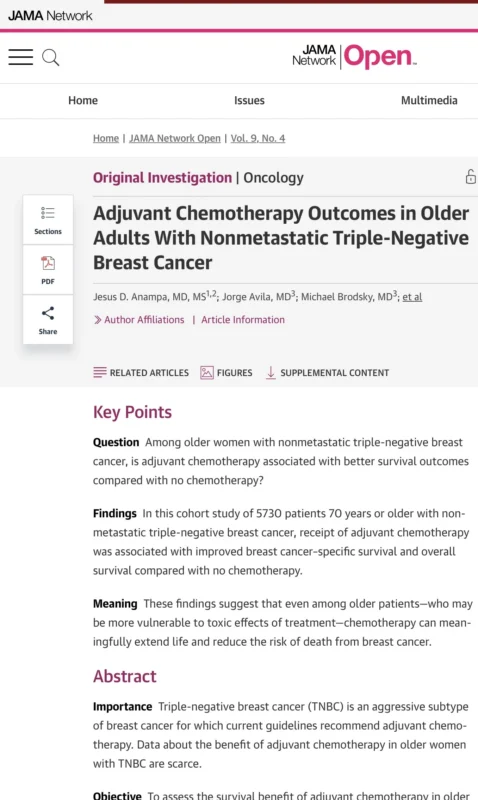
One of the quietest forms of undertreatment in breast oncology happens in older patients with triple-negative breast cancer. A patient turns 75 or 80, and chemotherapy is sometimes framed as an act of excess rather than an act of disease control. This week’s JAMA Network Open cohort study makes that shortcut much harder to defend.
Using SEER data, investigators evaluated 5,730 women aged 70 years or older with nonmetastatic TNBC. Adjuvant chemotherapy was associated with better breast cancer-specific survival, with an HR of 0.69, and better overall survival, with an HR of 0.55. The absolute impact was not uniform by stage. The reduction in 5-year breast cancer death was most substantial in stage III disease, 50% versus 35%, intermediate in stage II, 21% versus 15%, and minimal in stage I, 7% versus 6%. Chemotherapy use also dropped sharply with age, with an odds ratio of 0.15 in patients aged 80 to 89 and 0.02 in those aged 90 or older.
The limitation is important and should not be ignored. Treated patients were younger and likely fitter, so baseline imbalance and residual confounding may explain part of the observed benefit. But even with that caveat, the study reinforces something clinically obvious and too often neglected: age alone is not a treatment algorithm.
In triple-negative disease, where targeted rescue options remain limited for many patients, underusing chemotherapy in fit older adults is not necessarily gentleness. It can be undertreatment of a high-risk subtype. This paper does not argue for indiscriminate chemotherapy in all older patients. It argues for individualized assessment rather than age-based therapeutic drift, especially in stage II and III disease.
3. Inflammatory Breast Cancer Still Does Worse, and Trimodality Therapy Use Is Falling
Inflammatory breast cancer should still trigger urgency at the level of diagnosis, referral, and treatment planning. This week’s JAMA Network Open analysis makes clear why.
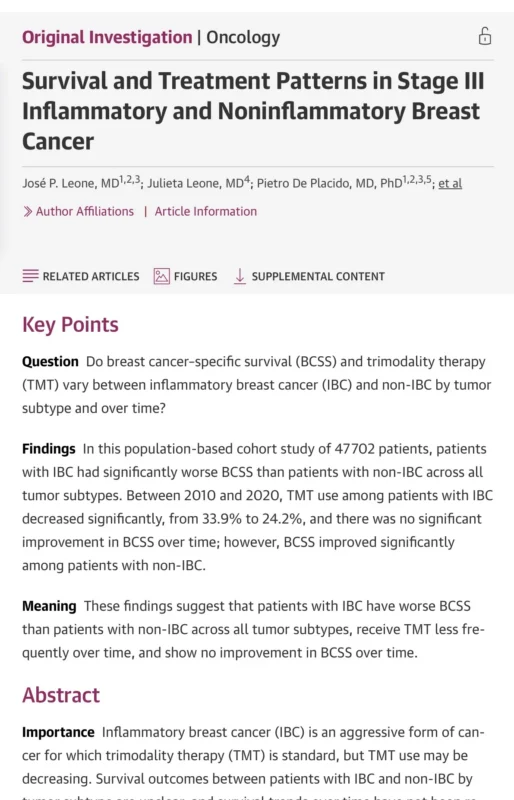
In a SEER cohort of 47,702 patients with stage III breast cancer, including 3,227 with inflammatory breast cancer, IBC had worse breast cancer-specific survival than non-IBC across subtypes. The adjusted hazard ratio was 1.53 for HR-positive/HER2-negative disease and 1.69 for TNBC. That confirms what clinicians already know in practice: inflammatory breast cancer remains a biologically and clinically distinct high-risk entity.
The more concerning part of the study is what it revealed about treatment patterns. Trimodality therapy, combining systemic therapy, surgery, and radiation, was associated with better breast cancer-specific survival, with an aHR of 0.67, and better overall survival, with an aHR of 0.65. The 8-year BCSS was 58.1% with trimodality therapy versus 47.7% without. Yet despite that association, use of trimodality therapy in IBC declined from 33.9% in 2010 to 24.2% in 2020.
That decline should worry every multidisciplinary breast team. IBC is one of the least forgiving presentations in breast oncology. The standard treatment framework is already aggressive because the disease is already aggressive. When the use of the treatment approach most clearly linked to better outcomes begins to fall, it should not be rationalized casually. It should be examined carefully.
4. PARP Inhibitors Continue To Work in Real-World Practice, Even When Used Later Than in Trials
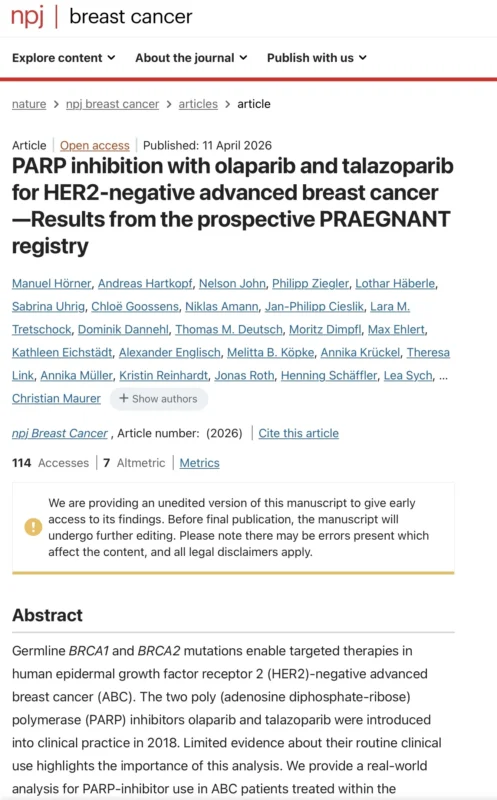
The PRAEGNANT registry study is one of the most clinically reassuring papers of the week because it answers a question that trialists cannot fully answer: do PARP inhibitors still deliver when they leave the clean architecture of a registration study and enter the less orderly reality of routine practice?
In this prospective German registry, 152 patients with germline BRCA-mutated HER2-negative advanced breast cancer received olaparib, in 90.8%, or talazoparib, in 9.2%. Median real-world PFS was 6.2 months, and median OS was 17.1 months, outcomes comparable to OlympiAD and EMBRACA despite the fact that these patients often received PARP inhibitors in a later median line of therapy, third line rather than second.
Subtype differences were substantial. HR-positive disease performed better than TNBC, with rwPFS of 7.3 versus 4.5 months and rwOS of 21.4 versus 10.2 months. Earlier line of therapy was associated with better outcomes across the board, and for HR-positive patients treated in first line, real-world OS reached 44.7 months. Among patients with known mutations, 62.9% carried BRCA2, 36.1% carried BRCA1, and only one PALB2 carrier was identified, underscoring how central germline BRCA1/2 testing remains for routine PARP inhibitor eligibility.
This study is important because it confirms two truths at once. PARP inhibitors are not just trial drugs. They remain effective in real-world practice. But they also work best when they are not held back too long. That makes early germline BRCA testing not just advisable, but essential.
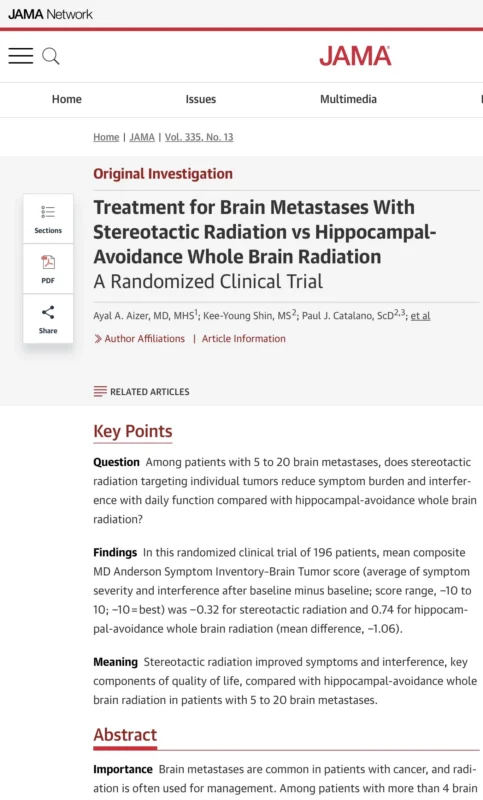
5. Stereotactic Radiation Outperformed HA-WBRT in Patients With 5 to 20 Brain Metastases
Radiation oncology has spent years slowly moving beyond arbitrary brain-metastasis thresholds, and this JAMA phase III trial adds one of the clearest arguments yet for why that shift matters.
The study included 196 patients with 5 to 20 brain metastases and compared stereotactic radiation with hippocampal-avoidance whole-brain radiation therapy. SRS significantly improved the primary symptom and interference endpoint, with mean change −0.32 versus +0.74, a mean difference of −1.06, and P<0.001. Grade 3 to 5 adverse events were similar, 12% versus 13%, but fatigue was more common with HA-WBRT, 44% versus 28%. New brain metastases were more frequent with SRS, 45.4% versus 24.2% at one year, but only 5.1% required salvage WBRT, and overall survival was similar, 8.3 versus 8.5 months.
This matters because many institutions still carry forward an outdated mental cutoff in which more than four brain metastases automatically nudges a patient toward whole-brain approaches. Modern stereotactic techniques and better supportive care have made that framework increasingly obsolete. This trial does not mean every patient with 5 to 20 lesions should get SRS. It does mean the old reflexive limit has become much harder to justify.
6. Estrogen-Only HRT After Oophorectomy Looks Reassuring, Especially for BRCA1 Carriers
The study on hormone therapy after oophorectomy in BRCA carriers may not be the week’s most dramatic readout, but it may prove to be one of the most practically helpful. Surgical menopause in a young BRCA carrier is not a side issue. It is a long-term survivorship problem with immediate consequences for bone health, sleep, vasomotor symptoms, cardiovascular risk, and daily function.
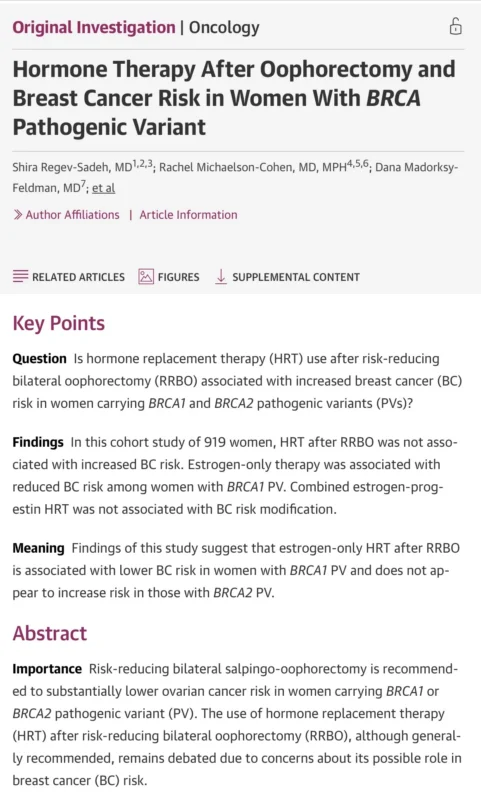
This multicenter cohort included 919 cancer-free BRCA1/2 carriers after risk-reducing bilateral oophorectomy, with a mean follow-up of 8.8 years. Overall, hormone replacement therapy was not associated with increased breast cancer risk. For combined estrogen plus progestin, the hazard ratio was 1.06. For estrogen-only therapy, it was 0.89. More notably, each year of estrogen-only HRT was associated with lower breast cancer risk overall, HR 0.90 per year, and among BRCA1 carriers, HR 0.87. A signal for long-term combined estrogen plus progestin in women undergoing oophorectomy before age 45 disappeared after multivariable adjustment.
The clinical message is clear. These data are reassuring for estrogen-only HRT, especially in BRCA1 carriers, and should support more confident management of surgical menopause. Too often, clinicians still default toward withholding estrogen in women whose quality of life is being severely damaged by premature menopause. This paper makes that reflexive caution harder to defend.
7. PREDIX LumB Was Negative Overall, but the Biomarker Signal Should Not Be Ignored
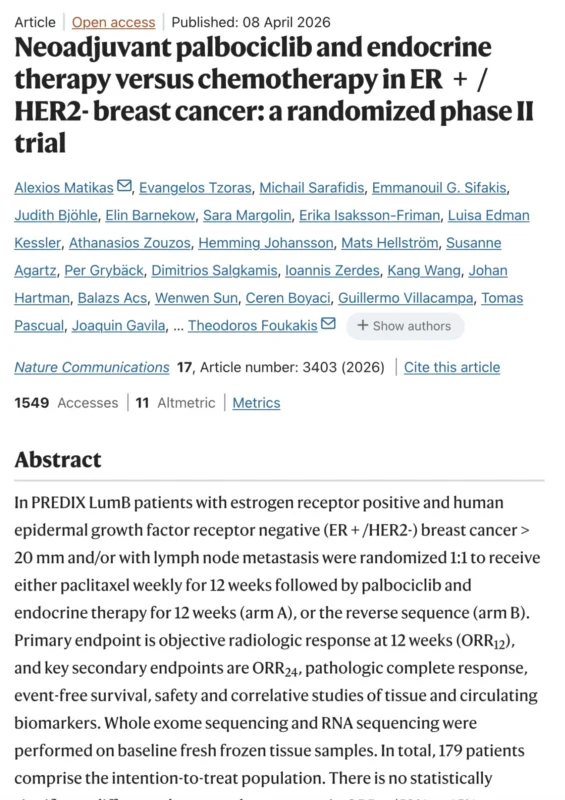
The randomized phase II PREDIX LumB trial is a good example of why negative trials still need close reading. The study randomized 179 patients with ER-positive/HER2-negative tumors larger than 20 mm and/or node-positive disease to two sequences involving paclitaxel and palbociclib plus endocrine therapy. There was no significant difference in ORR12, 59% versus 45%, P=0.058, no meaningful ORR24 difference, 78% versus 71%, and no event-free survival difference, with HR 1.06. Pathologic complete response rates were low and similar, 3 versus 5 cases.
But the biomarker analysis is what makes this trial worth remembering. The 31-gene CDKPredX signature identified tumors resistant to chemotherapy but relatively sensitive to palbociclib plus endocrine therapy, with a P interaction of 0.03, and the signal was validated independently in CORALLEEN, with P interaction 0.048. Quality of life was also better preserved during palbociclib plus endocrine therapy than during paclitaxel.
The take-home message is not that neoadjuvant CDK4/6 blockade beats chemotherapy overall. It does not. The message is that CDKPredX may help define a subgroup in which endocrine therapy plus palbociclib becomes a more rational, biomarker-guided alternative. That is a much more useful lesson than simply labeling the trial negative and moving on.
8. Baseline ctDNA Positivity Continues To Mature Into a Meaningful Long-Term Risk Marker
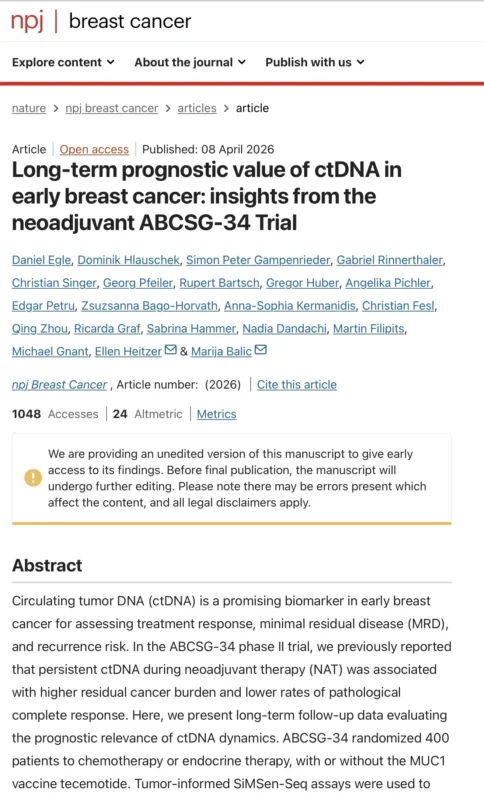
The ABCSG-34 long-term follow-up adds more weight to the idea that baseline ctDNA may soon become a serious risk-stratification tool in early breast cancer.
Among 109 patients followed for a median of 7.1 years, baseline ctDNA positivity was associated with poorer overall survival, 62.7% versus 81.2%, with HR 2.12. A strong adverse trend was also seen for distant relapse-free survival, 60.9% versus 77.9%, with HR 1.98, and restricted mean survival time analyses confirmed shorter time to invasive DFS events, distant recurrence, and death within eight years in ctDNA-positive patients.
The paper is also valuable for what it does not overclaim. The authors and the newsletter both note that ctDNA clearance during therapy still needs confirmation in larger cohorts before it can be treated as a clinically actionable endpoint. That is the right level of caution. Baseline ctDNA is increasingly looking like a robust prognostic marker. Clearance remains more exploratory.
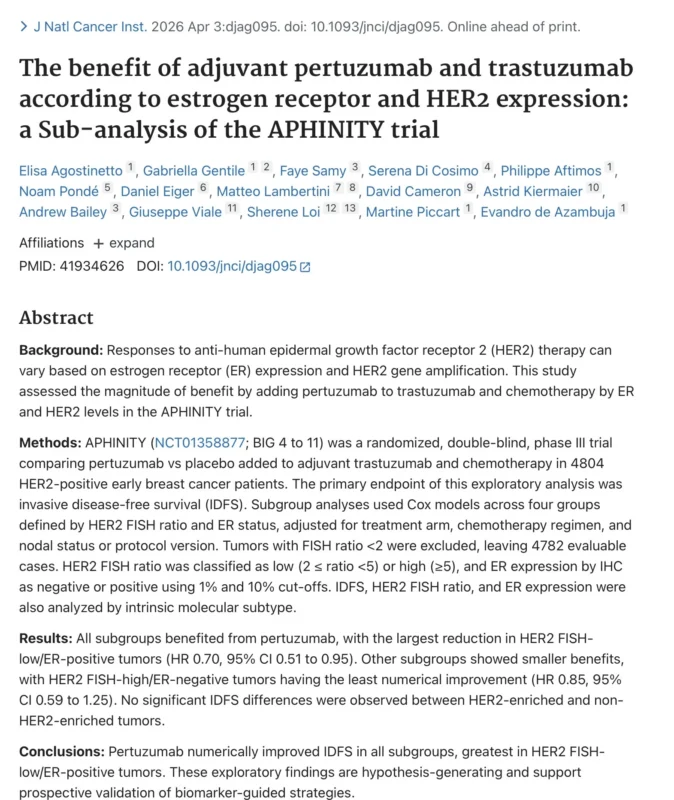
9. APHINITY Suggests Pertuzumab Benefit May Not Be Uniform, but the Data Are Still Hypothesis-Generating
This exploratory biomarker sub-analysis of APHINITY included 4,782 evaluable patients and found that pertuzumab numerically improved invasive disease-free survival across all subgroups, but not to the same apparent degree. The largest numerical benefit was seen in HER2 FISH-low/ER-positive tumors, with HR 0.70, while the smallest was in HER2 FISH-high/ER-negative disease, with HR 0.85. No significant differences were seen by HER2-enriched versus non–HER2-enriched intrinsic subtype.
This is scientifically interesting and clinically limited. The newsletter correctly emphasizes the key limitation: this was a post-hoc subgroup analysis, and formal interaction testing was negative. That means the results are hypothesis-generating, not practice-changing. Pertuzumab remains part of standard management for high-risk HER2-positive early breast cancer. But the paper does lay useful groundwork for future de-escalation trials, especially in ER-positive tumors with lower HER2 amplification.
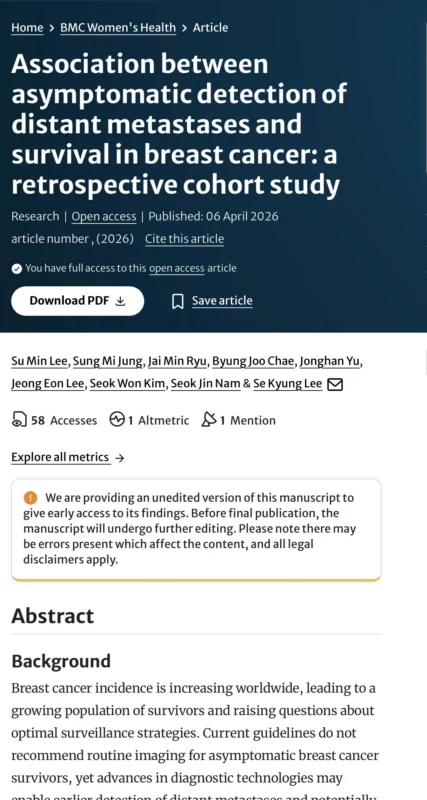
10. Asymptomatic Detection of Metastases Looks Better Retrospectively, but It Still Does Not Justify Routine Surveillance Imaging
The final paper in this ranking is worth reading mainly because it illustrates how easily retrospective survival differences can be overinterpreted. In a study of 316 patients who developed distant metastases after surgery, 64.6% were diagnosed while asymptomatic. Asymptomatic detection was associated with better post-metastatic overall survival, and symptomatic presentation remained independently associated with poorer post-metastatic OS after adjustment for disease-free interval and imaging utilization. The apparent advantage was mainly seen in HR-positive disease, not clearly in HER2-positive disease.
But this is exactly the type of finding that demands bias literacy. The study is strongly vulnerable to lead-time bias and length bias, and the newsletter explicitly warns that it should not be interpreted as support for routine surveillance imaging. That caution is essential. Earlier detection of metastases can easily appear beneficial without proving that surveillance itself improves survival.
So why include the paper at all? Because clinicians still encounter this argument in practice, often from retrospective data or anecdotal experience. This study is useful precisely because it looks tempting and still does not justify a change in surveillance policy.
The Bottom Line
The most important message from this week is not that there were ten interesting papers. It is that breast oncology keeps moving toward a more exacting standard of care, and several of the shortcuts still used in clinic are becoming much harder to justify.
If a patient’s access to T-DXd depends on HER2 testing, then HER2 testing itself needs to be better. If an older patient with TNBC has stage II or III disease and is fit enough to tolerate chemotherapy, age alone should not push her toward undertreatment. If inflammatory breast cancer still behaves worse across subtypes, declining use of trimodality therapy is not something to watch passively. If baseline ctDNA keeps identifying patients at long-term risk, it may soon matter before treatment begins, not only after treatment ends. And if a post-hoc analysis suggests pertuzumab benefit is uneven, that should guide future trials, not premature de-escalation.
The field is not just generating more data. It is exposing where practice remains imprecise. That is what makes this week’s literature important.