The first days of May bring a diverse set of updates across GU Oncology, highlighting emerging scientific insights alongside continued progress in clinical research and treatment development.
This week’s selection, covering posts from May 1 to May 10, reflects strong momentum across prostate, bladder, kidney, testicular, and penile cancers. Key updates include new evidence on salvage local therapies in radiorecurrent prostate cancer, evolving discussions around radioligand therapy, CAR T-cell approaches in metastatic castration-resistant prostate cancer, and real-world data in nonmetastatic castration-resistant prostate cancer.
At the same time, bladder cancer updates point to the growing complexity of treatment decision-making, with emerging data from KEYNOTE-B15/EV-304, increasing interest in AI-supported clinical decisions, and novel techniques for recurrent low-grade non-muscle-invasive bladder cancer. Rare GU malignancies also remain an important focus, with new studies addressing poor-risk testicular germ cell tumors, metastatic non-clear cell renal cell carcinoma, and B7-H3-targeted strategies in penile cancer.
Together, these insights highlight a field advancing across translational science, clinical research, real-world evidence, and multidisciplinary care, while continuing to address significant unmet needs across GU malignancies.
Syed Abdullah Javaid Bukhari — Medical Oncologist | CCT, MRCP, FRCP | Registered Consultant Medical Oncologist in GMC and SCFHS | King Abdullah Specialist Hospital, Al Qassim | Saudi Arabia
“Pleased to share our recent publication in Cureus on Stage IIIC poor-risk testicular germ cell tumors.
Working on this cohort highlighted a difficult reality—high early mortality and relapse rates persist, despite this being a largely curable disease overall.
Our findings emphasize the prognostic value of tumor marker normalization and the need for better treatment strategies in this high-risk group.
Grateful to my co-authors and team for their contribution.”
Sahar Barjesteh van Waalwijk van Doorn-Khosrovani — PharmD-PhD | Pharmacist CZ/CieBAG | Associate Professor of Medical Oncology, focused on Accessibility of Medicines | The Netherlands
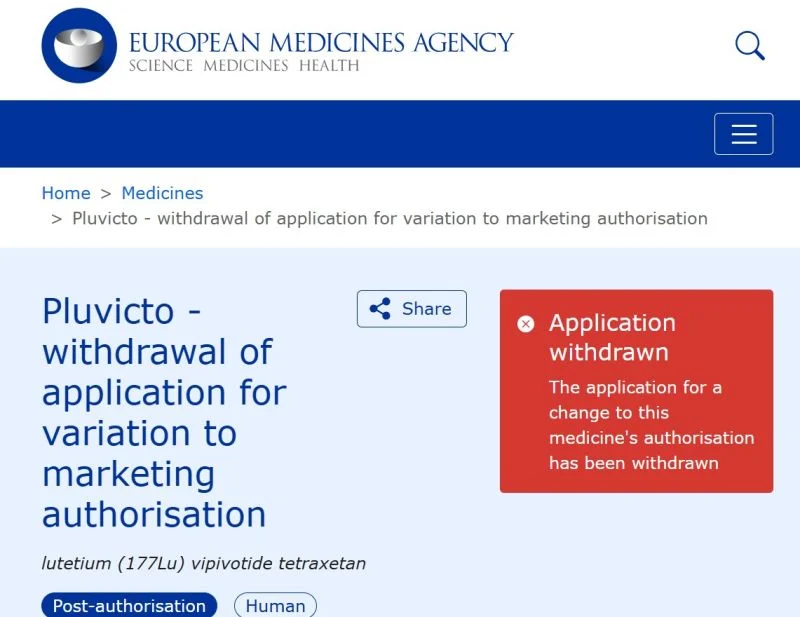
“Novartis has withdrawn its application for Pluvicto (¹⁷⁷Lu-PSMA-617) in earlier-line prostate cancer (mCRPC) based on the PSMAfore study.
The CHMP concluded the benefit was not clinically meaningful, with:
- insufficient comparator (ARPI after ARPI is not an appropriate control arm)
- no overall survival benefit”
Neal Shore — Medical Director, CPI – Carolina Urologic Research Center | Director, START GU Oncology Center of Excellence | United States
“Real-world analysis of androgen receptor inhibitors in US patients with nonmetastatic castration-resistant prostate cancer: DEAR-EXT study.”
Igor Tsaur — Director and Chairman, Department of Urology, University Hospital Tübingen | University Competence Center for Precision Surgery and Robotic-Assisted Urology | Germany
“Exciting News in Oncology Research!
I am very happy to share our latest publication investigating new therapeutic horizons for advanced penile cancer.
Our study highlights the promising role of B7-H3 (CD276) as a target for bispecific T-cell engager (BiTE) therapy, specifically utilizing constructs like CC-3. Given the limited treatment options for this rare disease, these findings represent a significant step toward more effective, targeted immunotherapy.
This project is particularly special to me: Helmut Salih and I jointly developed the initial idea to explore B7-H3 and CC-3 in penile cancer over a cup of coffee in his office two years ago.
Dear Helmut: It is incredibly rewarding to see that early vision yield such promising results today!
A huge congratulations and special thanks to Aleksander Kielbik for his consistent and resilient efforts in driving this research forward and for his unwavering dedication to improving outcomes for patients.
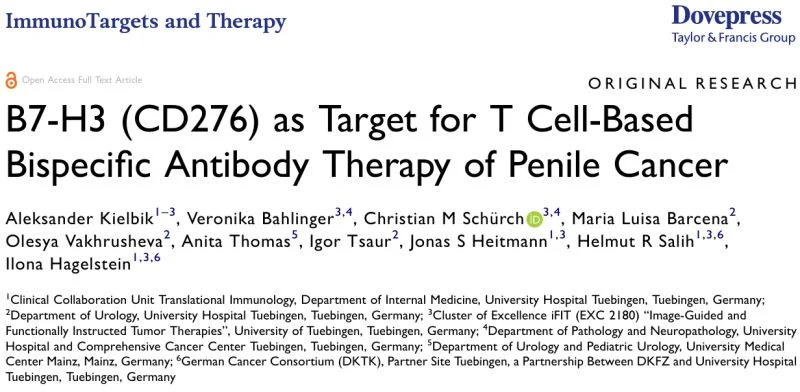
Title: B7-H3 (CD276) as Target for T Cell-Based Bispecific Antibody Therapy of Penile Cancer
Journal: ImmunoTargets and Therapy
Authors: Kielbik A, Bahlinger V, Schürch CM, Barcena ML, Vakhrusheva O, Thomas A, Tsaur I, Heitmann JS, Salih HR, Hagelstein I.”
Shahrokh Shariat, MD — Professor and Chairman, Department of Urology | Director of the Comprehensive Cancer Center | Co-lead of the Austrian Comprehensive Cancer Network, Medical University of Vienna | Austria
“New publication in JAMA Oncology — proud to share work that I believe will reshape how we counsel patients with radiorecurrent prostate cancer.
Key findings across 31 studies and 4,525 patients:
• Pooled 2-year and 5-year ADT-free survival: 76.8% and 55.2%
• Pooled 2-year and 5-year metastasis-free survival: 90.4% and 75.2%
• Severe (≥grade 3) adverse event rates: cryotherapy 2%, SBRT 4%, HIFU 5%, HDR brachytherapy 5%, salvage radical prostatectomy 13%, LDR brachytherapy 14%What I take from this as a urologic oncologist:
- The toxicity gradient matters. Salvage HDR-BT, SBRT, HIFU, and cryotherapy emerge as the lowest-morbidity options.
- ADT deferral is realistic. Maintaining ADT-free status in three-quarters of patients at two years and more than half at five years is clinically meaningful, given the cardiometabolic, cognitive, sexual, and quality-of-life consequences of long-term ADT.
- About one in ten patients experiences an early metastatic event — underscoring the absolute need for rigorous restaging (PSMA PET/CT, mpMRI) and shared decision-making.
- Prospective registries and well-designed comparative trials are urgently needed.
The conversation is no longer whether local salvage is reasonable — it is how we choose the right modality for the right patient.”
Alessandro Rametta — Oncologist at Fondazione IRCCS Istituto Nazionale dei Tumori di Milano | University of Milan | Italy
“I am pleased to share that our study, ‘International multicenter experience of prognostic factors and treatment outcomes of metastatic non-clear cell renal cell carcinoma’ is now published in Tumori Journal.
This work reports an international multicenter retrospective analysis of patients with metastatic non–clear cell RCC treated with at least one line of systemic therapy, combining data from Vall d’Hebron and the Meet-URO network.
Thank you to all co-authors and collaborators for their contribution.”
Giuseppe Procopio — Chief of Genitourinary Oncology | Director Prostate Program | Full Professor Qualified | FICOG and Meet-URO President | Italy
“New Expert Opinion published in Expert Review of Anticancer Therapy:
‘¹⁷⁷Lu-PSMA-617 radioligand therapy as an immune modulator in prostate cancer’
While ¹⁷⁷Lu-PSMA-617 is now an established treatment for PSMA-positive metastatic castration-resistant prostate cancer (mCRPC), growing evidence suggests that its role may extend far beyond direct tumor cytotoxicity.
In this review, we explored how PSMA-targeted radioligand therapy can reshape the tumor immune microenvironment by:
• inducing immunogenic cell death
• enhancing antigen presentation and T-cell activation
• interacting with hypoxia, vascularization, and tumor heterogeneity
• potentially sensitizing tumors to immunotherapy combinationsWe also discuss emerging strategies involving alpha-emitters and FAP-targeted radioligands, highlighting the importance of biomarker-driven patient selection, optimized dosimetry, and rational combination approaches to improve long-term outcomes.
A sincere thank you to all co-authors and contributors for this collaborative work.”
Enrique Grande — Medical Oncologist | One Oncology Madrid Program Director at Quironsalud | Global Leader in GU Oncology & Bladder Cancer | Spain
“AI + decision making in bladder cancer | Can artificial intelligence help us make better decisions in bladder cancer?
The complexity of treatment decisions in urothelial cancer is increasing rapidly:
• multiple lines of therapy
• emerging biomarkers
• new drug classes
• evolving sequencesAs clinicians, we are asked to integrate more data than ever before.
This is where I believe artificial intelligence can play a key role.
Not to replace clinical judgment — but to enhance it.At its best, AI could help us:
• identify optimal treatment sequences
• predict response and toxicity
• support personalized decision-makingHowever, the real challenge is not technological — it is clinical.
How do we integrate AI into daily practice in a meaningful and responsible way?Because in oncology, every decision matters.
And every patient is unique.The future will not be AI vs clinicians.
It will be AI + clinicians working together.”
Ibrahim A. Khalil — Urologic Oncology and Robotic Surgery Fellow | MD, ABHS-U | Jordan
“Excited to share our recent publication:
‘Narrow Band Imaging-Guided Diode Laser Ablation in Recurrent Low-Grade Non-Muscle-Invasive Bladder Cancer’ published in UroPrecision Journal.
Grateful to all mentors, co-authors, and collaborators involved in this work.”
Yan Leyfman, MD — Physician-Scientist | AI, Cellular Immunotherapy & Translational Oncology | Co-Founder, MedNews Week | United States
“CAR T has transformed hematologic malignancies—but prostate cancer remains one of the field’s toughest frontiers.
One major challenge: persistence.
Most CAR T cells in solid tumors burn out before they can sustain meaningful control.So investigators tried a different strategy:
Build CAR T cells enriched for stem cell–like memory T cells (TSCM)—cells designed for long-term survival and expansion.
In a Phase I study, patients with metastatic castration-resistant prostate cancer received P-PSMA-101, a PSMA-directed CAR T generated using a nonviral piggyBac platform.
What happened?
• Strong CAR T expansion
• PSA50 responses in 21%
• Durable remissions >12 months in some patients
• Stable disease in the majorityBut the potency came with tradeoffs:
• CRS in 61%
• Safety switch activation required in nearly one-quarter of patientsThe key insight: The same biology that may drive durability in solid tumors can also amplify toxicity.
Bottom line: This study highlights both the promise and the challenge of next-generation solid tumor CAR T:
• More persistent cells may produce deeper, longer responses
• But controlling that power safely remains the critical next step.”
You can also read about Top Prostate Cancer Trials to Watch at ASCO 2026 on OncoDaily.