
March brings Multiple Myeloma Awareness Month, placing a spotlight on a disease that continues to challenge even the most advanced oncology systems. While often less visible than solid tumors, multiple myeloma has steadily become one of the most dynamic and demanding areas in cancer care.
Across clinics and research centers, the conversation around myeloma is shifting. What was once considered a relatively uniform hematologic malignancy is now understood as a complex, evolving disease with diverse clinical behavior and rapidly expanding treatment options.
Understanding the Biology Behind the Disease
Multiple myeloma originates in plasma cells, a critical component of the immune system responsible for producing antibodies. Under normal conditions, these cells protect the body from infection. In myeloma, however, a single plasma cell undergoes malignant transformation and begins to expand within the bone marrow.
As these abnormal cells accumulate, they disrupt the normal balance of blood cell production. At the same time, they produce monoclonal proteins that lack protective function and instead contribute to organ damage, particularly affecting renal function.
A Disease With a Hidden Onset
One of the defining challenges of multiple myeloma is its often silent early course. Many patients are diagnosed incidentally, before symptoms become apparent.
When clinical signs emerge, they often reflect advanced biological activity. Bone pain is one of the most common presentations, frequently involving the spine or ribs. Fatigue, infections, and metabolic disturbances follow as the disease progresses.
From Precursor State to Active Malignancy
In most cases, multiple myeloma develops gradually from a precursor condition known as monoclonal gammopathy of undetermined significance. At this stage, abnormal proteins are detectable, but there is no organ damage.
Progression to active myeloma is driven by accumulated genetic changes and interactions within the bone marrow microenvironment. This continuum has become central to modern disease monitoring and risk assessment.
Gilead Sciences is moving to acquire Arcellx, centered on a late-stage, FDA-submitted cell therapy asset. The deal highlights the growing importance of full control over development and manufacturing in advanced oncology treatments.
Clinical Impact Beyond the Tumor
The burden of multiple myeloma is defined not only by malignant cells, but by its systemic complications.
Bone disease remains a hallmark feature, leading to pain, structural damage, and fractures. Renal impairment is common and can progress to kidney failure. Immunosuppression increases the risk of infections, while anemia contributes to fatigue and reduced functional status.
In a recent OncoDaily TV interview, host Ina Khachatryan spoke with multiple myeloma survivor Julie Cohen, who shared her journey from diagnosis to sustained remission. Her story highlights the impact of clinical trials, resilience, and patient support in shaping today’s myeloma care.
Diagnosis in the Era of Precision Medicine
The diagnostic pathway for multiple myeloma has evolved significantly. Blood and urine testing remain essential, particularly for detecting monoclonal proteins and assessing organ function.
Bone marrow evaluation confirms the presence of malignant plasma cells and allows for detailed genetic analysis. Techniques such as fluorescence in situ hybridization provide insight into chromosomal abnormalities that influence prognosis and treatment selection.
Imaging has also advanced, with MRI, CT, and PET scans offering more sensitive detection of bone involvement and disease extent.
A Daily Window Into Myeloma Research with Robert Orlowski
Beyond awareness campaigns and designated months, Robert Orlowski, Deputy Chair of Lymphoma/Myeloma and Vice Chair of Multiple Myeloma Research at the University of Texas MD Anderson Cancer Center, has been consistently sharing a different multiple myeloma paper each day on X.
Based on these curated highlights, we selected ten papers that you simply shouldn’t miss. Together, they capture the direction of multiple myeloma research right now, from frontline strategies to relapse settings, from immunotherapy to cellular approaches.
Top 10 Papers You Shouldn’t Miss
1.“Multicenter retrospective study of 344 pts w/ plasmablastic lymphoma finds median OS 5.0 yrs, PFS 1.4; HIV pts had best outcomes, organ transplant pts had worst; higher intensity chemo and PIs did not show survival benefit.”

2.“Study of safety and efficacy of commercial BCMA CAR T in systemic AL amyloidosis w/ myeloma finds ORR by AL criteria was 93% (5 VGPRs, 20 CRs; ide-cel ORR was 75% and 100% for cilta-cel); 12 and 18-mo OS rates were 85% and 81%.”

3.“Outpatient administration of cilta-cel may yield similar effectiveness and safety outcomes relative to inpatient (IP) administration while significantly reducing IP resource use (fewer IP days/pt/mo (2.4 vs. 6.6; p<0.001)).”

4. “Surveillance of smoldering myeloma pts who progress to active disease associated w/ favorable outcomes, including less irreversible renal complications, hypercalcemia, lytic lesions, pathological fxs, detrimental bone dz.”

5.“RRM2-driven trafficking is a novel and targetable mechanism of antigen escape in CAR-T; osalmid may restore MICA/B presentation and potentiates NKG2D CAR-T cell efficacy and could potentially enhance CAR-Ts across many antigens.”

6.“Global myeloma incidence (1990-2021) had slight increase, primarily in ageing populations and high/high-middle sociodemographic index (SDI) areas; more significant in males and middle SDI regions; mortality had minimal growth.”
7.“Age >65, male gender, diagnosis of symptomatic Waldenström macroglobulinemia and b2m >3 are significant predictors for shorter OS in IgM gammopathy; BM bx infiltration, Hgb <11.5, plts <100k assoc w/ shorter time to 1st tx.”

8.“Telomere length (LTL) and clonal hematopoiesis (CH) interact to influence outcomes in hematopoietic stem cell transplantation for myeloma, w/ longer LTL being associated with increased PFS amongst patients without CH.”
9.“PACE Score for daratumumab-treated newly dxd AL amyloidosis pts provides clinically applicable tool for early mortality risk stratification; uses NT-proBNP >5300 pg/mL, age > 75 years, absence of t(11;14), and ECOG PS.”
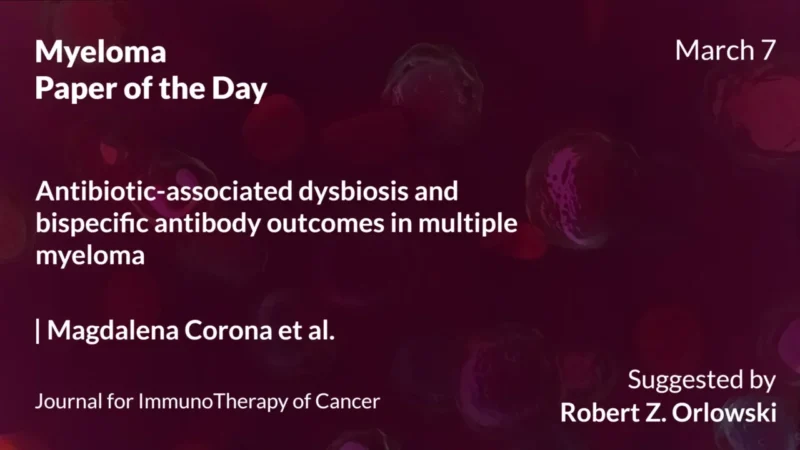
10.“Broad-spectrum antibiotics prior to T-cell engagers associated w/ significantly inferior 1-year OS (60 vs 77%) and PFS (26 vs 53%) and higher relapse incidence; microbiota composition correlated w/ therapy response and toxicity.”
On February 23, 2026, Gilead Sciences announced an agreement to acquire Arcellx for $115 per share in cash plus a $5 CVR, valuing the company at approximately $7.8 billion, with closing expected in Q2 2026.
The move gives Gilead full control over anito-cel, a late-stage cell therapy asset, while consolidating manufacturing and development within its Kite Pharma platform highlighting the growing importance of operational control in the evolving cell therapy landscape.

Explore more oncology news and features on OncoDaily.
Written by Nare Hovhannisyan, MD