


Every November, Lung Cancer Awareness Month brings global attention to one of the most significant challenges in cancer care. The campaign aims to raise awareness about lung cancer, encourage earlier detection, highlight advances in treatment, and support the millions of people affected by the disease worldwide.
Despite major progress in oncology, lung cancer remains the leading cause of cancer-related deaths worldwide, presenting ongoing challenges in prevention, early diagnosis, and access to effective treatment.
According to the International Agency for Research on Cancer (IARC), an estimated 2.6 million people were diagnosed with lung cancer worldwide in 2024, while approximately 1.9 million deaths were attributed to the disease. These figures, reported in 2026, highlight the continuing global burden of lung cancer and the importance of improving outcomes through research, prevention, and timely care.
What Exactly Is Lung Cancer?
Lung cancer develops when abnormal cells in the lungs begin growing uncontrollably, forming a malignant tumour that may invade nearby tissues or spread to other parts of the body.
There are two main types:
- Non-small cell lung cancer (NSCLC): The most common type, accounting for approximately 85% of cases.
- Small cell lung cancer (SCLC): A less common but generally faster-growing form that often spreads earlier.
The type and stage of lung cancer influence treatment decisions and prognosis.

Could These Symptoms Be a Warning Sign?
Lung cancer often develops without noticeable symptoms in its early stages. When symptoms appear, they may resemble common respiratory conditions.
Symptoms worth paying attention to include:
- A persistent cough or a noticeable change in an existing cough.
- Coughing up blood, even in small amounts.
- Shortness of breath or wheezing.
- Persistent chest pain, particularly when coughing or breathing deeply.
- Repeated chest infections.
- Unexplained weight loss, fatigue, or loss of appetite.
- Persistent hoarseness.
These symptoms do not necessarily mean cancer. However, persistent, unexplained, or worsening symptoms deserve medical evaluation.
Seek emergency medical care for severe difficulty breathing, significant coughing up of blood, fainting, or sudden severe chest pain.
Who Is at Risk? It’s Not Just Smokers
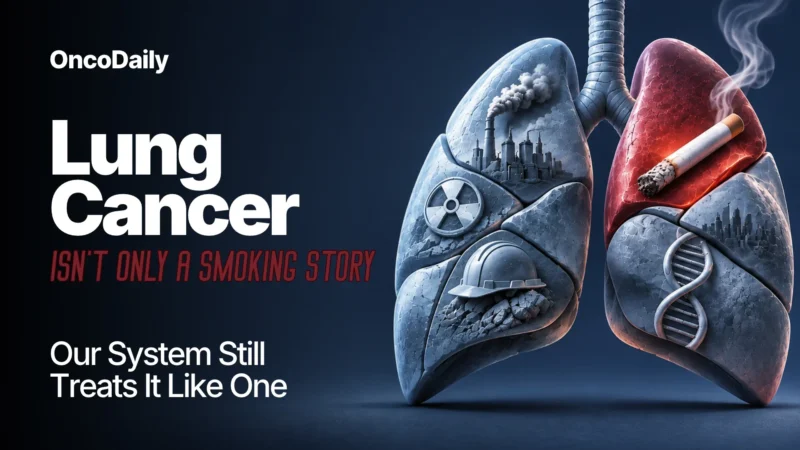
Smoking remains the leading risk factor for lung cancer, but people who have never smoked can also develop the disease.
Other risk factors include secondhand smoke, radon exposure, asbestos, certain workplace carcinogens, outdoor air pollution, and family history.
Having a risk factor does not mean someone will develop lung cancer, and having no known risk factors does not eliminate the possibility.
Quitting smoking reduces lung cancer risk at any age. Avoiding secondhand smoke and reducing exposure to known carcinogens are also important preventive measures.
How Can Lung Cancer Be Detected Early?
Low-dose computed tomography (LDCT) is the recommended screening test for eligible people at high risk of lung cancer.
In the United States, the US Preventive Services Task Force recommends annual LDCT screening for adults who:
- Are aged 50-80 years.
- Have a smoking history of at least 20 pack-years.
- Currently smoke or stopped smoking within the past 15 years.
- A pack-year means smoking an average of one pack of cigarettes daily for one year.
Screening is intended for people without symptoms. Those experiencing possible lung cancer symptoms need diagnostic evaluation rather than routine screening.
Not everyone requires annual CT scans, and screening can also lead to false-positive findings or unnecessary procedures.
A Suspicious Scan: What Happens Next?
An abnormal chest X-ray or CT scan does not automatically mean lung cancer.
Depending on the findings, doctors may recommend:
- Chest CT scan: Provides detailed images of the lungs and surrounding structures.
- PET-CT scan: May help assess suspicious lesions and determine whether cancer has spread.
- Bronchoscopy: Allows a specialist to examine the airways and collect tissue samples when appropriate.
- Needle biopsy: Obtains a sample from a suspicious area for laboratory examination.
- Pathology and biomarker testing: Confirms the diagnosis, identifies the cancer subtype, and may reveal molecular alterations that influence treatment.
Additional imaging, including brain MRI, may be recommended depending on the cancer type, stage, and symptoms.
A biopsy is generally needed to establish a definitive diagnosis, although the diagnostic approach depends on the individual situation.
What If Lung Cancer Is Confirmed?
The next step is determining the cancer’s stage and identifying the most appropriate treatment.
For NSCLC, doctors commonly use stages I–IV to describe how far the disease has spread. SCLC is often described as limited-stage or extensive-stage disease.
Treatment may involve:
- Surgery: Often considered for suitable patients with early-stage disease.
- Radiotherapy: Uses high-energy radiation to destroy cancer cells.
- Chemotherapy: Uses medicines that kill or inhibit rapidly dividing cancer cells.
- Targeted therapy: Acts against specific molecular alterations found in certain tumours.
- Immunotherapy: Helps the immune system recognize and attack cancer cells.
Some patients receive combinations of treatments, while others may be eligible for clinical trials.
Treatment decisions depend on the cancer subtype, stage, molecular profile, overall health, and patient preferences.
Awareness Starts With Knowing What to Do
Lung Cancer Awareness Month 2026 is not only about understanding the disease. It is about recognizing possible warning signs, knowing when screening may be appropriate, and understanding the steps involved in diagnosis and treatment.
Advances in molecular testing, targeted therapies, immunotherapy, and early detection have expanded treatment possibilities for many patients.
Yet timely diagnosis, access to specialist care, and clear communication remain essential.
Knowing the symptoms does not mean expecting the worst. It means knowing when to seek answers.
Written by Mane Hovhannisyan