
 Algeria
Small cell lung cancer (SCLC) responds quickly to treatment and relapses just as quickly. Everything in its management, from the first work-up to the follow-up schedule, is shaped by that tension.
Lung cancer is a major burden in Algeria: in 2022 it was the third most diagnosed cancer in the country, with an estimated 5,040 cases, the most diagnosed cancer in men, and the leading cause of cancer-related death among men (an estimated 13% in 2022, according to the Cancer Dashboard). Within lung cancer, SCLC accounts for roughly 15% of cases and is the most aggressive form. It is highly sensitive to chemotherapy and radiotherapy, but early resistance means that 5-year overall survival remains below 10%.
The 2026 Algerian National Therapeutic Guidelines in Medical Oncology give Small Cell Lung Cancer its own chapter, separate from non-small cell lung cancer (NSCLC). This article walks through that chapter, what changed since the 2024 edition, and what it means in the Algerian context.
Staging First, and Efficiently
The work-up is standard: clinical examination, biology (including LDH, calcium, liver function), bronchoscopy, thoracic CT with abdominal slices, brain MRI or CT, and bone scintigraphy. Two pragmatic rules stand out. The work-up can stop as soon as a first metastatic site is identified, with the order of tests guided by clinical picture and accessibility. And when local treatment is being considered, a PET-FDG and a brain MRI should be done before treatment starts, with pulmonary function tests (including DLCO) if thoracic radiotherapy is planned. In patients over 75, a G8 geriatric score is recommended.
Limited Disease: Chemoradiotherapy Is the Backbone
Early-stage disease (T1-T2 N0 M0). Surgery is the exception rather than the rule in Small Cell Lung Cancer, but when a patient has been operated on, adjuvant treatment follows the nodal status: cisplatin-etoposide for four cycles if pN0 (carboplatin AUC 5 if cisplatin is contraindicated), and chemoradiotherapy if pN1.
Locally advanced disease. For patients with PS 0-2, the standard is concurrent chemoradiotherapy: cisplatin-etoposide for 4 cycles (up to 6), with conformal thoracic radiotherapy delivering at least 60 Gy at conventional fractionation (or equivalent hyperfractionation), starting before the 6th week. Induction chemotherapy followed by sequential radiotherapy is an option. For patients with PS 3-4 due to the disease, or older and frailer patients, the standard becomes carboplatin-etoposide for 4 cycles with sequential radiotherapy. If poor PS is unrelated to the cancer, supportive care alone is recommended.
Prophylactic cranial irradiation (PCI). After response assessment, PCI (25 Gy in 10 fractions, without concurrent chemotherapy) is the standard for patients under 70, PS 0-2, with a complete response. In partial responders it is an option rather than a standard.
Extensive Disease: Immunotherapy Joins the First Line
For stage IV disease in patients with PS 0-1, the standard first-line treatment is carboplatin-etoposide plus atezolizumab for 4 cycles, followed by atezolizumab maintenance. Options include cisplatin-etoposide, or carboplatin-etoposide when cisplatin is contraindicated, and consolidative thoracic irradiation can be added in patients with PS 0-1 who respond significantly and have limited extra-thoracic disease. For PS 2-3 related to the disease itself, the guideline asks for an RCP discussion of the same treatment as for PS 0-1; for PS 2-3 unrelated to the disease, supportive care.
Relapse: The Three-Month Rule
Second-line choice depends on the interval since the end of first-line platinum:

In third line, single-agent chemotherapy is proposed for PS 1-2, and supportive care for PS 3-4.
A New Addition: EGFR-Mutant NSCLC That Transforms
The 2026 chapter adds a section that was absent from the 2024 edition: EGFR-mutated NSCLC (mostly adenocarcinoma) that transforms into SCLC, which the guideline reports in 3 to 14% of cases. These patients are treated with platinum-etoposide (cisplatin 80-100 mg/m² or carboplatin AUC 5, plus etoposide, every 3 weeks for 4 to 6 cycles). The guideline is explicit on two points: there are no data to support adding immunotherapy to chemotherapy in this setting (to be discussed in RCP), and continuation of the EGFR TKI should be discussed in RCP if the SCLC component still carries the EGFR mutation. This links the Small Cell Lung Cancer chapter to the biomarker-driven approach described in the lung cancer article: a patient progressing on an EGFR TKI may need a re-biopsy, not just another scan.
Follow-Up and Smoking Cessation
Surveillance consists of clinical examination every 3 months for 2 years, then every 6 months for 3 years, then annually; thoracic CT every 3 months for the first year, then every 6 months for 2 years, then annually; and brain MRI or contrast CT every 3 to 4 months for the first year, then every 6 months. PET-FDG has no role in surveillance except when contrast agents are contraindicated. The guideline also lists smoking cessation counseling as part of follow-up.
What Changed Since 2024
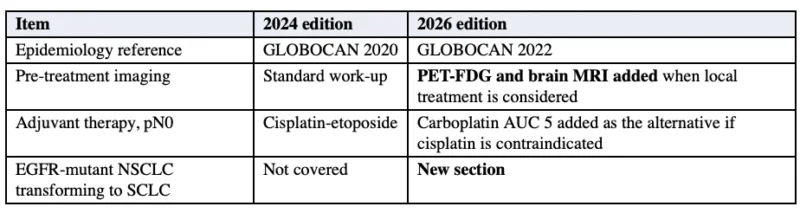
The first-line extensive-stage standard (carboplatin-etoposide-atezolizumab) and the relapse algorithm are unchanged from the 2024 edition.
The Algerian Context: What the Documents Show
Tobacco is the central issue. The Cancer Dashboard reports that 32% of Algerian men smoke, compared with 0.4% of women, which is reflected in lung cancer being the most common cancer in men but only the eleventh in women. Smoking prevalence was stable between 2005 and 2015, and smoking is twice as common among men aged 18-29 as among men aged 60-69. Tobacco taxation stands at 44% of the retail price, below the WHO best-practice level of 75%. The 2025 National Strategy commits to higher tobacco taxes, a ban on tobacco advertising and promotion, and a national multisectoral tobacco control committee. For Small Cell Lung Cancer, a disease so closely tied to heavy smoking, reducing tobacco use is the main lever for prevention.
Radiotherapy capacity matters more than usual in this disease. Concurrent chemoradiotherapy starting before week 6, PCI, and consolidative thoracic irradiation all depend on radiotherapy access. The Dashboard counts 57 external beam radiotherapy units, against an estimated need of about 98 machines based on IAEA benchmarks. For a disease where delay can cost the window of chemosensitivity, that gap has direct clinical consequences, though neither document quantifies waiting times for SCLC specifically.
Imaging. The 2026 requirement for PET-FDG and brain MRI before local treatment relies on equipment that the Dashboard places at 8 PET scanners and 2 PET-MRI units nationally, with PET density in the lowest bracket (0-1 per million) of the IAEA database. The National Strategy aims for 1 PET-CT per million inhabitants in the medium term.
What the chapter does not cover. The 2026 chapter lists no consolidation immunotherapy after chemoradiotherapy in limited-stage disease, and its second-line section remains entirely cytotoxic. Newer agents, such as tarlatamab, were the subject of an industry symposium at the 22nd JICC in Constantine in October, but they are not part of the chapter. Whether and when they will be, and how they would be accessed, is a question for future updates and for the registration lag documented in the Dashboard (16 of 60 new cancer medicines approved by the EMA between 2015 and 2020, or 27%, were approved in Algeria as of March 2025).
As a rough orientation only: if Small Cell Lung Cancer represents about 15% of the 5,040 lung cancer cases estimated in 2022, that would suggest on the order of several hundred patients per year. This is an extrapolation from two separate sources, not a registry figure.
Clinical Perspective
The SCLC chapter reflects a disease where the treatment algorithm is short and the margin for error is small. Staging is streamlined, chemoradiotherapy for limited disease has strict timing, first-line extensive-stage treatment now includes immunotherapy, and the relapse decision hinges on a single interval of three months. The 2026 update adds precision (pre-treatment PET-FDG and brain MRI) and one new clinical scenario, histologic transformation of EGFR-mutant NSCLC, rather than a change in the core treatment strategy.
For Algerian clinicians, the practical priorities are timing and access: getting concurrent radiotherapy started within the window, securing brain imaging both at baseline and in follow-up, re-biopsying patients who progress on EGFR TKIs, and counseling every patient on smoking cessation.
Clinical Pearls
- In limited-stage disease, thoracic radiotherapy should start before the 6th week of chemotherapy, concurrent with cisplatin-etoposide.
- PCI (25 Gy in 10 fractions) is standard only after a complete response, in patients under 70 with PS 0-2.
- First-line extensive-stage standard is carboplatin-etoposide-atezolizumab, then atezolizumab maintenance.
- Relapse after more than 3 months: rechallenge with platinum-etoposide. Relapse within 3 months: CAV, or carboplatin-paclitaxel or irinotecan as options.
- A patient progressing on an EGFR TKI may have transformed to SCLC (3-14%): re-biopsy, and do not assume immunotherapy adds benefit (no data in this setting).
- Brain imaging is part of both baseline work-up and follow-up (every 3-4 months in year one).
FAQ
Is SCLC treated with surgery in Algeria?
Rarely. Surgery is limited to early-stage disease (T1-T2 N0 M0), followed by adjuvant chemotherapy or chemoradiotherapy depending on nodal status. Most patients present with locally advanced or extensive disease, for which chemoradiotherapy or systemic therapy is the standard.
Who should receive prophylactic cranial irradiation?
The standard is patients under 70 with PS 0-2 and a complete response after treatment of limited-stage disease. In partial responders, PCI is an option to discuss rather than a standard.
Does every patient with extensive-stage SCLC get immunotherapy?
The standard for PS 0-1 is carboplatin-etoposide-atezolizumab. Chemotherapy alone (cisplatin-etoposide, or carboplatin-etoposide) remains a listed option, and for PS 2-3 patients whose poor status is due to the disease, the guideline asks for an RCP discussion of an identical approach.
What happens when SCLC relapses?
The interval since the last platinum cycle decides. After more than 3 months, platinum-etoposide is reintroduced; within 3 months, CAV is the standard, with carboplatin-paclitaxel or irinotecan as options.
Is there a role for PET-FDG in follow-up?
No, except when a contrast agent cannot be used. PET-FDG belongs to the pre-treatment work-up when local treatment is considered, while surveillance relies on clinical examination, thoracic CT, and brain MRI or CT.
Are newer drugs for SCLC part of the Algerian guideline?
Not in the 2026 chapter. The second-line section lists only cytotoxic options, and no consolidation immunotherapy is listed for limited-stage disease. Availability of newer agents in Algeria should be checked locally.