Picture a woman I’ll call Diane. She smoked through her twenties and thirties and quit at 41. For the next two decades she did nearly everything her doctors asked.
At 62 she develops a cough that won’t go away. By the time anyone orders a scan, the cancer has spread. Diane was never offered a low-dose CT. Nobody forgot. She had simply quit too long ago to qualify.
November is Lung Cancer Awareness Month, and Diane’s story is the one I want us to be aware of. Not because it’s rare, but because our system is built to produce it.
The screening gap is a design problem
Lung cancer is still the leading cause of cancer death in the US, with about 125,000 deaths in 2025.1 Treatment has moved fast: targeted therapies and immunotherapy have changed what a diagnosis means for many people. Detection is improving too.
But look at who actually gets screened.
- Uptake: In 2024, only 18.7% of eligible US adults were up to date with lung cancer screening.2 That’s roughly 1 in 5.
- Eligibility: A Northwestern study of 997 people diagnosed between 2018 and 2023 found that only 35% met current USPSTF screening criteria.3 About two in three people with lung cancer would never have been invited.
Put those together and the program reaches a fraction of a fraction. If you work in a cancer center, most of the lung cancer patients you meet this year were never on the screening map at all.
Eligibility is built on pack-years and quit dates. Smoking history is a strong risk signal, so that was a reasonable place to start. But the people it misses are disproportionately women, Asian patients, never- smokers, and former smokers like Diane who quit more than 15 years ago.3 In other words, people who did the hard thing.
Blood tests won’t close this on their own. In September, an FDA advisory panel backed Galleri, the most advanced multi-cancer blood test. But Galleri is not yet FDA-approved, and its 142,000-person NHS trial missed its primary endpoint of reducing late-stage cancers. 4,5 The advisers also said explicitly that people should keep up established screening, including lung CT.4
Better detection technology doesn’t fix an invitation list that leaves most patients off it.
Where lifestyle enters the story
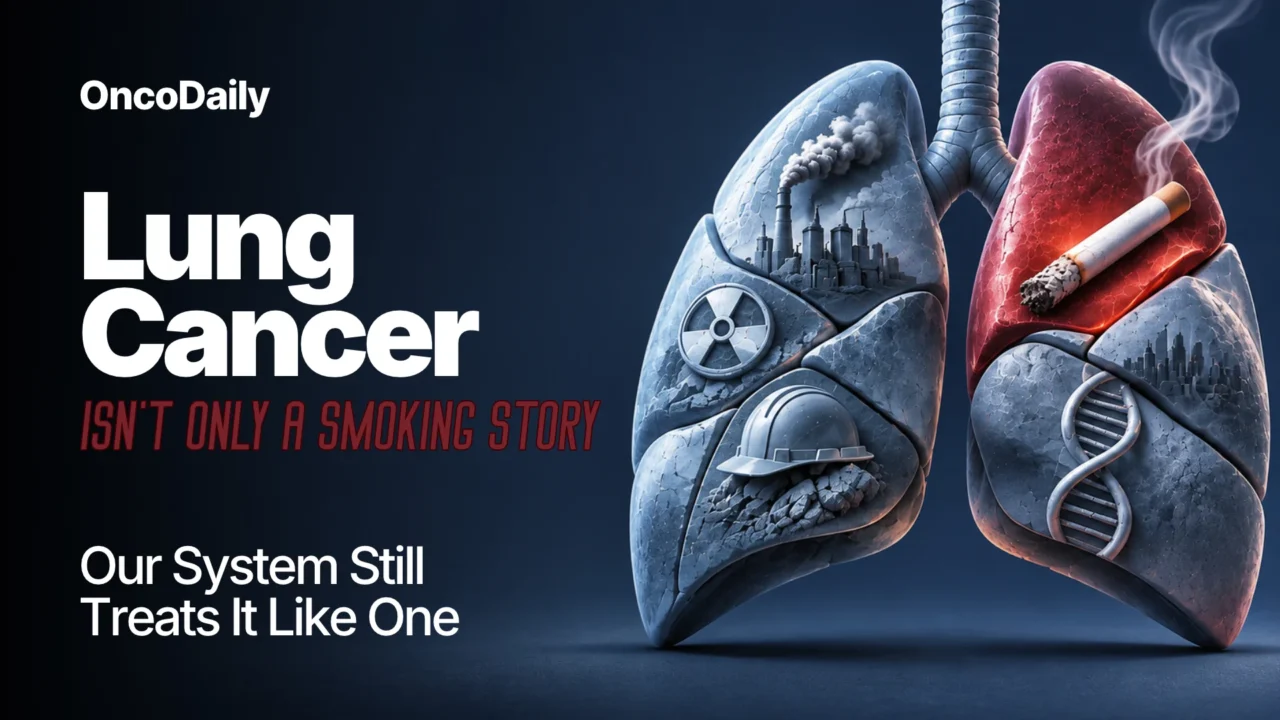
Smoking is still the leading cause of lung cancer, and nothing here changes that. But if our thinking stops at smoking, we miss two groups: the people who never smoked, and the people who did, for whom smoking isn’t the only thing shaping risk.
Two studies are worth knowing.
Diet: ultra-processed food. A 2025 Thorax analysis followed 101,732 US adults aged 55 to 74 for about 12 years. 6 The quarter who ate the most ultra-processed food had a 41% higher risk of lung cancer than the quarter who ate the least. That was 37% higher for non-small cell and 44% higher for small cell, after adjusting for smoking and overall diet quality.6
That’s a relative number. Across the whole cohort, about 1.7% of participants developed lung cancer over 12 years (1,706 people). 6 A 41% relative increase on a base that size matters at population scale. It does not mean an individual’s risk jumps by 41 points.
The limits are real:
- Diet was measured once, by questionnaire, at the start.
- The cohort was mostly white and well educated.
- Adjusting for smoking can’t fully capture how much and how long people smoked, so some leftover confounding is plausible.
- The proposed mechanism (inflammation, compounds created during processing, whole foods pushed off the plate) is the authors’ hypothesis, not something they measured.
The authors themselves say the finding needs confirming in other populations.6
Movement: lifetime inactivity. A Roswell Park study compared 660 people with lung cancer to 1,335 cancer-free controls. 7 People who reported no regular weekly recreational activity across adulthood had 2.23 times the odds of lung cancer. Among never-smokers the figure was about 3 times, though with a wide confidence interval (1.33 to 6.78) because the group was small. Among the patients, inactivity was associated with 40% higher lung cancer mortality.7
The catch is the design. This is a hospital-based case-control study that relied on people’s recall of their lifelong activity. Lung cancer often causes breathlessness and fatigue long before diagnosis, so some of that "inactivity" may be the disease showing up early rather than a cause of it. That reverse-causation trap is sharper in lung cancer than almost anywhere else.
What else we need to know.
These studies are not saying that ultra-processed food or inactivity causes lung cancer. They show associations, and one comes from a design we would normally treat cautiously and almost with a brush of true importance.
It’s also important to reiterate that a healthy lifestyle doesn’t replace screening, quitting, or treatment. It doesn’t.
What’s important to notice is that both studies point the same way as a much larger body of evidence on activity and diet across cancer risk and survivorship.8,9 And lung cancer is where we’ve done the least to act on that evidence.
A disappointing gap: who gets offered support
Here is where I think our field is failing people. In my experience, people with smoking histories are often not offered exercise or nutrition support at all. The unspoken assumption is that they ‘won’t be interested.”
That’s an assumption, not data, and it does two kinds of harm. It withholds support, and it reinforces the stigma that already keeps people away from screening.
These are the people carrying the most risk. Once they quit, they’re also the people the screening system is most likely to lose. A conversation about movement and food is a point of contact that eligibility rules can’t close.
What this means for how we build
These steps rest on existing guidelines,8,9 not on either study above:
- Ask about activity and diet at every lung cancer touchpoint (screening visit, diagnosis,
survivorship), whatever the person’s smoking history. - Stop treating smoking status as a measure of motivation. Offer the same support you’d offer anyone.
- Back broader screening criteria. In the Northwestern data, widening eligibility to ages 40 to 85, 10 or more pack-years, and no limit on years since quitting would have caught 62% of cases instead of 35%.3
- Measure who you reach. If your lifestyle program has almost no lung cancer patients in it, that’s a referral pattern, not a lack of interest.
Lifestyle isn’t a footnote to tobacco. It’s a conversation we’ve left out of lung cancer care, and the people we leave out are the ones who need it most.
References
- American Cancer Society. Latest ACS lung cancer data: only 1 in 5 eligible adults in U.S. screened for lung cancer; 62,000 lives over 5 years could be saved if all eligible screened. American Cancer Society Pressroom. Published November 19, 2025.
- Bandi P, et al. Lung cancer deaths prevented and life-years gained from lung cancer screening: current vs 100% screening uptake. JAMA. Published online November 19, 2025.
- Yang HC, Chang A, Visa M, Yoon A, Abbott A, Ma Y, et al. Age-based screening for lung cancer surveillance in the US. JAMA Netw Open. 2025;8(11):e2546222.
- Galleri moves closer to FDA decision as evidence on multi-cancer blood testing evolves. Patient Worthy. Published October 4, 2026.
- GRAIL, Inc. GRAIL reports fourth quarter and full year 2025 financial results. Published February 19, 2026.
- Wang K, Zhao J, Yang D, et al. Association between ultra-processed food consumption and lung cancer risk: a population-based cohort study. Thorax. Published online July 29, 2025.
- Cannioto R, Etter JL, LaMonte MJ, Ray AD, Joseph JM, Al Qassim E, et al. Lifetime physical inactivity is associated with lung cancer risk and mortality. Cancer Treat Res Commun. 2018;14:37-45.
- Rock CL, Thomson C, Gansler T, et al. American Cancer Society guideline for diet and physical activity for cancer prevention. CA Cancer J Clin. 2020;70(4):245-271.
- World Cancer Research Fund/American Institute for Cancer Research. Diet, Nutrition, Physical Activity and Cancer: A Global Perspective. Continuous Update Project Expert Report 2018.
by Sami Mansfield, Founder of Cancer Wellness for Life
Sami Mansfield, is the Founder of Cancer Wellness for Life and an exercise oncology and lifestyle medicine consultant. With over 20 years of experience in oncology wellness, she specializes in developing evidence-based exercise and lifestyle programmes for cancer patients and survivors. She is a contributing author to the American Society of Clinical Oncology (ASCO) guidelines on exercise, diet, and weight management during cancer treatment and serves as Chair of the Cancer Member Interest Group at the American College of Lifestyle Medicine.
You can also explore:
Sami Mansfield: GLP-1s After Breast Cancer: A Prescription Is Not a Survivorship Plan