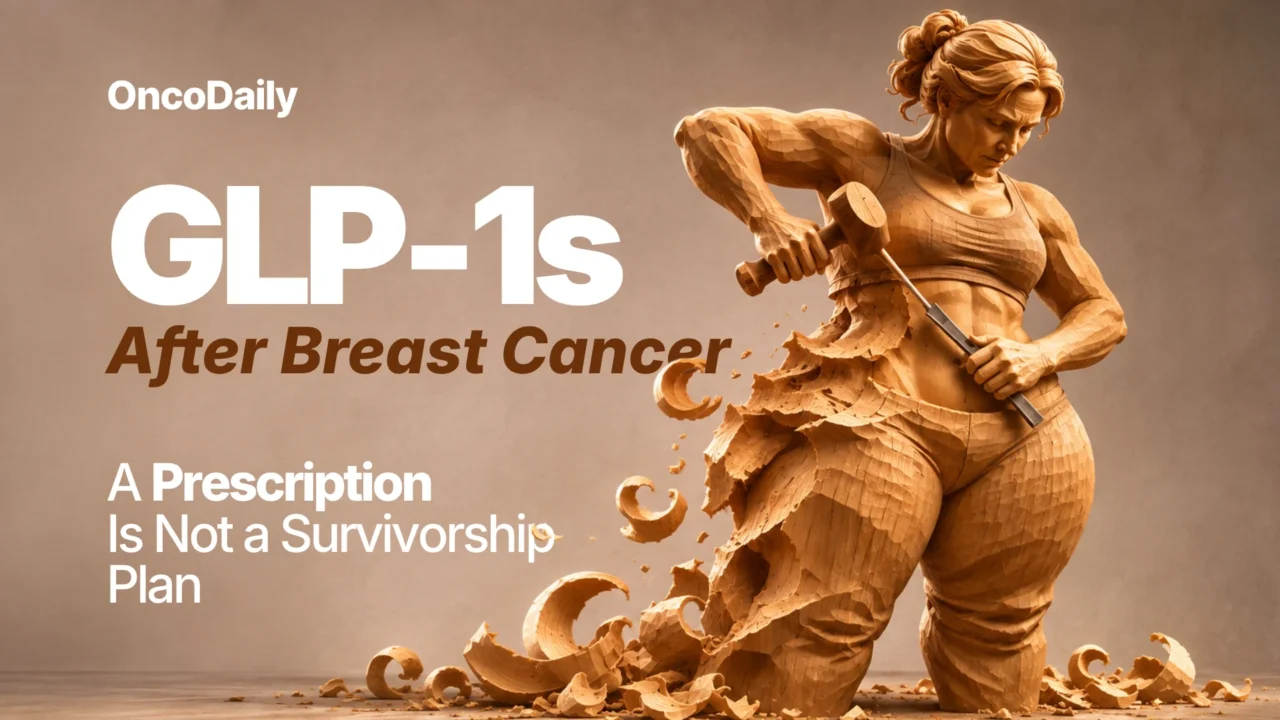
We tell women after breast cancer to manage their weight. Then, when they find something that helps, we ask whether they should be taking it. We should also ask what support we failed to provide before they went looking.
Picture the visit. She’s 54. Three years past treatment for stage II breast cancer. As the appointment wraps up, she lowers her voice: “I started a GLP-1 through telehealth. Is that okay?”
That question deserves more than approval or alarm. It deserves a plan.
Because a prescription can change her appetite. It cannot coordinate her oncology follow-up, build her strength program, or help her figure out what to eat when very little sounds appealing. Someone has to connect those pieces. Too often, that someone is the patient.
We made weight her responsibility. Who owns the support?
Consider what we ask women to manage after breast cancer. Appointments. Medications. Symptoms. Work. Relationships. A body that may feel unfamiliar. Then comes another instruction: manage your weight. “Eat healthy and exercise” sounds reasonable in an exam room. At home, it leaves a lot unanswered. What can I eat when I’m nauseated? How do I lift weights when my joints hurt? Who can help me get stronger without making me afraid of getting injured?
A woman seeking medication may be responding to a gap in care that has been there for years. She deserves a conversation without a test of whether she tried hard enough first.
A smaller body is an incomplete definition of success.
GLP-1 therapies can be valuable tools for people with appropriate clinical indications. But when the scale becomes our main measure of progress, we leave an essential question unanswered: What is happening to her ability to live? Can she carry her groceries? Get off the floor? Climb the stairs without organizing her day around them?
In the SURMOUNT-1 body composition substudy, approximately 75% of the weight lost with tirzepatide was fat mass and 25% was lean mass. The proportions were similar in the placebo group. These were adults with overweight or obesity-not a breast cancer survivorship trial.1
That finding needs precision. Lean mass is not interchangeable with skeletal muscle. A change on a body composition scan does not automatically mean lost strength or drug-induced frailty.2 But it gives us a reason to look beyond pounds.
If we celebrate weight loss without checking function, we are grading an outcome we have only partly measured.
“Eat more protein” is still an unfinished plan.
Protein matters. So does giving muscle a reason to stay. The 2025 joint advisory from lifestyle medicine, nutrition, and obesity organizations calls for adequate nutrition, resistance training, and assessment of strength and function alongside GLP-1 treatment.2 The practical question is whether patients can actually access that care. A strength-training recommendation needs a starting point. A nutrition recommendation needs to account for symptoms, appetite, preferences, and budget. A referral needs somewhere to go. Otherwise, we have given the patient another assignment and called it support.
Long-term medication is not failure. Neither is needing help when it stops.
We also need to stop treating medication discontinuation as an administrative detail. Cost changes. Coverage changes. Side effects become intolerable. Patients reconsider their options.
In the STEP 1 extension, participants regained about two-thirds of their previous weight loss during the year after semaglutide and structured lifestyle support were withdrawn.3
That does not prove better habits would have prevented regain. It does make “call us if you stop” look like a thin maintenance strategy.
Lifestyle medicine should never become a promise that sufficiently disciplined patients can graduate from medication. It should help people protect their health while taking it-and help them navigate what happens if treatment changes.
What should happen in the next follow-up visit?
We do not need every oncologist to become an obesity specialist, dietitian, and exercise professional. We do need someone to own the handoff.
The joint advisory provides a foundation: assess nutrition, strength, function, lifestyle, and barriers to care.2 Here is how that could translate into a survivorship visit.
Ask without judgment.
“Are you taking anything for weight management, including medication prescribed outside this clinic?” Make disclosure routine. Patients should not have to work up the courage to mention it.
Establish more than a starting weight.
Assess intake, symptoms, strength, and daily function. A grip-strength test or chair-rise assessment can help establish a baseline when appropriate.2 Then decide when to reassess.
Turn advice into something she can do.
Connect her with a dietitian who understands oncology and a qualified exercise professional. Build a progressive resistance program around her current capacity, with clinical input where needed. Account for treatment effects, bone health, neuropathy, pain, and other limitations.
Ask whether the plan fits her life.
Can she afford the medication and enough nourishing food? Can she reach the referred service? What is happening to her energy, mood, relationships, and confidence?
Plan for continuity.
Who manages side effects? Who follows up if strength declines? Who helps when coverage ends? These questions belong at the beginning of care.
Lifestyle support needs a delivery system.
ASCO recommends aerobic and resistance exercise during active treatment with curative intent.4 The GLP-1 joint advisory places nutrition and physical activity within comprehensive obesity care.2 We have recommendations.
The harder work is building access, arranging follow-up, and making sure a referral becomes care.
For a cancer center, that means naming the responsible clinician, identifying accessible services, and checking whether the patient reached them. For a health system, it means treating strength and nutrition support as services to deliver-not boxes to mark “discussed.”
The woman in that exam room came with a medication question. Our answer should show her that someone is paying attention to the whole person taking it.
Before we congratulate her on the pounds lost, can we tell her who is helping her protect her strength?
References
- Look M, Dunn JP, Kushner RF, et al. Body composition changes during weight reduction with tirzepatide in the SURMOUNT-1 study of adults with obesity or overweight. Diabetes Obes Metab. 2025;27(5):2720- 2729.
- Mozaffarian D, Agarwal M, Aggarwal M, et al. Nutritional priorities to support GLP-1 therapy for obesity: a joint advisory from the American College of Lifestyle Medicine, the American Society for Nutrition, the Obesity Medicine Association, and The Obesity Society. Obesity (Silver Spring). 2025;33(8):1475-1503.
- Wilding JPH, Batterham RL, Davies M, et al. Weight regain and cardiometabolic effects after withdrawal of semaglutide: the STEP 1 trial extension. Diabetes Obes Metab. 2022;24(8):1553-1564.
- Ligibel JA, Bohlke K, May AM, et al. Exercise, diet, and weight management during cancer treatment: ASCO guideline. J Clin Oncol. 2022;40(22):2491-2507.
by Sami Mansfield, Founder of Cancer Wellness for Life
Sami Mansfield, is the Founder of Cancer Wellness for Life and an exercise oncology and lifestyle medicine consultant. With over 20 years of experience in oncology wellness, she specializes in developing evidence-based exercise and lifestyle programmes for cancer patients and survivors. She is a contributing author to the American Society of Clinical Oncology (ASCO) guidelines on exercise, diet, and weight management during cancer treatment and serves as Chair of the Cancer Member Interest Group at the American College of Lifestyle Medicine.
You may also find this interesting:
GLP-1 and Cancer: What Research Shows About Cancer Risk and Prevention

Sami Mansfield: ESMO 2026 and Lifestyle Medicine – Missing, or Opportunity?