What defines chronic myelomonocytic leukemia (CMML)?
Persistent monocytosis is the clinical hallmark, but it explains only part of the disease. CMML combines dysplastic and proliferative features, evolves through sequential genetic events, and develops within an aging, inflammatory hematopoietic system. Together, these interconnected processes have complicated disease classification, challenged risk stratification, and most importantly, therapeutic progress.
What Is CMML? The Janus Face of Myeloid Neoplasia
Chronic myelomonocytic leukemia is a rare hematologic malignancy at the intersection of myelodysplastic and myeloproliferative neoplasms. It shares features with them and follows a clinical course that often differs from both.
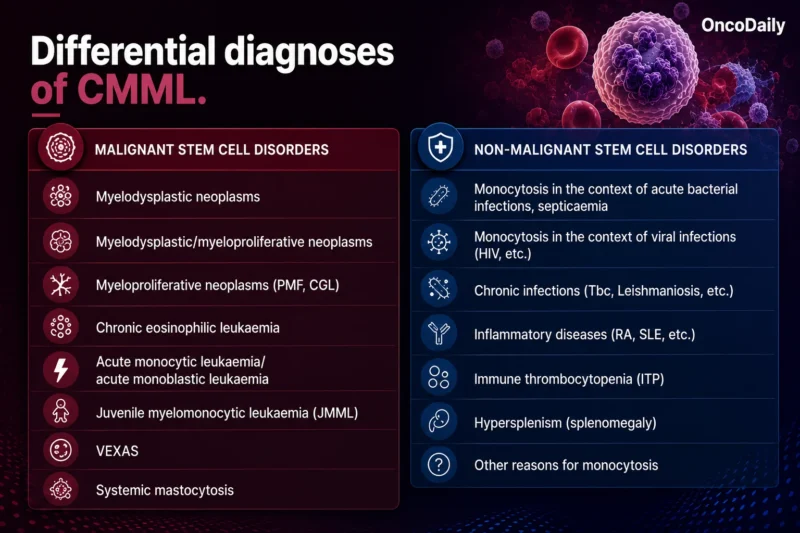
CMML is characterized by the presence of sustained (>3 months) peripheral blood monocytosis (≥0.5 x 10/L, monocytes ≥10% of white blood cell count), with bone marrow dysplasia or a clonal cytogenetic/molecular abnormality, and fewer than 20% blasts in the peripheral blood and bone marrow. The disease carries an inherent risk to transform to acute myeloid leukemia (15-20% over 3-5 years).
The incidence of CMML is less than 1/100 000/year. Precise epidemiological data are not really available, since epidemiological studies have mostly recorded CMML as MDS. Assessing the incidence becomes even more difficult when we consider it may be preceded by a clonal monocytosis of unclear significance.
Dysplastic and Proliferative Variants
For good reason, both the WHO and the ICC continue to distinguish CMML as dysplastic or proliferative.
Patients with the proliferative variant have fewer cytopenias, higher white blood cell and absolute monocyte counts, greater organomegaly, more pronounced lymphadenopathy, more frequent extramedullary manifestations involving the skin and kidneys, and more frequent autoimmune phenomena, including thrombocytopenia and neuropathies. They also have more severe constitutional symptoms, such as night sweats, low-grade fever, and signs of catabolism, characteristic of proliferative neoplasms such as primary myelofibrosis.
Patients with the dysplastic type of CMML generally suffer from haematopoietic insufficiency and are thus more reminiscent of a myelodysplastic syndrome. The diagnosis of CMML should eventually specify:
- CMML proliferative vs dysplastic type
- CMML type I vs II, according to peripheral and medullary blast counts
In the realm of CMML, a small group of patients present with ring sideroblasts and/or SF3B1 mutation. These patients formally have a CMML diagnosis but resemble the MDS/MPN SF3B1 category and have a much better prognosis.
Some develop therapy-related CMML following prior cytotoxic treatment, characterized by a poor risk type. Rarely, CMML can present with leukemia cutis as an initial manifestation, or directly present with blast transformation (CMML-BT).
CMML Begins Long Before Diagnosis: Genetics and Inflammaging
Among all hematologic neoplasms, CMML displays the most striking skewing towards older age with a median age at presentation of >70 years. The disease develops gradually as hematopoietic stem cells accumulate somatic mutations throughout life. Driver mutations commonly occur in leukemia genes, and lead to clonal hematopoiesis of indeterminate potential (CHIP) when such mutations can be detected at a variant allele fraction of ≥2%, in the absence of blood count abnormalities.
CHIP often represents the earliest stage of CMML development. Many of the same mutations that define CMML are frequently detected years before the disease becomes clinically apparent.
Aging also changes the hematopoietic system itself. Oxidative stress, telomere shortening, and reduced stem cell diversity gradually narrow the pool of hematopoietic stem cells, leaving blood production to a limited number of dominant clones.
The interplay between mutated stem cells, the aging bone marrow, inflammatory signaling, and immune regulation has an equally important role in determining whether clonal hematopoiesis remains stable or evolves into overt CMML.
Genes with an epigenetic function are often affected early, followed by genes involved in RNA splicing, and, later on, by genes participating in signalling pathways. It is well known that the presence of ASXL1 and DNMT3A mutations and absence of TET2 mutations negatively impact overall survival. Mutations that alter the RAS signaling pathway are associated with myeloproliferation and transformation into acute leukaemia.
The Role of Inflammation
Inflammation is not simply a consequence, it is part of the disease itself. In CMML, classical monocytes, the main inflammatory subset of circulating monocytes (CD14⁺CD16⁻), account for more than 95% of all blood monocytes. These cells produce an abnormal cytokine environment which has measurable consequences. Patients with CMML have an increased risk of cardiovascular events, and approximately one in five develops a systemic inflammatory or autoimmune disorder.
Experimental models have shown that TET2-deficient stem cells gain a proliferative advantage in inflammatory environments, particularly in the presence of TNF-α. These cells expand more rapidly, produce higher levels of inflammatory cytokines, including IL-6, and become more resistant to apoptosis.
Mutations in spliceosome genes can activate NF-κB signaling, providing another mechanism that amplifies inflammation. Together they establish a self-reinforcing cycle in which mutant clones generate inflammatory signals, while the inflammatory microenvironment promotes clonal expansion and disease persistence.
Diagnosing CMML
The diagnosis of CMML is based on cytomorphological evaluation of the peripheral blood and bone marrow aspirate, together with histopathological examination of a bone marrow trephine biopsy using immunohistochemistry. The percentage of blasts, including promonocytes, should be assessed in both peripheral blood and bone marrow.
Flow cytometry is used to characterize the type of monocytes in blood and marrow. FISH can help to detect aberrant karyotypes. Screening for somatic mutations is very important because it can provide evidence of clonality in >95% of cases and also provides prognostic information. Increasing LDH values may indicate disease progression, even prior to the development of cytopenia, increasing WBCs or detection of blasts in the peripheral blood.
Risk Stratification
Whenever possible, prognostic assessment should be performed using the CMML-specific Prognostic Scoring System Molecular (CPSSmol) or, at minimum, the CMML-specific Prognostic Scoring System (CPSS). The CPSS stratifies patients according to CMML subtype (dysplastic vs. proliferative), bone marrow blast percentage, transfusion dependence, and cytogenetic abnormalities.
The CPSSmol further incorporates RUNX1, NRAS, ASXL1, and SETBP1 mutations and lowers the bone marrow blast cutoff from 10% to 5%, improving identification of high-risk patients. The prognostic impact of variant allele frequency has not yet been systematically evaluated in CMML.
AI-Based Prognostic Model
More recently, an international working group developed the International CMML Prognostic Scoring System (iCPSS) using artificial intelligence to identify molecular clusters associated with prognosis. The model combines clinical, hematologic, morphologic, cytogenetic, and molecular variables, including 10 recurrent somatic mutations, and stratifies patients into five distinct risk groups. Compared with the CPSSmol, approximately 40% of patients are reassigned to a different risk category. The iCPSS has also been validated in patients undergoing allogeneic hematopoietic stem cell transplantation, where it predicts post-transplant overall survival.
Navigating CMML Treatment
Unlike many hematologic malignancies, CMML has no single standard treatment pathway. Management is guided by the dominant clinical problem, disease risk, patient fitness, and transplant eligibility. For some, the priority is anemia or other cytopenias. For others, it is proliferative disease, inflammation, organ involvement, or an increasing risk of transformation to acute myeloid leukemia.
Observation
Not every patient requires immediate treatment. A watch-and-wait approach is appropriate for low-risk patients with stable blood counts, no significant cytopenias, minimal symptoms, and no evidence of disease progression. Approximately 10% of patients never require treatment for their underlying bone marrow disorder.
Control of Proliferative Disease
Patients with proliferative CMML often require cytoreductive therapy. Hydroxyurea remains the standard first-line treatment for controlling blood counts and reducing symptomatic splenomegaly, while JAK inhibition has shown activity in some patients with marked inflammatory symptoms. Corticosteroids may benefit selected patients with autoimmune or inflammatory manifestations.
Improving Hematopoiesis
Patients with predominantly dysplastic CMML are often managed similarly to those with myelodysplastic syndromes. Treatment focuses on improving ineffective hematopoiesis and reducing transfusion requirements. Erythropoiesis-stimulating agents may benefit selected patients with symptomatic anemia and low endogenous erythropoietin levels, whereas red blood cell transfusions are important supportive therapy. Severe neutropenia and thrombocytopenia are managed primarily with supportive care.
Hypomethylating Agents
Hypomethylating agents remain the only approved disease-modifying therapy for CMML. Azacitidine is approved in Europe, while both azacitidine and decitabine are approved in the United States. These agents improve blood counts and delay disease progression but overall response rates are <50%, with true remissions being achieved in <20% patients. Skin infiltration and other extramedullary manifestations may also respond to HMAs, though they frequently indicate more advanced disease.
Their benefit appears greatest in patients with predominantly dysplastic disease. Early azacitidine studies relied on the International Prognostic Scoring System (IPSS), which is now recognized as suboptimal for risk stratification in CMML. The phase III DACOTA trial compared decitabine with hydroxyurea in high-risk proliferative CMML and demonstrated higher response rates with decitabine but no significant improvement in overall survival.
The Only Curative Option: Allogeneic Transplantation
Allogeneic hematopoietic stem cell transplantation is the only treatment with curative potential, but due to older age and comorbidities, this approach is unfeasible for the majority of patients.
Transplantation is generally considered for patients with intermediate- or high-risk disease who are medically fit. Recent studies suggest that individualized transplant timing improves survival, emphasizing the importance of referral before advanced disease progression or prolonged treatment failure.
Several factors influence transplant outcomes, including disease burden at transplantation, management of splenomegaly, donor selection, and conditioning intensity. More recent studies, largely derived from patients with MDS, indicate that younger matched unrelated donors may provide better disease-free survival and lower relapse rates than older matched sibling donors.
Beyond Current Therapies
Investigational therapies directed against GM-CSF signaling, LILRB4, RAS pathway activation, and other recurrent molecular abnormalities aim to interfere with clonal expansion rather than simply control blood counts. Biomarker-guided treatment strategies and oral combination regimens are also under investigation.
Targeting the RAS Pathway
KRAS G12C, KRAS G12D, and pan-RAS inhibitors are currently under clinical evaluation in proliferative CMML. RAS-directed therapies may also help overcome resistance associated with RAS activation in patients treated with FLT3, IDH1/2, or BCL2 inhibitors.
The PI3K pathway, a major downstream effector of RAS signaling, represents another target. In preclinical studies, the PI3Kδ inhibitor umbralisib and the JAK1/2 inhibitor ruxolitinib demonstrated synergistic activity in primary CMML samples. This combination is currently being evaluated in a phase I trial.
Transformation of CMML to Acute Myeloid Leukemia
The acquisition of additional somatic driver mutations or expansion of pre-existing mutant clones alone do not account for all cases of leukemic transformation. Growing evidence suggests that alterations beyond the protein-coding genome also contribute. Clarifying these interactions may help identify patients t risk of disease progression who require treatment escalation or referral for allogeneic SCT.
In patients who transformed to acute leukaemia, the therapeutic dilemma is even higher. Not only the probability of response to HMA or HMA plus venetoclax is lower but also the probability of a long‐lasting remission after allogeneic transplantation is poorer, with a median overall survival of less than nine months.
Rare occurrences of CMML BT to blastic plasmacytoid dendritic cell neoplasms (BPDCN) secondary to specific molecular and copy number alterations have been documented, indicative of common clonal origins.
Looking Ahead
Historically, CMML patients were enrolled in MDS trials despite important biological differences. More recently, CMML has been recognized as a distinct entity for clinical trial design, and most contemporary MDS studies now exclude these patients. Nevertheless, dedicated CMML trials remain relatively few, whenever possible, eligible patients should be considered for enrollment.
Continued integration of molecular profiling into clinical practice, together with the development of targeted therapies, biomarker-guided treatment strategies, and optimized patient selection for transplantation, is expected to improve outcomes beyond current standards of care.
(Marando L. et al., Patnaik M.M. et al., 2024, Nachtkamp K. et al., Addinsell H.M. et al., Gagelmann N. et al., Lauzon-Young C. et al., 2025)
You can also read: Blastic Plasmacytoid Dendritic Cell Neoplasm (BPDCN): Current Perspectives on an Ultra-Rare Malignancy
Written by Susanna Mikayelyan, MD
FAQ
Is chronic myelomonocytic leukemia (CMML) considered a type of leukemia or a bone marrow disorder?
CMML is both. It is classified as a leukemia because it arises from abnormal blood-forming cells and can progress to acute myeloid leukemia (AML). At the same time, it behaves like a chronic bone marrow disorder, sharing features with both myelodysplastic (MDS) and myeloproliferative neoplasms (MPNs), making it biologically distinct from either group alone.
Can someone live for years without knowing they have CMML?
Yes. CMML often develops slowly, and some individuals have persistent monocytosis or clonal hematopoiesis for years before the disease becomes clinically apparent. In early stages, the condition may be discovered incidentally during routine blood tests rather than because of symptoms.
Why does CMML mainly affect older adults?
Aging increases the accumulation of genetic mutations in hematopoietic stem cells while also altering the bone marrow environment through chronic low-grade inflammation and reduced stem cell diversity. These age-related changes create conditions that favor the emergence and expansion of abnormal clones, explaining why CMML is predominantly diagnosed after the age of 70.
Can lifestyle changes prevent CMML from progressing?
There is currently no evidence that diet, exercise, or lifestyle modifications can prevent CMML progression. Nevertheless, maintaining cardiovascular health, controlling other medical conditions, preventing infections, and attending regular follow-up visits can help improve overall health and support treatment outcomes.
What is the only curative treatment for CMML?
Allogeneic hematopoietic stem cell transplantation (allo-HSCT) is currently the only treatment with curative potential for CMML. However, because it carries significant risks and CMML mainly affects older adults, transplantation is reserved for carefully selected patients who are medically fit.
What FDA-approved treatments are available for CMML?
The U.S. FDA has approved two hypomethylating agents, azacitidine and decitabine, for the treatment of CMML. These therapies can improve blood counts, reduce symptoms, and delay disease progression, but they are not curative. Allogeneic hematopoietic stem cell transplantation remains the only treatment with curative potential.