At the 2026 ASCO Annual Meeting, Nicholas D. James, PhD, MBBS, FRCP presented preliminary results from RAD-IO, a trial exploring durvalumab with chemoradiotherapy in patients with localized muscle-invasive bladder cancer.
For patients treated with bladder-preserving chemoradiotherapy, the role of immune checkpoint inhibitors is still being defined. RAD-IO evaluated durvalumab given before, during, and for 12 months after chemoradiotherapy with radiotherapy, 5-fluorouracil, and mitomycin C. The trial was funded by AstraZeneca.

Read more about Radiotherapy for Bladder Cancer on OncoDaily.
Study Design
RAD-IO is a multi-stage, partially randomized trial in localized muscle-invasive bladder cancer. It compared chemoradiotherapy with durvalumab against chemoradiotherapy alone before transitioning to a single-arm durvalumab plus chemoradiotherapy design after feasibility and safety criteria were met.
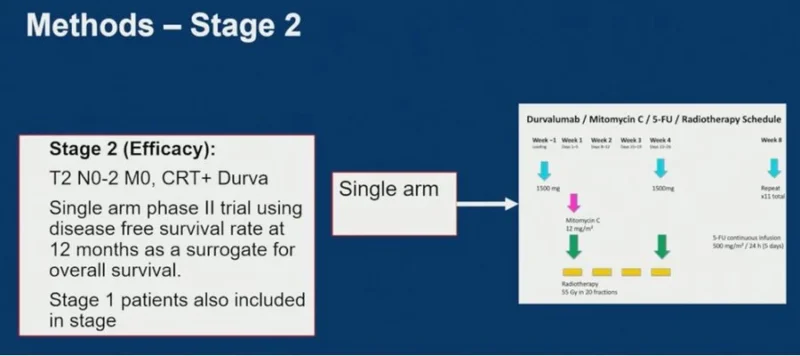
In the reported stage 2 efficacy cohort, eligible patients had T2 N0–2 M0 muscle-invasive bladder cancer.. Neoadjuvant chemotherapy was delivered as standard of care before trial therapy when patients were fit enough to receive it. The analysis reported the primary endpoint of 1-year disease-free survival among evaluable patients treated with durvalumab plus chemoradiotherapy. Progression-free survival, disease-free survival, overall survival, and safety outcomes were also assessed.
Key Findings
All data were preliminary. The median age was 70 years, and 41 patients, or 74.5%, received neoadjuvant chemotherapy. Among the 54 patients who started treatment, all completed the planned radiotherapy course of 55 Gy in 20 fractions. No patients stopped radiotherapy early, and 87% had no radiotherapy extension or delay.
Chemoradiotherapy delivery was highly feasible. All treated patients received mitomycin C and week 1 5-fluorouracil, while 78% received week 4 5-fluorouracil. Durvalumab completion was lower: 33 of 54 treated patients, or 61%, completed planned durvalumab treatment, while 21 of 54 patients, or 39%, discontinued durvalumab early.
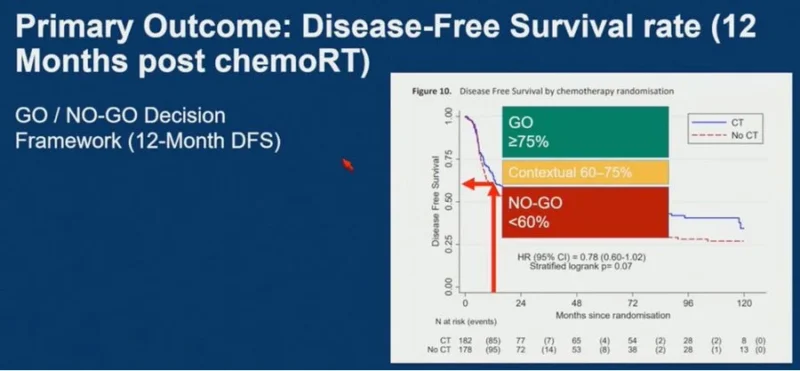
At 12 months after chemoradiotherapy, 40 of 50 evaluable patients were disease-free, corresponding to a 12-month disease-free survival rate of 80%, with a 95% confidence interval of 67% to 89%. This met the prespecified “go” criterion for further evaluation, defined as a 12-month disease-free survival rate of at least 75%. Secondary progression-free survival findings were also encouraging, with 83.6% of patients having no progression-free survival event at 12 months. Distant metastasis was reported in 9.1% of patients, and local disease was reported in 7.3%.
Safety
The safety analysis reported 35 serious adverse events. These included 17 unrelated serious adverse events, 12 serious adverse reactions, and 6 suspected unexpected serious adverse reactions.
Ten serious adverse events were related to durvalumab, 3 were related to chemotherapy, and 5 were related to both durvalumab and chemotherapy. Three serious adverse events led to treatment discontinuation, including 2 involving 5-fluorouracil and 1 involving durvalumab. A total of 168 adverse events of special interest were reported. The most common were diarrhea, rash, and increased creatinine. Investigators also reported 41 additional grade 3 or higher adverse events.
Expert Highlights on Social Media
highlighted the relevance of RAD-IO for bladder preservation in muscle-invasive bladder cancer, while also emphasizing the need for longer follow-up and randomized data:
“Bladder preservation in MIBC remains one of the most important curative-intent questions in GU oncology.
The key question here:
Can immune checkpoint inhibition be safely integrated with standard chemoradiotherapy?
RAD-IO evaluated durvalumab with bladder-directed chemoradiotherapy using 5-FU + mitomycin C in patients with muscle-invasive bladder cancer.Study design
Stage 2 efficacy cohort:
• T2 N0–2 M0 MIBC
• CRT + durvalumab
• Single-arm phase II design
• Primary endpoint: 12-month disease-free survival
• 12-month DFS used as a surrogate for longer-term outcomeThe trial used a clear GO / NO-GO framework:
- GO: DFS ≥75%
- Contextual: 60–75%
- NO-GO: <60%
Feasibility
Among 54 participants who started treatment:
• 100% received full radiotherapy: 55 Gy in 20 fractions
• 0 stopped radiotherapy early
• 87% had no RT extension or delay
• 100% received mitomycin C
• 100% received week 1 5-FU
• 78% received week 4 5-FU
• 61% completed planned durvalumab
• 39% discontinued durvalumab early
So, delivery of CRT was highly feasible, while immunotherapy completion was more challenging.Primary outcome
At 12 months post-CRT:• DFS rate: 80%
• 40/50 disease-free
• 95% CI: 0.67–0.89This crossed the prespecified GO threshold.
Secondary outcome PFS was consistent:
• No event: 83.6%
• Distant metastasis: 9.1%
• Local disease: 7.3%My take
RAD-IO provides an encouraging signal that durvalumab can be integrated with bladder-preserving chemoradiotherapy in MIBC.
But this is not yet practice-changing.
Important caveats:
- single-arm phase II design
- 12-month endpoint
- no randomized comparator
- durability and late toxicity remain critical
- completion of durvalumab was imperfect
Still, this is a very relevant direction.
In an era where systemic therapy is becoming increasingly active in urothelial cancer, bladder preservation strategies need to evolve too.
The next question is not simply whether CRT works.
It is:
- Which patients are best suited for bladder preservation?
- Can immunotherapy improve cure without compromising safety?
- How should we integrate systemic therapy, radiation, surgery, and patient preference?
For MIBC, the future may be a more personalized curative-intent pathway — not one-size-fits-all cystectomy versus CRT.”
Javier Puente also commented on the early efficacy signal from RAD-IO, highlighting progression-free and event-free outcomes:
“RAD-IO: Adding durva to bladder-preserving chemoRT yielded encouraging early efficacy in MIBC More than 75% of patients remained progression-free at 12 m, while 83.6% were event-free. With only 5 distant metastatic events and 4 local recurrences reported”
Rashid K. Sayyid also highlighted RAD-IO on X, emphasizing the trial’s efficacy threshold and feasibility findings:
“RAD-IO: Multi-stage trial of Durva + CRT (5-FU/MMC) for MIBC bladder preservation (n=100)
12-mo DFS: 80% (95% CI 67-89%) → met prespecified GO criterion (≥75%)
- Distant mets: 9%; local recurrence: 7%
- 96% alive at analysis
- No pts required cystectomy during follow-up
- RT completion: 100%
- Full-course Durva completed in 61%
- Chemo discontinued early in 22%
- No dominant toxicity signal; AEs consistent with CRT + Durva
Adding neoadjuvant, concurrent, and adjuvant Durva to bladder-preservation CRT was feasible, tolerable, and met efficacy thresholds for further evaluation”
Conclusion
Preliminary results from RAD-IO suggest that adding neoadjuvant, synchronous, and adjuvant durvalumab to bladder-preserving chemoradiotherapy is feasible and tolerable in patients with localized muscle-invasive bladder cancer.
Adverse events were reported to be in line with the expected safety profiles of the component therapies, including chemoradiation and durvalumab. The efficacy data met the prespecified criteria for further evaluation when benchmarked against previous studies.
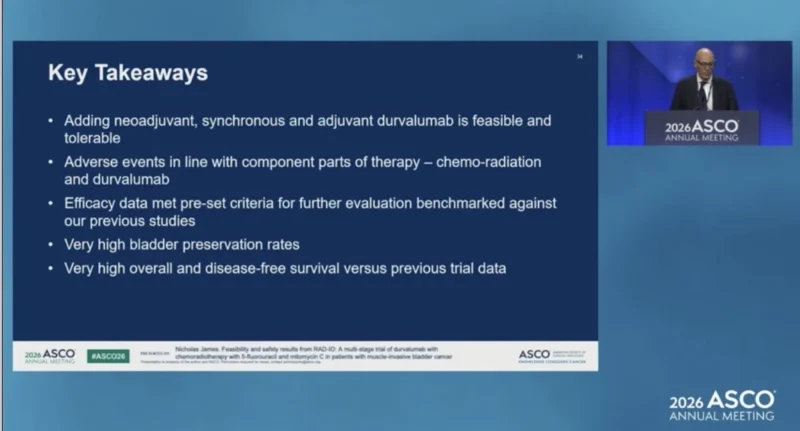
The study also reported high bladder preservation rates and encouraging overall and disease-free survival compared with previous trial data. These findings support further investigation of durvalumab plus chemoradiotherapy as a bladder-preserving treatment approach in muscle-invasive bladder cancer.
The full abstract is available on the official ASCO website.
You can read about RAMPART at ASCO 2026 on OncoDaily.