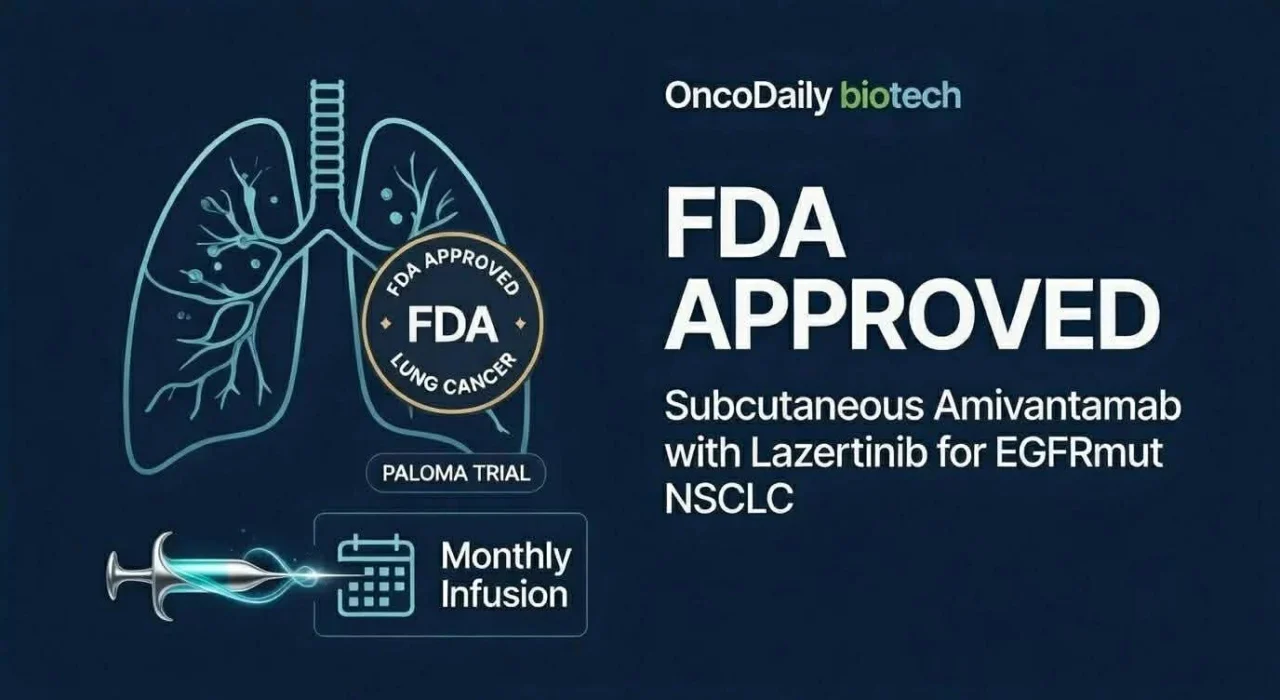
On December 17, 2025, the U.S. Food and Drug Administration (FDA) approved RYBREVANT FASPRO™ (amivantamab and hyaluronidase-lpuj), establishing the first and only subcutaneous (SC) formulation of amivantamab for patients with epidermal growth factor receptor (EGFR)–mutated non-small cell lung cancer (NSCLC). The approval applied across all FDA-approved indications of RYBREVANT® (amivantamab-vmjw), enabling a transition from prolonged intravenous (IV) infusion to rapid SC administration.
Building on that milestone, on February 17, 2026, the FDA approved a new simplified once-monthly dosing schedule for RYBREVANT FASPRO when administered in combination with oral lazertinib (LAZCLUZE®) for first-line treatment of EGFR-mutated advanced NSCLC. Patients may transition to monthly dosing as early as Week 5, with clinical outcomes consistent with the previously approved bi-weekly SC regimen.
Together, these approvals represent a meaningful evolution in both delivery and scheduling of EGFR- and MET-targeted antibody therapy—reducing administration burden while maintaining efficacy and safety in a population where long-term disease control remains challenging.
Mechanistic Background: Amivantamab and Subcutaneous Optimization
Amivantamab is a fully human bispecific IgG1 antibody targeting both EGFR and MET, with immune effector–directing activity. By inhibiting EGFR signaling, blocking MET-mediated resistance pathways, and engaging immune cell cytotoxicity, amivantamab addresses multiple mechanisms of tumor growth and therapeutic escape in EGFR-mutated NSCLC.
RYBREVANT FASPRO combines amivantamab with recombinant human hyaluronidase PH20 (rHuPH20) using Halozyme’s ENHANZE® delivery technology, enabling dispersion of large biologic volumes in subcutaneous tissue while achieving systemic exposure comparable to IV infusion. This formulation reduces administration time from hours to approximately five minutes and significantly lowers infusion-related burden.
The newly approved monthly schedule maintains pharmacokinetic comparability to bi-weekly SC and historical IV dosing, with consistent mean plasma concentrations and exposure parameters.Clinical Evidence Supporting Subcutaneous and Monthly Approval
The initial SC approval was supported by the Phase 3 PALOMA-3 trial (NCT05388669), which enrolled 418 patients with EGFR-mutated advanced or metastatic NSCLC following progression on osimertinib and platinum-based chemotherapy.
The trial met both co-primary pharmacokinetic endpoints, demonstrating comparable amivantamab exposure between SC and IV formulations based on Ctrough and AUC parameters.
Importantly, clinical outcomes favored the SC formulation. Patients receiving SC amivantamab plus lazertinib demonstrated:
- Improved progression-free survival
- Longer duration of response
- A statistically significant overall survival advantage
Median overall survival favored the SC arm (HR 0.62; 95% CI, 0.42–0.92; nominal P = 0.02), with 12-month survival rates of 65% versus 51% for SC versus IV administration.

Read About Lung Cancer Remission Rate on OncoDaily
PALOMA-3: Pharmacokinetics and Survival Outcomes
The Phase 3 PALOMA-3 trial randomized patients with EGFR-mutated advanced NSCLC to subcutaneous RYBREVANT FASPRO (amivantamab and hyaluronidase-lpuj) plus lazertinib versus intravenous amivantamab-based regimens plus lazertinib. The study met both co-primary pharmacokinetic endpoints, demonstrating steady-state Ctrough and AUC within predefined equivalence margins between SC and IV formulations. Clinically, subcutaneous therapy reduced the risk of death by 38% (HR 0.62; nominal P=0.02), with 12-month overall survival rates of 65% versus 51% for SC versus IV.
Objective response rate was 30% with SC versus 33% with IV (meeting noninferiority criteria), and median progression-free survival was 6.1 months versus 4.3 months, respectively. Infusion-related reactions were markedly lower with SC administration (13% vs 66%), and venous thromboembolism occurred in 9% versus 14% of patients. Administration time decreased from approximately 5 hours with IV infusion to about 5 minutes with SC injection, with day-one chair time reduced from 6.5 hours to 23 minutes. Patient convenience was reported by 85% in the SC arm versus 52% in the IV arm, and 81% preferred the subcutaneous route.
You Can Also Read PALOMA-3 Trial Update: Subcutaneous Rybrevant FASPRO Plus Lazertinib Versus Intravenous Amivantamab-Based Regimens by OncoDaily
First-Line Survival Context: MARIPOSA
The development of RYBREVANT FASPRO is grounded in the survival benefit demonstrated in the Phase 3 MARIPOSA trial (NCT04487080), which evaluated amivantamab plus lazertinib versus osimertinib in the first-line treatment of advanced NSCLC harboring EGFR exon 19 deletions or L858R mutations.
At a median follow-up of 37.8 months, the combination demonstrated a statistically significant overall survival benefit:
- HR 0.75 (95% CI, 0.61–0.92; P = 0.0048)
- Median OS not reached in the combination arm
- Median OS 36.7 months with osimertinib
Resistance analyses presented at IASLC WCLC 2025 showed lower rates of MET amplification and secondary EGFR mutations such as C797S in patients receiving dual EGFR-MET blockade, reinforcing the biologic rationale for combination therapy.
The availability of a simplified monthly subcutaneous injection now delivers this survival-backed regimen in its most streamlined form.
Read About MARIPOSA Trial on OncoDaily
RYBREVANT FASPRO (Amivantamab) Safety Profile and Key Considerations
The safety profile of monthly SC dosing is comparable to bi-weekly SC administration and consistent with known effects of EGFR/MET inhibition.
Key toxicities associated with RYBREVANT FASPRO (amivantamab and hyaluronidase-lpuj) include interstitial lung disease (ILD)/pneumonitis, venous thromboembolism particularly when administered in combination with lazertinib severe dermatologic reactions, ocular toxicity, and embryo-fetal toxicity. Prophylactic anticoagulation is recommended during the initial months of combination therapy to mitigate the risk of venous thromboembolic events.
Importantly, administration-related reactions are significantly reduced with SC delivery compared with IV infusion, representing a clinically meaningful improvement in tolerability and infusion-center workflow.
Regulatory and Clinical Implications
The approval of RYBREVANT FASPRO initially transformed delivery from multi-hour IV infusion to a five-minute subcutaneous injection. The February 2026 approval of once-monthly dosing further simplifies care, reducing clinic visits while maintaining pharmacokinetic exposure, efficacy, and safety.
In the evolving landscape of EGFR-mutated NSCLC where resistance inevitably develops despite third-generation TKIs the combination of amivantamab and lazertinib represents a survival-backed, resistance-targeting strategy. The availability of a monthly SC regimen strengthens its real-world feasibility and long-term treatment sustainability.
Rather than altering the therapeutic target, this evolution refines how it is delivered—optimizing convenience without compromising clinical outcomes. For patients facing a chronic, life-limiting disease, fewer clinic visits and shorter administration times may meaningfully enhance quality of life while preserving therapeutic intensity.
You Can Also Read Non-Small Cell Lung Cancer: Causes, Symptoms, Diagnosis, Treatment Options, and Latest 2025 Advances in Targeted and Immunotherapy by OncoDaily
FAQ
What is the FDA approval date for RYBREVANT FASPRO subcutaneous formulation?
RYBREVANT FASPRO (amivantamab and hyaluronidase-lpuj) gained FDA approval on December 17, 2025, as the first SC version of amivantamab for all EGFR-mutated NSCLC indications, replacing prolonged IV infusions with ~5-minute SC dosing. Source.
When was monthly dosing approved for RYBREVANT FASPRO with lazertinib?
On February 17, 2026, the FDA approved once-monthly SC dosing for RYBREVANT FASPRO + oral lazertinib (LAZCLUZE) in first-line EGFR-mutated advanced NSCLC, starting as early as Week 5, with PK/efficacy matching bi-weekly SC. Source.
What is amivantamab and how does RYBREVANT FASPRO work?
Amivantamab is a bispecific IgG1 antibody targeting EGFR and MET, blocking signaling, resistance pathways, and engaging immune cytotoxicity in EGFR-mutated NSCLC. FASPRO adds rHuPH20 (ENHANZE tech) for SC dispersion, matching IV exposure in ~5 minutes.
What were the PALOMA-3 trial results for RYBREVANT FASPRO SC vs IV?
In Phase 3 PALOMA-3 (NCT05388669; n=418 post-osimertinib/platinum), SC + lazertinib beat IV on PFS, DoR, and OS (HR 0.62, 95% CI 0.42–0.92, P=0.02; 12-mo OS 65% vs 51%). PK endpoints (Ctrough/AUC) were met.
Does PALOMA-2 support monthly RYBREVANT FASPRO dosing?
Yes, WCLC 2025 data from PALOMA-2 showed monthly SC + lazertinib in 1L EGFR-NSCLC had high ORR, consistent PK/safety (ARRs 12%, VTE 13% w/anticoag), and 8% discontinuation rate—no new signals vs bi-weekly SC.
What is the MARIPOSA trial OS benefit for amivantamab + lazertinib?
Phase 3 MARIPOSA (NCT04487080) showed amivantamab + lazertinib vs osimertinib in 1L EGFR exon 19del/L858R NSCLC: OS HR 0.75 (95% CI 0.61–0.92, P=0.0048) at 37.8 mo follow-up; median OS not reached vs 36.7 mo. Lower MET amp/C797S resistance.
What are the main side effects of RYBREVANT FASPRO?
Key risks: ILD/pneumonitis, VTE (esp. w/lazertinib; prophylax w/anticoag), severe skin reactions, ocular toxicity, embryo-fetal harm. SC reduces ARRs (12-13%) vs IV (66%); VTE 13% w/anticoag vs 38% historical IV.
How does RYBREVANT FASPRO monthly dosing compare to bi-weekly?
Monthly SC maintains PK exposure, efficacy, and safety like bi-weekly SC (ARRs 12% vs 13%), with fewer visits. VTE aligned (13% vs 11% w/anticoag); no new signals, 8% TRAE discontinuations.
What technology enables subcutaneous RYBREVANT FASPRO?
Halozyme’s ENHANZE with rHuPH20 disperses large volumes SC, achieving IV-comparable exposure. Cuts admin time to 5 min from hours, lowers ARRs, and supports monthly scheduling.
Why is monthly RYBREVANT FASPRO important for EGFR-mutated NSCLC?
It simplifies 1L therapy (SC + lazertinib) backed by MARIPOSA survival (HR 0.75), targets EGFR/MET resistance post-TKIs, reduces burden (fewer visits), and improves QoL while preserving outcomes in a hard-to-control disease.