
Key takeaways
- BTK inhibitor resistance is becoming increasingly complex, with mutations such as C481, T474, and L528W affecting treatment response.
- Pirtobrutinib offers an effective option after covalent BTK inhibitor failure, improving progression-free survival compared with conventional treatment options.
- The BRUIN CLL-322 trial showed promising results, with the pirtobrutinib triplet reducing the risk of progression or death by approximately 45%.
- BTK degraders are emerging as promising therapies, showing activity in heavily pretreated CLL, including patients resistant to existing BTK inhibitors.
- Treatment sequencing depends on prior therapy and resistance patterns, with venetoclax, pirtobrutinib, CAR-T therapy, and clinical trials offering options for different patient groups.
At LeukO 2026: Global Virtual Congress on Leukemias, organized by OncoDaily, Henrique Nunes Pêcego, Hematologist and Bone Marrow Transplantation Coordinator at the State Institute of Hematology (HEMORIO) in Rio de Janeiro, Brazil, discussed the evolving treatment landscape for chronic lymphocytic leukemia (CLL) in patients who develop resistance to Bruton tyrosine kinase (BTK) inhibitors.
His presentation examined the molecular mechanisms driving treatment resistance, the growing role of noncovalent BTK inhibition, promising results from the phase III BRUIN CLL-322 trial, and emerging therapies designed to overcome resistance to existing targeted drugs.
The arrival of BTK inhibitors such as ibrutinib, acalabrutinib, and zanubrutinib has substantially improved CLL outcomes. However, as more patients receive these agents over prolonged periods, clinicians are increasingly encountering disease that progresses despite treatment.
For these patients, selecting the next therapy has become a complex clinical decision. Previous drug exposure, the reason treatment was discontinued, acquired resistance mutations, and the availability of subsequent therapies all influence the choice.
Pêcego emphasized that understanding how a patient’s disease became resistant is now essential to planning what comes next.
Understanding BTK Inhibitor Resistance: Not All Mutations Behave the Same
BTK inhibitors interfere with signaling pathways that support the survival and proliferation of malignant B cells.
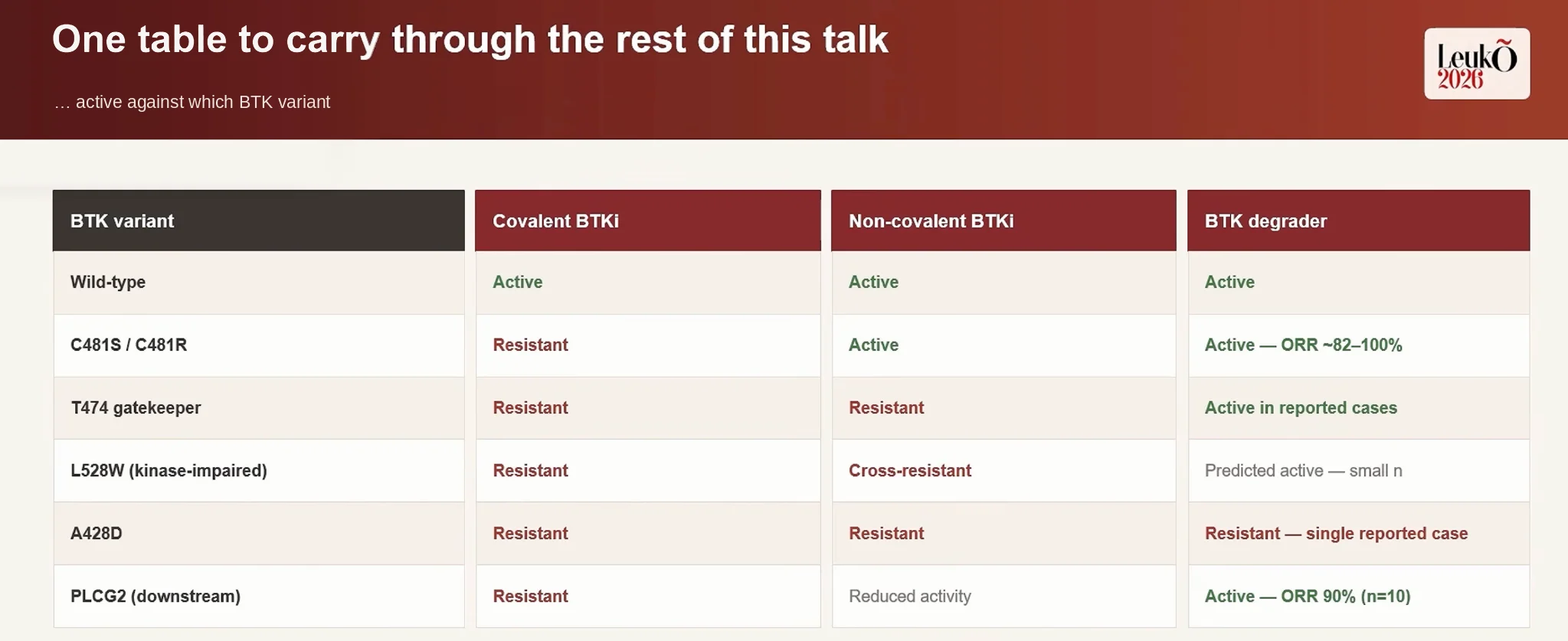
First- and second-generation covalent BTK inhibitors, including ibrutinib, acalabrutinib, and zanubrutinib, bind irreversibly to the BTK protein, particularly at the C481 residue.
Although these drugs can produce prolonged disease control, resistant leukemia clones may emerge during continuous treatment.
Pêcego explained that acquired alterations involving BTK and PLCG2 account for a substantial proportion of resistance in patients progressing on covalent BTK inhibitors.
These molecular changes are clinically important because different mutations can affect sensitivity to subsequent treatments.
The best-known mechanism involves mutations at BTK C481.
These alterations interfere with the binding of covalent inhibitors, allowing BTK signaling to continue despite treatment.
However, the kinase may remain susceptible to noncovalent inhibitors such as pirtobrutinib, which do not require binding at C481.
Other mutations create different problems.
T474 gatekeeper mutations can reduce sensitivity to both covalent and noncovalent BTK inhibitors, while L528W is associated with resistance to several agents, including pirtobrutinib.
Mutations in PLCG2, a protein involved in signaling downstream of BTK, may allow malignant cells to bypass BTK inhibition.
Pêcego discussed molecular analyses from the ELEVATE-RR and ALPINE studies, illustrating how different BTK inhibitors can select for different resistance patterns.
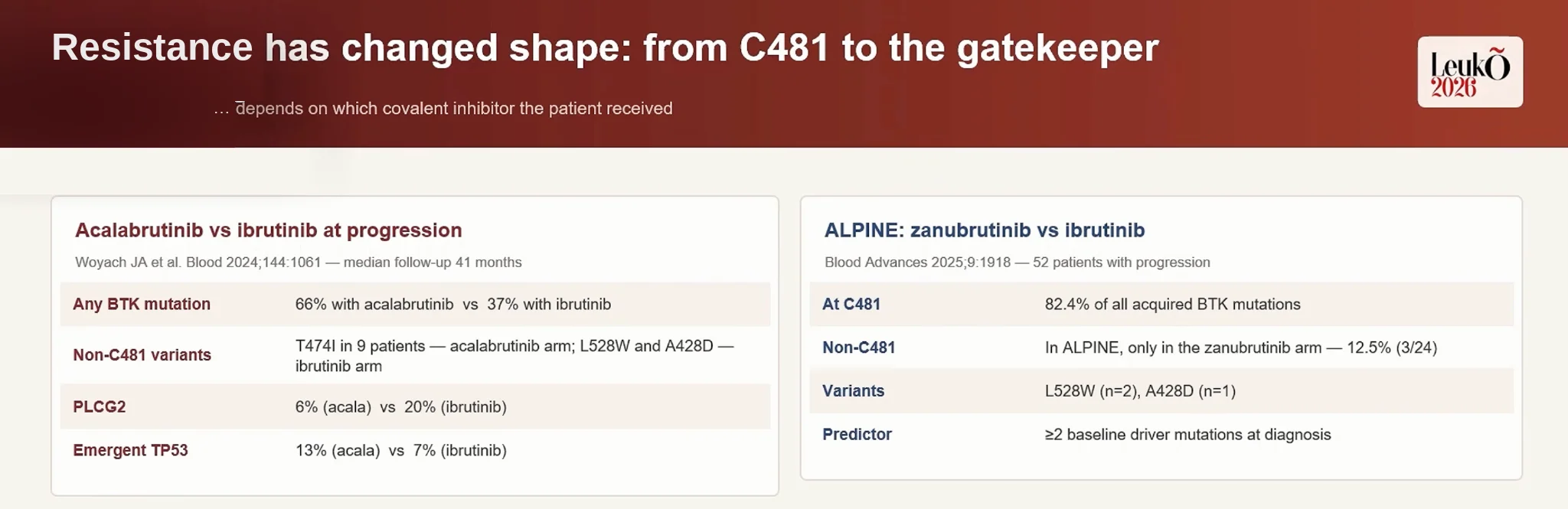
The clinical significance is that resistance to one BTK inhibitor does not necessarily predict an identical response to another.
It also explains the growing interest in therapies that eliminate the BTK protein rather than simply inhibiting its activity.
Double-Exposed and Double-Refractory CLL Are Different Clinical Situations
Before discussing the newer treatments, Pêcego stressed a distinction that can substantially change the prognosis and management of patients with previously treated CLL.
A patient who has received both a BTK inhibitor and venetoclax is not necessarily refractory to both treatments.
Some patients discontinue BTK inhibitors because of adverse effects such as atrial fibrillation, bleeding, or intolerance.
Others complete a planned course of venetoclax-based therapy and remain in remission before experiencing relapse.
These patients may still have disease that is sensitive to one or both therapeutic mechanisms.
By contrast, double-refractory CLL refers to disease that has progressed despite treatment with both a covalent BTK inhibitor and a BCL-2 inhibitor such as venetoclax.
Pêcego reviewed a cohort of 95 previously treated patients demonstrating the prognostic importance of this distinction.
Among patients refractory to both treatment classes, median overall survival was approximately 2.2 years.
For patients who had received both classes but were not refractory to them, median overall survival had not been reached during the reported follow-up.
The double-refractory group also required subsequent therapy urgently, with a median time to next treatment of approximately 0.6 months.
These findings demonstrate why treatment history must include more than the names of previously administered medicines.
For Pêcego, the first question when evaluating a patient after BTK inhibitor therapy is whether the previous treatment was discontinued because of progression or intolerance.
That information may be as important as the molecular testing results when deciding how to sequence subsequent therapy.
Pirtobrutinib: Randomized Evidence After Covalent BTK Inhibitor Failure
One of the most important developments in relapsed/refractory CLL has been the introduction of pirtobrutinib, a noncovalent BTK inhibitor.
Unlike ibrutinib, acalabrutinib, and zanubrutinib, pirtobrutinib does not depend on irreversible binding to C481.
This allows it to retain activity against many CLL clones carrying mutations that cause resistance to covalent BTK inhibition.
Pêcego focused on the phase III BRUIN CLL-321 trial, published in the Journal of Clinical Oncology in 2025.
The study enrolled 238 patients with relapsed/refractory CLL or small lymphocytic lymphoma (SLL) who had previously received a covalent BTK inhibitor.
Participants were randomized to receive pirtobrutinib or the investigator’s choice of idelalisib plus rituximab or bendamustine plus rituximab.
The trial demonstrated a statistically significant improvement in progression-free survival.
Median progression-free survival was 14.0 months with pirtobrutinib, compared with 8.7 months in the control group, corresponding to a hazard ratio of 0.54.
The median time to next treatment was also longer with pirtobrutinib, at approximately 24 months versus 11 months.
These results supported the role of noncovalent BTK inhibition after covalent BTK inhibitor exposure.
In December 2025, the FDA granted traditional approval to pirtobrutinib for adults with relapsed/refractory CLL or SLL previously treated with a covalent BTK inhibitor.
Pêcego also emphasized the limitations of the randomized findings.
An overall survival benefit had not been established, and interpretation was complicated by crossover from the control arm to pirtobrutinib after disease progression.
Previous venetoclax exposure also appeared to influence outcomes, with shorter intervals before subsequent treatment among patients who had already received BCL-2 inhibition.
The study therefore established an important treatment option without resolving how best to sequence every available targeted therapy.
Why Pirtobrutinib Monotherapy Is Not Enough for Every Patient
Pêcego also reviewed longer-term findings from the original phase I/II BRUIN study.
In an analysis involving 282 patients and a median follow-up of approximately 46 months, the overall response rate reached 81.6%.
However, the complete response rate was only 3.9%, while median progression-free survival was approximately 18.7 months.
The distinction between overall response and complete remission is important.
Pirtobrutinib can achieve meaningful disease control in heavily pretreated patients, but deep remissions remain uncommon with monotherapy.
Previous venetoclax exposure was again associated with shorter progression-free survival.
Patients who had not previously received a BCL-2 inhibitor had a median progression-free survival of approximately 22 months, compared with 16 months among those previously exposed.
Pêcego noted that activity remained encouraging in several high-risk molecular populations, including patients with del(17p) or TP53 alterations.
However, the relatively short duration of disease control and low rate of complete remission provide a rationale for investigating more effective combinations.
How CLL Develops Resistance to Pirtobrutinib
Pirtobrutinib can overcome many C481-associated resistance mechanisms, but its activity is not permanent.
Pêcego discussed molecular sequencing studies examining how resistant clones evolve during treatment.
In one analysis involving paired baseline and progression samples from 88 patients, 68% acquired at least one new mutation, while 44% developed a new BTK alteration.
Among the emerging mutations were T474 gatekeeper variants and L528W, which can reduce sensitivity to noncovalent BTK inhibition.
The molecular findings revealed an important pattern.
In many patients, previously dominant C481-mutated clones declined during pirtobrutinib treatment, while other resistant clones expanded.
This suggests that pirtobrutinib can successfully suppress leukemia populations resistant to covalent inhibitors, but treatment may subsequently select for different mechanisms of resistance.
Some of these mutations were already detectable at very low levels before treatment.
Consequently, a negative result on routine next-generation sequencing does not guarantee that resistant subclones are absent or that progression will not occur.
These findings are encouraging further investigation into more sensitive molecular monitoring and therapies capable of overcoming multiple BTK resistance mechanisms.
BRUIN CLL-322: A Major Advance in Fixed-Duration CLL Treatment
One of the central studies in Pêcego’s presentation was the phase III BRUIN CLL-322 trial, presented at the European Hematology Association (EHA) Congress in June 2026 and subsequently published in The Lancet.
The study investigated whether adding pirtobrutinib to an established fixed-duration regimen could improve outcomes for patients with previously treated CLL.
The trial enrolled 639 patients, randomized between:
- Pirtobrutinib, venetoclax, and rituximab (PVR).
- Venetoclax and rituximab (VR).
- Approximately 80% of participants had previously received a covalent BTK inhibitor.
Importantly, patients previously treated with venetoclax or another BCL-2 inhibitor were excluded, meaning the results cannot be directly generalized to venetoclax-exposed or double-refractory disease.
Treatment was designed to be time-limited, with a planned duration of approximately two years.
The trial met its primary endpoint.
Median progression-free survival was not reached with the pirtobrutinib triplet, compared with 39.7 months with venetoclax and rituximab alone.
The hazard ratio was 0.547, corresponding to an approximately 45% reduction in the relative risk of disease progression or death.
The benefit was also reflected in two-year progression-free survival, which was approximately 87% with the triplet versus 72% with the doublet.
For Pêcego, the results represented a significant development in the use of noncovalent BTK inhibition after prior CLL treatment.
Deeper Remissions, Not Simply More Responses
An especially interesting finding from BRUIN CLL-322 was the difference between overall response rates and the depth of those responses.
The overall response rate was 88.5% with the triplet versus 83.3% with venetoclax and rituximab, a difference that was not statistically significant.
However, among patients with evaluable peripheral blood samples at the end of treatment, rates of undetectable measurable residual disease (MRD) were substantially higher with the addition of pirtobrutinib.
At a sensitivity level of one cancer cell in 10,000 cells:
- 86.3% of evaluable patients in the triplet group achieved undetectable MRD.
- 60.7% of evaluable patients in the venetoclax–rituximab group achieved undetectable MRD.
These findings suggest that the addition of pirtobrutinib may improve the depth of remission even when conventional response rates appear similar.
MRD is an increasingly important measure in CLL because deeper molecular responses are associated with more prolonged disease control, particularly with fixed-duration treatment.
However, the association between MRD negativity and progression-free survival does not, by itself, prove that MRD clearance fully explains the trial’s survival benefit.
Pêcego emphasized the growing importance of assessing response depth rather than relying exclusively on the proportion of patients achieving a conventional response.
The Benefit Comes With Additional Toxicity
The improved disease control was accompanied by greater treatment-related risks.
Grade 3 or higher infections occurred in approximately 34% of patients receiving the triplet, compared with 23% receiving venetoclax and rituximab.
Severe neutropenia was also more frequent with the triplet.
However, rates of atrial fibrillation were similar between the treatment groups, and discontinuation because of treatment-related adverse events occurred in approximately 5% of patients in each arm.
Overall survival data remained immature.
Pêcego emphasized that the results support a potentially important new treatment strategy, but longer follow-up is needed to establish whether the progression-free survival benefit translates into improved overall survival.
The triplet was also not an established FDA-approved regimen for CLL at the time of his presentation.
Its role in routine practice will depend on subsequent regulatory decisions, guideline updates, and further evaluation of treatment selection and safety.
BTK Degraders: A New Strategy for Overcoming Resistance
After reviewing noncovalent inhibition, Pêcego turned to a different therapeutic approach: BTK protein degradation.
Traditional BTK inhibitors work by binding the protein and interfering with its kinase activity.
However, BTK contributes to cellular signaling through both its enzymatic activity and its structural role in signaling complexes.
Some resistant mutations can interfere with drug binding while preserving the ability of BTK to support leukemia cell survival.
BTK degraders are designed to overcome this limitation by promoting the destruction of the protein itself.
These agents recruit cellular protein-degradation machinery, directing BTK toward proteasomal breakdown.
By removing the protein, degraders may disrupt both its catalytic and noncatalytic signaling functions.
This mechanism is particularly relevant to resistant variants such as L528W, which can retain signaling activity despite reduced kinase function.
Pêcego discussed two investigational BTK degraders that have generated encouraging early clinical results: tacabrutideg and bexobrutideg.
Tacabrutideg: Encouraging Responses in Heavily Pretreated CLL
Tacabrutideg, formerly BGB-16673, is being investigated in the phase I/II CaDAnCe-101 trial.
Pêcego reviewed results involving 67 patients with relapsed/refractory CLL or SLL, many of whom had received multiple previous treatment regimens.
The median number of prior treatment lines was four.
Most patients had previously received a covalent BTK inhibitor, approximately 82% had received venetoclax, and some had already been exposed to pirtobrutinib.
High-risk molecular features, including del(17p) or TP53 alterations, were also common.
Despite this heavily pretreated population, tacabrutideg demonstrated substantial clinical activity.
The overall response rate was 85.1% across evaluated doses, increasing to 94.1% at the 200-mg dose.
Responses were also observed in patients previously exposed to covalent BTK inhibitors, venetoclax, and pirtobrutinib.
These findings suggest that BTK degradation may retain activity after resistance to several established targeted therapies.
However, complete responses remained uncommon, at approximately 3%.
Treatment-related safety also requires careful consideration.
Severe infections were observed in this heavily pretreated population, and infection-related deaths were reported during follow-up.
The patients’ underlying disease, prior therapies, and immune dysfunction may all contribute to these risks.
Although the results demonstrate promising activity, CaDAnCe-101 remains an early-phase, nonrandomized study.
It cannot establish that tacabrutideg is superior to pirtobrutinib or other approved therapies.
Bexobrutideg: Another Approach to BTK Protein Degradation
Pêcego also discussed bexobrutideg, formerly NX-5948, which is being evaluated in patients with relapsed/refractory B-cell malignancies.
In a phase Ia cohort involving 48 patients with CLL or SLL, the overall response rate was approximately 83%.
The reported median progression-free survival was 22.1 months.
Most patients had received several previous treatment lines, and nearly all had prior BTK inhibitor exposure.
Responses were observed across multiple molecular subgroups, including patients harboring BTK C481 mutations.
However, activity appeared lower among patients previously treated with noncovalent BTK inhibitors, suggesting that prior therapy may influence the effectiveness of subsequent degradation-based treatment.
One potentially important feature of bexobrutideg is its ability to penetrate the central nervous system.
The agent has been detected in cerebrospinal fluid, and preliminary clinical observations have described responses involving CNS disease.
This could become relevant for selected patients with difficult-to-treat extranodal involvement, although further research is needed to establish its clinical benefit in this setting.
Bexobrutideg also has a distinct safety profile that includes bruising and other bleeding-related manifestations, alongside cytopenias.
As with tacabrutideg, the available findings come from early-phase studies.
Neither agent has established superiority over approved noncovalent BTK inhibition.
Why Phase III Trials Matter
Pêcego noted that both BTK degraders are progressing into randomized clinical development.
The CaDAnCe-304 trial is comparing tacabrutideg with pirtobrutinib, while DAYBreak CLL-306 is evaluating bexobrutideg against pirtobrutinib.
Another study, CaDAnCe-302, is investigating tacabrutideg against investigator-selected treatment in patients previously exposed to BTK and BCL-2 inhibitors.
Pêcego considered the selection of pirtobrutinib as a comparator particularly meaningful.
It reflects the growing role of noncovalent BTK inhibition in the treatment of patients who have already received covalent inhibitors.
The next question is whether degradation of the BTK protein can provide more durable disease control, overcome additional resistance mechanisms, or improve clinical outcomes compared with the current treatment options.
Until randomized evidence becomes available, BTK degraders remain investigational therapies best accessed through clinical trials.
Beyond BTK: Venetoclax, Cellular Therapy, and Richter Transformation
Although much of the presentation focused on BTK-directed treatment, Pêcego emphasized that subsequent therapy does not always need to target BTK.
For patients whose disease progresses during covalent BTK inhibition and who have not previously received venetoclax, a venetoclax-based regimen remains an important treatment option.
However, the effectiveness of venetoclax after BTK inhibitor failure may depend on why the previous therapy was discontinued and the biology of the progressing disease.
Pêcego discussed real-world findings suggesting that patients who progress on BTK inhibition generally experience less favorable outcomes with subsequent treatment than those who discontinue because of intolerance.
He also noted retrospective evidence associating venetoclax plus obinutuzumab with favorable outcomes in selected post-BTK inhibitor populations.
However, such findings remain observational and cannot establish superiority over other venetoclax combinations without randomized comparisons.
CAR-T Cell Therapy for Double-Exposed CLL
For patients who have received both BTK and BCL-2 inhibitors, cellular therapy represents another potential treatment strategy.
Pêcego reviewed evidence from TRANSCEND CLL 004, which evaluated lisocabtagene maraleucel (liso-cel), a CD19-directed CAR-T cell therapy.
Liso-cel is FDA-approved for eligible patients with relapsed/refractory CLL or SLL who have received at least two prior lines of systemic therapy, including a BTK inhibitor and a BCL-2 inhibitor.
The trial demonstrated clinically meaningful responses in a heavily pretreated population, including complete remissions and prolonged disease control in selected patients.
Pêcego also discussed an analysis comparing liso-cel outcomes with matched real-world patients receiving other treatments.
In that nonrandomized comparison, median overall survival was 33.6 months in the liso-cel group versus 14.8 months in the real-world comparator group.
The findings are encouraging, but differences in patient selection and other potential confounders mean they should not be interpreted as randomized proof of a survival advantage.
For Pêcego, cellular therapy remains particularly interesting because some complete responders appear capable of maintaining prolonged remission.
However, CAR-T treatment is complex, requires specialized infrastructure, and does not benefit every patient.
Richter Transformation Remains Particularly Difficult
Pêcego also addressed Richter transformation, in which CLL develops into a more aggressive lymphoma, most commonly diffuse large B-cell lymphoma.
Treatment outcomes remain poor, and there is no universally effective standard approach for all patients.
He discussed emerging immunotherapy strategies, including bispecific antibodies and combinations with chemotherapy.
Early clinical studies involving agents such as epcoritamab and glofitamab have reported encouraging responses.
However, the populations evaluated have been small, making it difficult to draw conclusions about long-term survival or compare approaches directly.
Another important challenge is the immune dysfunction associated with CLL itself.
Abnormal T-cell function may reduce the effectiveness of therapies that depend on activating the patient’s immune system.
This has encouraged researchers to investigate combinations designed to reduce leukemia burden and improve the conditions for T-cell-directed treatment.
Venetoclax Plus Epcoritamab: The AETHER Trial
One example is the HOVON 165/AETHER trial, which evaluates the combination of venetoclax and epcoritamab in relapsed/refractory CLL or SLL.
Epcoritamab is a bispecific antibody that brings CD3-positive T cells into contact with CD20-expressing malignant B cells.
The study investigates whether reducing leukemia burden with venetoclax before introducing epcoritamab can improve treatment activity.
Pêcego reviewed an interim analysis presented at EHA 2026.
Among patients with evaluable samples, undetectable measurable residual disease (MRD) at a threshold of 0.01% was reported in approximately 88% at cycle 4 and 90% at cycle 6.
These early molecular results were encouraging.
However, the study remains ongoing, and the findings are based on relatively small evaluable patient groups.
Longer follow-up is necessary to determine whether the responses translate into durable remissions, prolonged survival, and an acceptable safety profile.
The trial also illustrates how future CLL treatment may increasingly combine therapies with complementary mechanisms rather than relying on repeated treatment within a single drug class.
The 2026 EHA Guidelines: How Should Treatment Be Sequenced?
Pêcego concluded his presentation by discussing the 2026 European Hematology Association (EHA) Guidelines on the Management of Chronic Lymphocytic Leukemia and Richter Transformation.
The recommendations reflect major changes in CLL treatment, including the increasing preference for targeted therapies over conventional chemoimmunotherapy.
They also emphasize the importance of distinguishing patients who are intolerant of a previous treatment from those whose disease has progressed despite it.
For patients with relapsed/refractory disease, the guidelines support selecting subsequent therapy according to previous exposure, treatment response, patient characteristics, and the presence of resistance.
In patients with double-refractory CLL, pirtobrutinib is a preferred treatment option.
The guidelines also recommend considering allogeneic transplantation for appropriately selected, eligible patients, potentially using pirtobrutinib as a bridge to transplantation.
BTK degraders remain investigational and are not recommended outside clinical trials.
An important limitation is that the guidelines were published before the presentation of BRUIN CLL-322 at EHA 2026.
Consequently, the new randomized triplet findings were not incorporated into that edition.
A Practical Approach After BTK Inhibitor Failure
Drawing on the available evidence, Pêcego outlined how he approaches treatment selection in clinical practice.
His first consideration is why the covalent BTK inhibitor was stopped.
For patients who discontinued treatment because of intolerance rather than progression, switching to another BTK inhibitor or using a fixed-duration venetoclax-based regimen may be appropriate.
If the disease progressed during covalent BTK inhibition and the patient has not previously received venetoclax, a venetoclax-based regimen remains an established option.
Pêcego also considers the fixed-duration pirtobrutinib, venetoclax, and rituximab triplet particularly interesting in this setting, based on BRUIN CLL-322.
However, its use must be distinguished from established guideline recommendations and considered according to availability and regulatory status.
For patients who have progressed after both covalent BTK inhibition and venetoclax, pirtobrutinib provides an evidence-supported option.
Venetoclax retreatment may be considered in selected patients who previously completed fixed-duration therapy and experienced a prolonged treatment-free remission.
For patients whose disease is refractory to covalent BTK inhibitors, venetoclax, and pirtobrutinib, clinical trial enrollment becomes especially important.
Options under investigation include BTK degraders, while CAR-T cell therapy and allogeneic transplantation may be considered according to treatment history, patient fitness, eligibility, and access.
Throughout this process, Pêcego emphasized the need to distinguish established evidence from emerging approaches and to consider clinical trial availability whenever possible.
The Future of CLL Treatment After BTK Inhibitor Resistance
The treatment landscape for relapsed/refractory CLL is changing rapidly.
Pirtobrutinib has provided an effective noncovalent BTK inhibitor option after covalent BTK inhibitor exposure, supported by randomized clinical evidence.
The BRUIN CLL-322 trial has now demonstrated that adding pirtobrutinib to fixed-duration venetoclax and rituximab can improve progression-free survival and increase the proportion of patients achieving undetectable MRD.
At the same time, BTK degraders are introducing a different way to target resistant disease, with early results suggesting activity against mutations that reduce sensitivity to existing inhibitors.
Cellular therapies and bispecific antibody combinations offer additional possibilities for heavily pretreated patients, although their optimal place in the treatment sequence remains uncertain.
For Pêcego, the central clinical challenge is selecting treatment based on the patient’s actual resistance history rather than assuming that all previously exposed patients have the same disease.
The reason a drug was discontinued, the mutations present at progression, and the treatments that remain effective all contribute to that decision.
As new therapies become available, overcoming BTK inhibitor resistance will increasingly depend on understanding how CLL evolves under treatment and using that information to select the next therapy before further resistance develops.
Written by Eliz Baloyan, MD, Features Writer and Editor at OncoDaily and CancerWorld