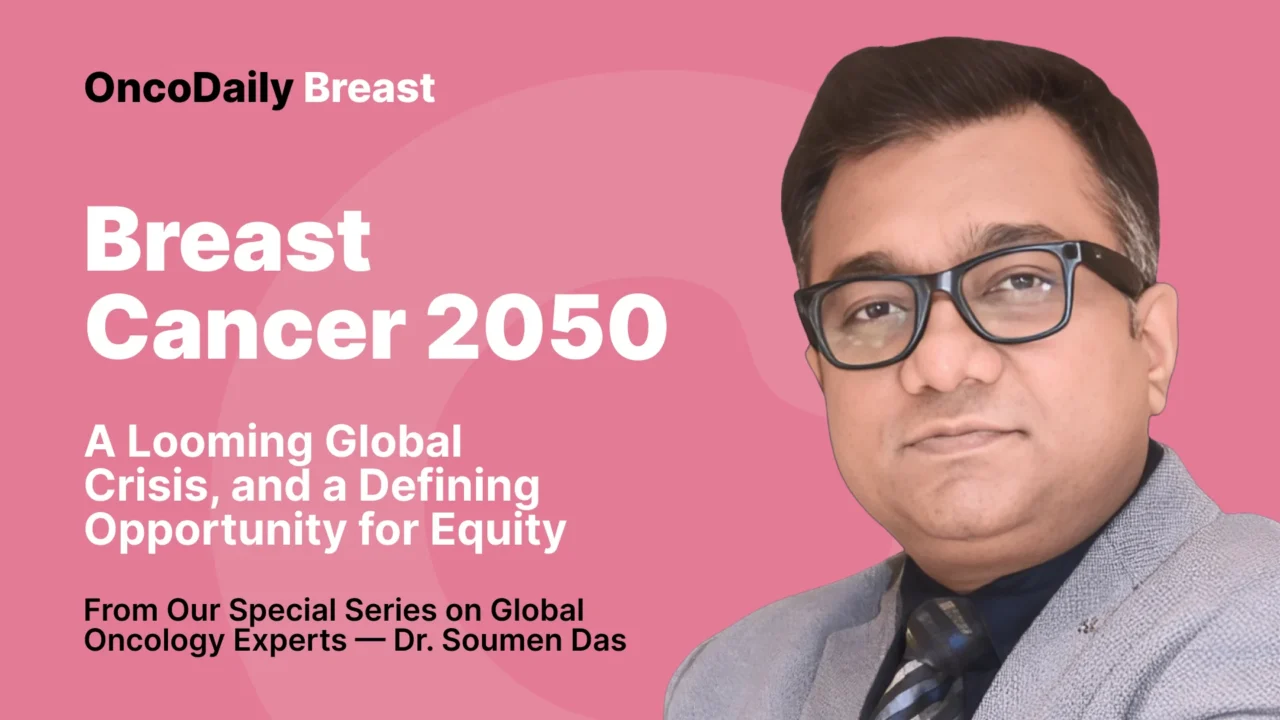
By 2050, breast cancer 2050 projections show cases are expected to exceed 3.5 million annually, with the majority of deaths occurring in regions least equipped to manage them. This is not just a rising cancer burden, it is a growing reflection of global inequity.
Read About Breast Cancer on OncoDaily
A Shifting Global Landscape
Breast cancer is now the most commonly diagnosed cancer worldwide, with approximately 2.3 million new cases in 2023. According to projections published in The Lancet Oncology, incidence will continue to rise steadily over the coming decades.
However, the most concerning trend is not incidence alone, it is mortality.
While high-income countries (HICs) continue to see improvements in survival due to advances in screening and treatment, low- and middle-income countries (LMICs) are facing a disproportionate increase in deaths. By 2050, more than half of global breast cancer mortality is expected to occur in these regions.
Where a patient lives is increasingly determining whether she survives.
From Epidemiology to Inequity
Historically, breast cancer was considered a disease of HICs. That paradigm has changed.
Today, LMICs are witnessing the fastest rise in incidence, driven by:
- Demographic shifts
- Urbanization
- Reproductive changes
- Lifestyle factors
Yet, the real divide emerges in outcomes. In some regions, mortality is projected to increase by 60–70%, highlighting a stark imbalance between disease burden and access to care.
A Framework Exists, But Implementation Lags
The World Health Organization’s Global Breast Cancer Initiative (GBCI) provides a clear roadmap built on three pillars:
- Early diagnosis
- Timely and effective treatment
- Sustained care and adherence
The targets are achievable: diagnose at least 60% of cases early and ensure completion of treatment. The challenge is no longer understanding the problem.
It is executing the solution at scale.
The Missing Link: Continuum of Care
Early detection alone does not save lives, timely treatment does. Across many LMICs, patients enter the healthcare system but fail to navigate through it effectively. This breakdown can be understood through delays in care:
- Primary delay: Symptom onset → first healthcare contact
- Secondary delay: First contact → diagnosis and treatment
- Tertiary (system-related) delay: Fragmentation within care pathways
All are significant,and all are modifiable.
Addressing Primary Delay: Awareness and Cultural Shift
Late-stage presentation is often not due to aggressive disease, but delayed health-seeking behavior.
Barriers include:
- Limited awareness
- Fear and stigma
- Socio-cultural constraints
Solutions must go beyond campaigns, they must build a culture of early engagement. At the Institute of Breast Diseases, Kolkata (IBDK), initiatives like Project Pink Alert aim to:
- Promote breast self-awareness
- Encourage early reporting
- Engage communities and survivors
Importantly, the focus extends to younger generations, creating long-term behavioral change.
Reducing Secondary Delay: Standardizing Pathways
System inefficiencies are a major contributor to poor outcomes. Fragmented diagnostics, inconsistent clinical assessment, and lack of clear referral pathways delay treatment initiation.
Structured tools can transform this. The Breast Clinical Reporting and Data System (BCRADS), developed at IBDK, introduces:
- Standardized clinical assessment
- Risk-based triage
- Early referral pathways
- A unified clinical language
In resource-limited settings, such tools can significantly reduce diagnostic uncertainty and accelerate care.
Treatment Completion: The Financial Reality
Diagnosis alone is not enough, treatment must be completed.
In many LMICs, financial toxicity leads to:
- Interrupted therapy
- Dose reductions
- Treatment abandonment
Universal Health Coverage (UHC) is essential. Global efforts such as the Access to Oncology Medicines (ATOM) Coalition are working to improve access to essential therapies. However, sustainable progress requires national-level commitment to:
- Financial protection
- Affordable diagnostics and drugs
- Integration into public health systems
Without affordability, early detection will not translate into survival.
Toward One Standard of Care
Treatment variability remains a major driver of inequity. The goal is not identical care everywhere, but equitable, guideline-based care for all.
A unified vision is needed:
“One World, One Standard of Treatment.”
Frameworks from WHO and resource-stratified guidelines already exist. The next step is implementation with accountability.
The Road Ahead
The projections for 2050 are not inevitable, they reflect current trajectories.
The path forward is clear:
- Scale community-driven early detection
- Standardize diagnostic pathways
- Ensure financial protection
- Implement resource-adapted treatment standards
- Strengthen data systems and accountability
Clinician-led, locally adapted solutions will be key to success.
Conclusion: A Defining Moment
Breast cancer is no longer just a clinical challenge, it is a global equity test.
The science exists.
The frameworks are defined.
The need is urgent.
What remains is execution.
If we fail, inequity will define survival in 2050.
If we succeed, we can change the trajectory, globally.
At the Institute of Breast Diseases, Kolkata, we believe:
“A patient’s pin code should not determine her chance of survival.”
The time to act is now.
Special Thanks
We extend our sincere gratitude to Dr. Soumen Das for his outstanding contribution to this important and timely article, “ Breast Cancer 2050: A Looming Global Crisis, and a Defining Opportunity for Equity.”
Through his global perspective and deep clinical insight, Dr. Das highlights one of the most pressing challenges in modern oncology, the growing disparity in breast cancer outcomes worldwide, and calls for urgent, actionable change. His work not only reflects scientific expertise but also a strong commitment to advancing equitable cancer care across diverse healthcare settings.
Dr. Das brings a distinguished background as a European Breast Surgical Oncologist, certified specialist, serving as Director of the Institute of Breast Disease, Kolkata, and Head of the Department of Surgical Oncology at Netaji Subhas Chandra Bose Cancer Hospital, India. His global contributions include roles as a reviewer for the NCCN Framework for Breast Cancer (V4.2025), International Advisor for The Royal College of Physicians and Surgeons of Glasgow, and Global Fellowship Reviewer in Cancer Control for UICC.
His leadership, advocacy, and dedication to improving access to care continue to inspire the oncology community worldwide.We are honored to feature his voice in this special series.