100 Influential Women in Oncology in 2026: Key Opinion Leaders in Social Media and Beyond

OncoDaily Grand Rounds at ESMO 2026: Sarcoma Edition

How Systemic Therapy Is Reshaping Breast Cancer Care in 2026

Jason Mouabbi: Is T-DM1 Still Useful after T-DXd in HER2+ Metastatic Breast Cancer

Small-Molecule Inhibitors in NSCLC: A 2026 Practical Guide to Drug Interactions and Toxicity

Sri Navaratnam Named Candidate for UICC Board of Directors 2026–2028

Michail Ignatiadis: Grateful for Hosting Session on Metastatic Breast Cancer at MAMMÔ 2026

Oncopeptides Reports Blood-Brain Barrier Penetration in Glioblastoma INSULA Study

The Child-Pugh Score assesses the severity of chronic liver disease and predicts prognosis using bilirubin, albumin, INR, ascites, and hepatic encephalopathy.
Total Bilirubin (mg/dL)
Serum Albumin (g/dL)
INR
Ascites
Hepatic Encephalopathy
Child-Pugh Score Calculator is a clinical tool used to assess the severity of chronic liver disease, particularly cirrhosis, and to help predict patient prognosis. It evaluates liver function using five parameters: bilirubin levels, albumin levels, INR (prothrombin time), presence of ascites, and hepatic encephalopathy.
Score Categories:
The Child-Pugh score is widely used for treatment planning, surgical risk assessment, and determining eligibility for certain medications, but it should be interpreted alongside other clinical findings.
The Child-Pugh score is a clinical scoring system used to estimate the severity of chronic liver disease, most commonly applied in patients with cirrhosis. It classifies hepatic function into three grades — Class A, Class B, and Class C — based on five clinical and laboratory parameters. The score is widely referenced in hepatology, oncology, and pharmacy, and appears in the prescribing information of numerous drugs to guide dose adjustments in hepatic impairment.
The OncoDaily Child-Pugh Score Calculator helps clinicians, trainees, and informed patients calculate and understand a Child-Pugh class from five standard inputs. It does not diagnose liver disease, replace clinical assessment, or generate treatment recommendations. Instead, it supports structured classification of liver function severity in the context of patient care.
The Child-Pugh score — also known as the Child-Turcotte-Pugh (CTP) score — is a clinical scoring system that estimates the severity of chronic liver disease, particularly cirrhosis. It calculates a total from five clinical and laboratory parameters and places patients into one of three functional classes. Each class carries different implications for treatment planning, medication safety, procedural risk, and prognosis.
The system was originally described by Child and Turcotte (1964) to guide surgical decision-making in portal hypertension, using five criteria that included nutritional status as one parameter (Child CG, Turcotte JG. Surgery and portal hypertension. Major Probl Clin Surg. 1964;1:1–85). It was subsequently modified by Pugh et al. (1973), who replaced nutritional status with prothrombin time, producing the scoring structure in use today (Pugh RN, Murray-Lyon IM, Dawson JL, et al. Transection of the oesophagus for bleeding oesophageal varices. Br J Surg. 1973;60(8):646–649).
The child pugh score calculator, liver disease calculator, and child pugh turcotte score calculator found on major clinical platforms — including MDCalc, the MSD Manual, Cleveland Clinic, and the UW Hepatitis C Online CTP tool — all use this same five-parameter framework.
The table forms the foundation of the child-pugh score calculator criteria table. Each of the five parameters receives 1, 2, or 3 points based on severity. The five scores are summed to produce the total Child-Pugh score, which ranges from 5 to 15. Cutoff values are consistent with those published by Cleveland Clinic (reviewed August 2025) and MDCalc.
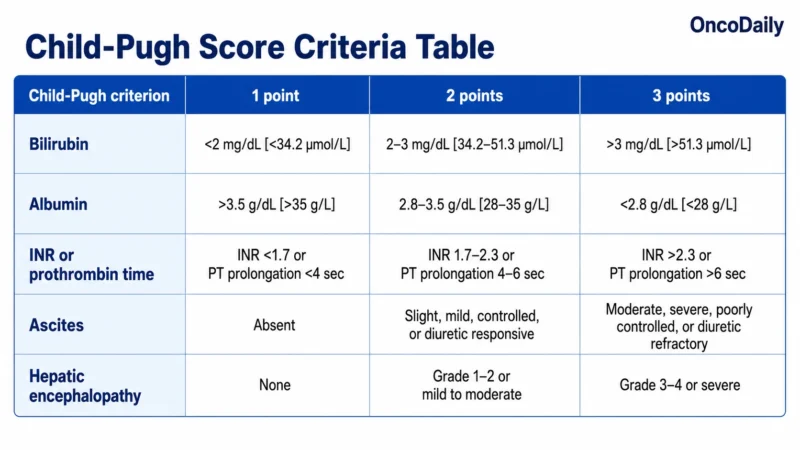
Bilirubin is a bile pigment produced from the breakdown of haemoglobin. The liver conjugates and excretes bilirubin into bile; impaired clearance in cirrhosis raises serum levels and produces jaundice. Total bilirubin below 2 mg/dL (< 34.2 µmol/L) scores 1 point; 2–3 mg/dL (34.2–51.3 µmol/L) scores 2 points; above 3 mg/dL (> 51.3 µmol/L) scores 3 points. Both conventional and SI units apply because oncology trials and international guidelines use both interchangeably.
Albumin is the predominant plasma protein synthesised by hepatocytes. As synthetic function declines in progressive cirrhosis, albumin falls — reducing oncotic pressure, altering drug binding, and contributing to fluid shifts. Albumin above 3.5 g/dL (> 35 g/L) scores 1 point; 2.8–3.5 g/dL (28–35 g/L) scores 2 points; below 2.8 g/dL (< 28 g/L) scores 3 points. Low albumin in this context is a marker of reduced hepatic synthetic reserve, distinct from nutritional hypoalbuminaemia in patients with otherwise intact liver function.
The liver synthesises most coagulation factors, including factors I, II, V, VII, IX, and X. As synthetic function declines, coagulation time prolongs — measured as INR or prothrombin time (PT). INR below 1.7 (PT prolongation under 4 seconds) scores 1 point; INR 1.7–2.3 (PT 4–6 seconds prolonged) scores 2 points; INR above 2.3 (PT over 6 seconds prolonged) scores 3 points. The original 1973 publication by Pugh et al. used PT in seconds; INR is the standardised modern equivalent used by current clinical calculators and drug labels.
Ascites is the pathological accumulation of fluid in the peritoneal cavity, developing in cirrhosis through portal hypertension and reduced oncotic pressure. Absent ascites scores 1 point; mild or diuretic-controlled ascites scores 2 points; moderate to severe or refractory ascites scores 3 points. This parameter is assessed clinically through physical examination, abdominal imaging, and review of drainage records. Because mild ascites is often suppressed by diuretics, grading reflects the patient’s current status and requires clinical judgment.
Hepatic encephalopathy is a spectrum of neuropsychiatric dysfunction caused by accumulation of neurotoxins — particularly ammonia — that the damaged liver cannot adequately clear. Grading follows the West Haven criteria: Grade 1 involves subtle cognitive and sleep changes; Grade 2 involves asterixis and disorientation; Grade 3 involves marked confusion and stupor; Grade 4 is coma. No encephalopathy scores 1 point; Grade 1–2 scores 2 points; Grade 3–4 scores 3 points. Like ascites, this is a clinical judgment input and severity varies with treatment, triggers, and disease course.
Each of the five parameters receives a score of 1, 2, or 3 based on severity. The five scores are added together to produce a total between 5 and 15. Lower totals indicate better-preserved liver function; higher totals indicate more severe hepatic dysfunction. The total then maps to Class A, B, or C — the output used in clinical practice.
A score of 1 reflects a near-normal or least-severe value. A score of 2 reflects a moderate abnormality. A score of 3 reflects a severe abnormality. As a worked example: a patient with bilirubin 1.8 mg/dL (1 point), albumin 3.0 g/dL (2 points), INR 1.5 (1 point), mild diuretic-controlled ascites (2 points), and no encephalopathy (1 point) produces a total of 7 — placing the patient in Class B.
The five required inputs are total serum bilirubin, serum albumin, INR (or PT), ascites status, and hepatic encephalopathy grade. Accuracy of input determines accuracy of output. An outdated bilirubin result or clinical undergrading of encephalopathy shifts the score and therefore the resulting class. Both Cleveland Clinic and the UW Hepatitis C Online CTP Calculator specify that current laboratory values and a contemporaneous clinical assessment are required for reliable scoring.
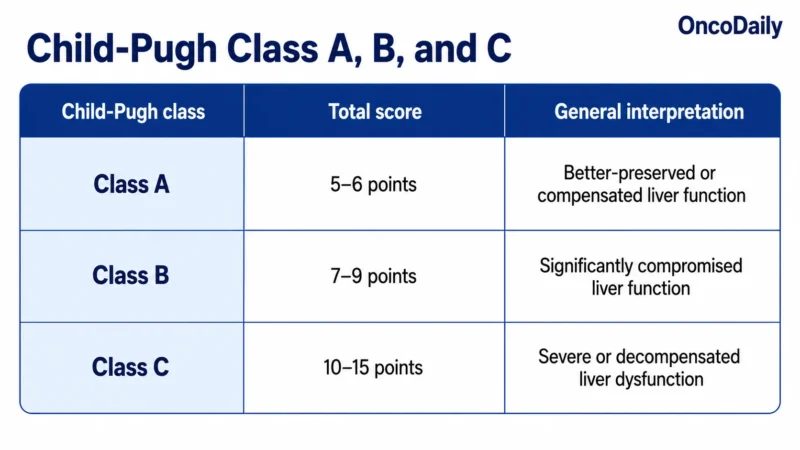
The sum of the 5 criteria places the patient into Child-Pugh Class A, B, or C. These categories help clinicians describe the severity of cirrhosis and liver dysfunction in a standardized way.
Class A (5–6 points) indicates relatively well-preserved or compensated liver function. The liver retains adequate synthetic capacity, bilirubin clearance, and coagulation factor production at the time of scoring. Class A does not indicate an absence of liver disease — cirrhosis remains present — but reflects current functional status. In oncology, Class A patients with hepatocellular carcinoma are evaluated for potentially curative interventions including surgical resection and ablation. The BCLC (Barcelona Clinic Liver Cancer) staging system, endorsed by EASL and AASLD, uses Child-Pugh class as a key variable in treatment allocation.
Class B (7–9 points) indicates significantly compromised hepatic function. The liver’s ability to synthesise proteins, metabolise drugs, and clear toxins is substantially reduced, affecting medication safety, procedural risk, cancer treatment tolerability, and monitoring intensity. Drug labels from the FDA and EMA frequently reference Child-Pugh Class B when recommending dose reductions or contraindications for hepatically metabolised agents. The NHS SPS Specialist Pharmacy Service guidance on calculating and using the Child-Pugh score (2024) specifically addresses its use for dose adjustment decisions in clinical pharmacy practice.
Class C (10–15 points) indicates severe or decompensated liver dysfunction. Common features include refractory ascites, recurrent encephalopathy, profound coagulopathy, and critical hypoalbuminaemia. Published data report approximate one-year survival rates of 95%, 80%, and 45% for Class A, B, and C respectively — a gradient that reflects the clinical severity of each tier. Class C requires specialist hepatology review and, in eligible patients, liver transplantation evaluation. It is also a common exclusion criterion for aggressive systemic or locoregional cancer therapy in HCC treatment guidelines.
The Child-Pugh score is a structured severity classification tool, not a general liver disease risk calculator for healthy individuals. Its primary applications are estimating cirrhosis severity at a specific time point, supporting prognosis discussions, assessing surgical and procedural risk, guiding liver disease management, reviewing medication safety in hepatic impairment, and informing oncology decisions when the liver is involved.
The Child-Pugh score is most meaningful in patients with established cirrhosis or advanced chronic liver disease. It provides a reproducible, structured snapshot of hepatic function at the time of assessment. Clinicians use it to communicate consistently across specialties — hepatology, oncology, surgery, and pharmacy — and to track changes in a patient’s functional status over time. The MSD Manual’s clinical calculator for Child-Pugh classification positions the score within this context: estimating severity of liver disease in patients with cirrhosis.
The Child-Pugh score was originally developed in part to estimate operative risk in patients with cirrhosis. Garrison et al. (Ann Surg, 1984) reviewed 100 consecutive cirrhotic patients undergoing non-shunt abdominal surgery and reported mortality rates of 10%, 31%, and 76% for Classes A, B, and C respectively. Mansour et al. (Surgery, 1997) confirmed comparable rates of 10%, 30%, and 82% in a separate series. Higher Child-Pugh class is consistently associated with greater perioperative risk; the final decision to proceed integrates urgency of the procedure, anaesthetic assessment, and hepatology input.
Drug manufacturers and regulatory agencies reference Child-Pugh Class A, B, or C in prescribing information for hepatically metabolised agents. This reflects the pharmacokinetic reality that impaired liver function alters drug metabolism, protein binding, first-pass clearance, and biliary excretion — affecting both efficacy and toxicity risk. The NHS SPS guidance (2024) specifically addresses the use of the Child-Pugh score for dose adjustment decisions in clinical pharmacy. There is no universal liver-dose calculator applicable to all medicines; each drug’s label, together with the patient’s current Child-Pugh class and full clinical context, guides prescribing decisions in hepatic impairment.
In oncology, the Child-Pugh score carries particular weight because cancer treatment and liver function interact in clinically significant ways. For patients with hepatocellular carcinoma (HCC), liver metastases, or underlying cirrhosis who require cancer therapy, the score provides a structured assessment of available liver reserve before treatment initiation. It informs decisions about systemic therapy, locoregional treatments such as transarterial chemoembolisation (TACE) or thermal ablation, surgical resection, and radiation planning.
Treatment decisions in hepatocellular carcinoma depend not only on tumour burden and vascular invasion but also on the degree of underlying liver dysfunction. The BCLC staging system — first described by Llovet et al. in 1999 and embedded in EASL Clinical Practice Guidelines (2018, 2022) — incorporates Child-Pugh class as a key determinant of treatment allocation. Patients with early-stage HCC and Class A function are evaluated for resection, ablation, or transplantation. Class B patients are considered for TACE or systemic therapy. Class C is generally a contraindication to aggressive systemic or locoregional therapy in most HCC guidelines. Final treatment decisions require multidisciplinary review integrating oncology and hepatology expertise.
Read more about Liver Cancer Success Rate on OncoDaily.
Hepatic metabolism plays a central role in the pharmacokinetics of many cancer drugs. Impaired liver function reduces clearance of hepatically metabolised agents, raises free drug concentration due to reduced albumin binding, and increases toxicity risk. The SHARP trial enrolled 602 patients with advanced HCC, of whom more than 95% had Child-Pugh Class A liver function. This established Child-Pugh class as the direct evidence basis for sorafenib eligibility in this setting and illustrates how trial design determines which patients the data actually applies to. Prescribing clinicians should review each drug’s label for Child-Pugh-based dosing guidance and consult hepatology when treating Class B or C patients with systemic cancer therapy (Llovet JM et al., NEJM, 2008).
The Child-Pugh score and the Model for End-Stage Liver Disease (MELD) score both quantify liver disease severity but differ in composition, primary use, and susceptibility to examiner variability.
The Child-Pugh score incorporates two clinically graded parameters — ascites and encephalopathy — alongside three laboratory values: bilirubin, albumin, and INR. The MELD score relies entirely on three laboratory values: serum bilirubin, serum creatinine, and INR. MELD was derived by Kamath et al. and published in Hepatology in 2001. The MELD-Na variant, which adds serum sodium, became the US transplant allocation standard via UNOS/OPTN in 2002, replacing Child-Pugh for that specific purpose.
MELD and MELD-Na are the standard tools for liver transplant prioritisation. They were developed to predict 90-day mortality in patients with end-stage liver disease listed for transplantation. Kim et al. demonstrated in the New England Journal of Medicine (2008) that MELD-Na outperforms MELD alone in predicting waitlist mortality by incorporating the prognostic value of hyponatraemia. For transplant-related prognostic discussions, MELD is the preferred instrument. MDCalc recommends comparing Child-Pugh with MELD when a patient’s score seems unexpectedly high or low relative to the clinical picture.
Child-Pugh class and MELD severity diverge in individual patients. A patient with refractory ascites and mild encephalopathy may score Class C on Child-Pugh but carry a relatively low MELD if bilirubin, creatinine, and INR remain near-normal. Conversely, a patient with markedly elevated creatinine from hepatorenal syndrome — a significant prognostic indicator captured by MELD but absent from Child-Pugh — may have a high MELD with a modest Child-Pugh class. This divergence reflects the different variables each system prioritises, not a discrepancy in clinical data.
The Child-Pugh score is a widely validated and practically useful clinical instrument, but its limitations are well-documented. It uses broad categorical cutoffs, incorporates two subjective parameters, and excludes several variables of significant prognostic importance.
Subjective Inputs
Ascites and hepatic encephalopathy are graded through clinical assessment, not objective measurement. Studies have demonstrated inter-rater variability in assigning these grades, particularly when symptoms are mild, fluctuating, or partially suppressed by treatment. Ripoll et al. (Hepatology, 2007) showed that the subjective components of Child-Pugh contribute to reduced reproducibility compared with fully laboratory-based tools such as MELD. This variability is especially relevant in multi-centre oncology trials where consistent scoring across sites affects eligibility and subgroup analyses.
The score compresses continuous laboratory variables into three broad categories. A patient with bilirubin of 0.8 mg/dL and one with bilirubin of 1.9 mg/dL both receive 1 point, despite a clinically meaningful difference. Conversely, bilirubin of 3.1 mg/dL and 18 mg/dL both receive 3 points. This compression limits sensitivity to gradual clinical change and creates boundary effects where small fluctuations near a cutoff shift the class without reflecting a meaningful change in hepatic function.
The Child-Pugh score excludes several variables that carry independent prognostic weight: serum sodium, renal function (both captured in MELD-Na), active infection, frailty, nutritional status, tumour burden, and performance status. In oncology patients, these omissions are clinically significant. Patients with equivalent Child-Pugh classes can have substantially different treatment tolerance depending on ECOG performance status, sarcopenia, or the hepatotoxic profile of the planned regimen.
The Child-Pugh score reflects hepatic function at a single time point. Cirrhosis is a dynamic disease: the score changes with disease progression, acute decompensating events, treatment response, and resolution of precipitating factors. Relying on an outdated score for clinical decisions introduces meaningful risk.
Reassessment is appropriate when ascites worsens or improves, encephalopathy develops or deteriorates, bilirubin, albumin, or INR shift meaningfully, the patient is hospitalised for a liver-related complication, a variceal bleeding episode occurs, spontaneous bacterial peritonitis is diagnosed, or a sudden functional decline is observed. These events frequently shift patients between classes and change the risk-benefit profile of ongoing or planned treatments.
The score used for a clinical decision should reflect current hepatic function, not a result from weeks or months earlier. Current labs and a clinical reassessment are required before major surgery, initiation of systemic cancer therapy, locoregional intervention such as TACE or ablation, enrolment in a clinical trial with Child-Pugh eligibility criteria, radiation therapy planning to the liver, or significant medication changes involving hepatically metabolised drugs.
The Child-Pugh score calculator is designed for healthcare professionals and trainees already familiar with the clinical parameters it requires. It is also informative for patients and caregivers who want to understand the classification their care team uses to describe liver function.
Clinicians use the Child-Pugh score as a structured support tool alongside current laboratory data, physical examination, imaging, medication review, and MELD comparison where relevant. As MDCalc states: calculations must be re-checked and must not be used alone to guide patient care, nor should they substitute for clinical judgment.
Patients and caregivers use this calculator to understand what Child-Pugh Class A, B, or C means in relation to treatment planning, medication decisions, and monitoring intensity. Patients must not use the result to self-diagnose liver disease or to change, stop, or start medications. Any clinical decision based on the score is the responsibility of the treating clinician.
Find more videos on OncoDaily YouTube TV.
Our calculators apply published formulas as precisely as we can. Even so, no formula captures every detail of a real patient. Use the result as one input to your own assessment, not the final word.





