David Kerr’s 8-Year-Old Daughter Interviews Him About Life as a Cancer Doctor

Pope Leo XIV to Undergo Surgery to Remove Early-Detected Lung Nodule

15 Posts Not To Miss From DCLung26

Small-Molecule Inhibitors in NSCLC: A 2026 Practical Guide to Drug Interactions and Toxicity

Sanofi Foundation Marks Milestone in Global Humanitarian Action

Sri Navaratnam Named Candidate for UICC Board of Directors 2026–2028

Michail Ignatiadis: Grateful for Hosting Session on Metastatic Breast Cancer at MAMMÔ 2026

10 Must-Read Posts In GU Oncology This Week

Body Mass Index (BMI) is a simple calculation used to assess whether a person has a healthy body weight for their height, based on weight and height.
Unit
Use our BMI calculator to estimate your body mass index, understand adult BMI ranges, health context, and important limitations.
A BMI calculator uses your height and weight to estimate your body mass index, also known as BMI.
BMI is widely used as a quick screening measurement. It can help indicate whether an adult’s weight falls within a commonly used category, but it cannot diagnose obesity, malnutrition, or any medical condition on its own.
Your BMI result should always be interpreted alongside your overall health, lifestyle, medical history, body composition, and other measurements.
Body mass index is a calculation based on a person’s height and weight.
It is often used by healthcare professionals as one part of a broader health assessment. BMI can help identify people who may benefit from further evaluation of blood pressure, cholesterol, blood glucose, nutrition, physical activity, or other health markers.
However, BMI does not directly measure body fat. It also cannot distinguish between muscle, bone, fat, and fluid.
BMI can be calculated using metric or imperial measurements.
The metric formula is:
BMI = weight in kilograms ÷ height in metres squared
For example, a person who weighs 70 kg and is 1.75 metres tall would have a BMI of approximately 22.9.
The imperial formula is:
BMI = 703 × weight in pounds ÷ height in inches squared
An online BMI calculator can provide the result quickly after entering your height and weight.
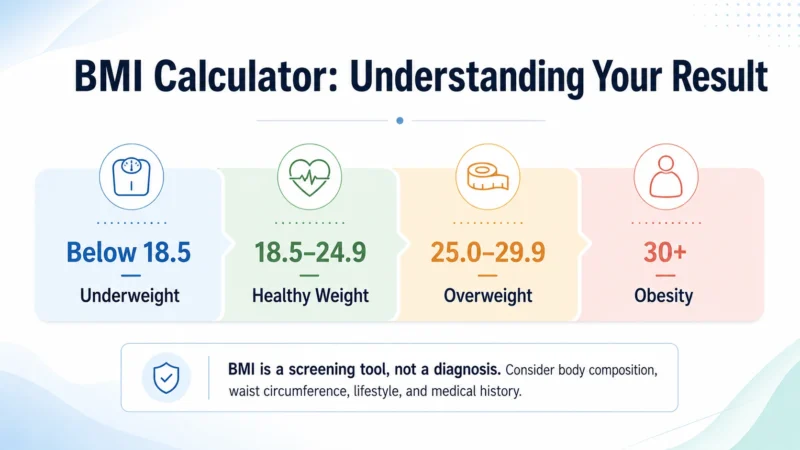
For most adults aged 20 years and older, BMI is commonly interpreted using four broad categories.
A BMI below 18.5 is generally classified as underweight.
A BMI from 18.5 to 24.9 is generally considered the healthy-weight range.
A BMI from 25.0 to 29.9 is generally classified as overweight.
A BMI of 30.0 or above is generally classified as obesity.
These categories are screening ranges. They are not a diagnosis and should not be used as the only measure of health.
The BMI formula is the same for women and men. It only requires height and weight.
However, BMI results may not have the same meaning for every person. Body-fat distribution, muscle mass, age, hormonal changes, physical activity, pregnancy status, menopause, and medical history can all influence how BMI should be understood.
For example, a person with a high level of muscle mass may have a BMI in the overweight range despite having a low level of body fat.
The standard BMI categories for adults do not change with age. However, body composition often changes over time.
Older adults may lose muscle mass and bone density. This means a person may have more body fat than their BMI result suggests. At the same time, a low BMI in an older adult may raise concerns about poor nutrition, frailty, or muscle loss.
For this reason, BMI should be reviewed together with strength, mobility, appetite, weight changes, and overall health.
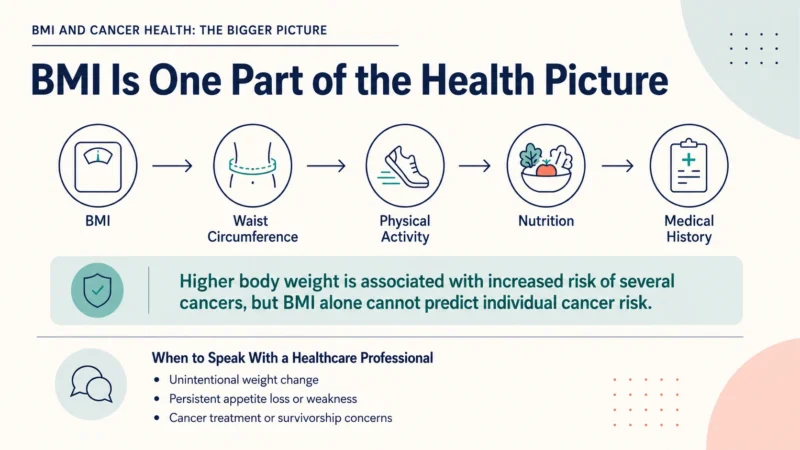
Higher body weight is linked with an increased risk of several cancers. However, BMI alone cannot predict whether an individual will develop cancer.
Cancer risk is influenced by many factors. These include age, genetics, tobacco exposure, alcohol use, physical activity, diet, infections, environmental exposures, family history, and cancer screening participation.
For people undergoing cancer treatment or living after cancer, unintentional weight loss, muscle loss, appetite changes, swelling, or rapid weight gain may be more clinically important than BMI alone.
BMI can be a starting point for conversation, but it should not replace assessment by an oncology team, dietitian, or other healthcare professional.
BMI is useful for population health research and initial screening, but it has important limitations.
It does not directly measure body fat.
It does not show where fat is stored in the body.
It cannot distinguish between fat, muscle, bone, and fluid.
It may overestimate body fat in athletes or people with greater muscle mass.
It may underestimate body fat in some older adults or people who have lost muscle.
It may be less useful during pregnancy or in people with conditions that cause fluid retention, major weight changes, or changes in body composition.
A more complete assessment may include waist circumference, blood pressure, laboratory tests, symptoms, medications, nutrition, physical activity, and medical history.
Adult BMI categories should not be used for children or teenagers.
For children and adolescents aged 2 to 19 years, BMI is interpreted using age- and sex-specific percentiles. This means a child’s BMI is compared with growth-chart data for others of the same age and sex.
A BMI below the fifth percentile is generally classified as underweight.
A BMI from the fifth percentile to below the 85th percentile is generally classified as healthy weight.
A BMI from the 85th percentile to below the 95th percentile is generally classified as overweight.
A BMI at or above the 95th percentile is generally classified as obesity.
A paediatrician or qualified healthcare professional can help interpret a child’s BMI result in the context of their growth pattern, development, nutrition, and health history.
It may be helpful to speak with a healthcare professional if your BMI is very low or falls within the obesity range.
You should also seek medical advice if you have rapid or unintentional weight changes, appetite loss, persistent fatigue, swelling, weakness, or other new symptoms.
People who are pregnant, planning pregnancy, living with a chronic medical condition, receiving cancer treatment, or recovering after cancer may need a more individual assessment.
Our calculators apply published formulas as precisely as we can. Even so, no formula captures every detail of a real patient. Use the result as one input to your own assessment, not the final word.





