





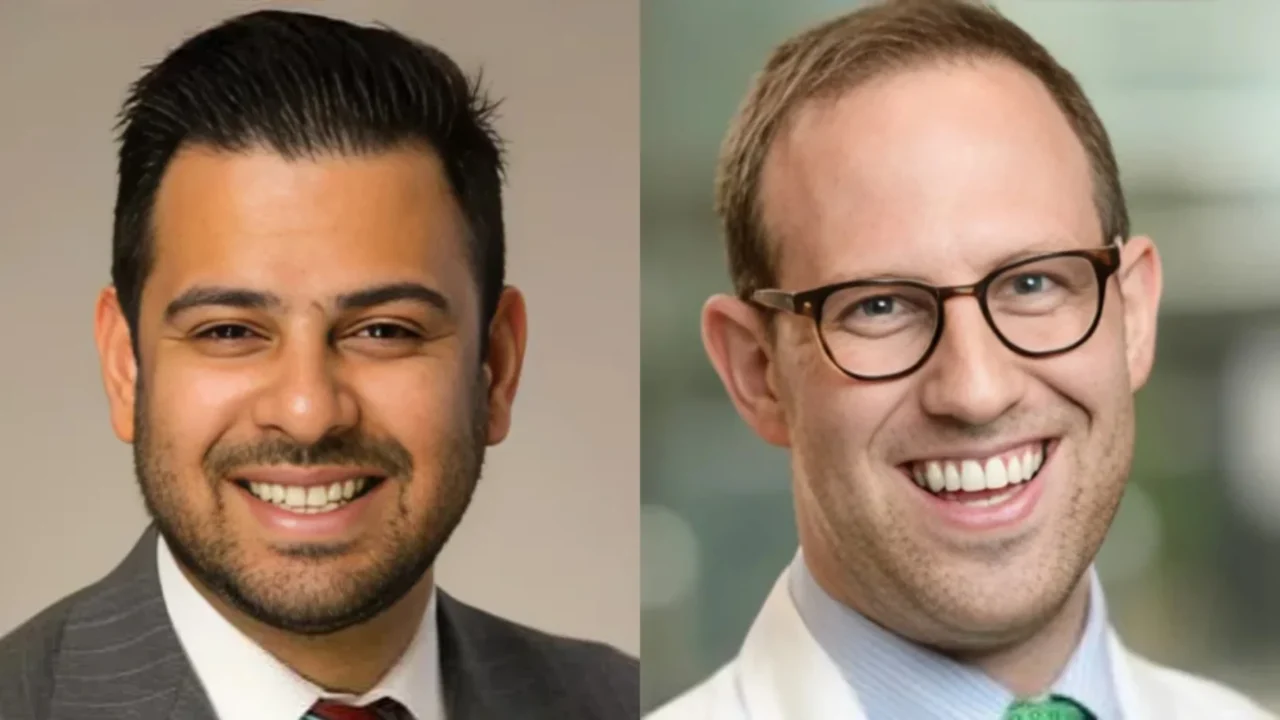
Tejas Patil, Assistant Professor of Thoracic Oncology; Vice Head of Clinical Affairs, Division of Oncology, University of Colorado Anschutz, shared Benjamin Herzberg‘s, Thoracic Oncologist at Herbert Irving Comprehensive Cancer Center, post on X, adding:
“First, congrats to Benjamin Herzberg for being a co-author in the influential NEJM paper on daroxonrasib!
Second, please bookmark this thread! Eloquently highlights key tensions in oncology.
In my opinion, we need more trials looking at new sequencing strategies (novel combos upfront, fixed duration intensification, dynamic and conditional trials adapted to longitudinal genomic and epigenomic assessments) along with a more nimble regulatory infrastructure.”
Quoting Benjamin Herzberg’s post:
“A few additional thoughts I’ve had reflecting upon lessons from daraxonrasib in addition to Wungki Park‘s excellent summary below.
1. Genetics remains the king of biomarkers. Want to know what to drug? Ask the tumor. Selection wins. If the tumor has a RAS mutation, there’s a reason it doesn’t have a MEK mutation. Or a RAF mutation. Dozens of abandoned MAPK therapies support this. Hit the target first.
2. Complex mechanisms are overrated. I was taught drugs didn’t work in PDAC because of dense stroma. This drug works. Better reasoning: chemo doesn’t work because it’s just the wrong tool. Build the right tool, and the mechanism simplifies. (Lenalidomide mechanism – same story)
3. This is an opening salvo in precision oncology for non-G12C RAS mutations. NSCLC coming soon. But as we get more of these, the next job becomes harder. Are we required to run single-mechanism trials only, until we can’t? Combo trials are slow or driven by commercial concerns.
We’ll need faster trials, regulatory understanding, and more investigators pushing multiple on- and off-mechanism ways to kill the same tumor. No one thinks of HIV therapy in terms of one target. Will have to be the same for cancer, but we’re really not there.
4. Chemistry is the key. We have amazing new tools to make modular small and macromolecules. Why do we only have ~20-30 targets of note across dozens of pipelines? See Jia (Jenny) Liu‘s thoughts from a few weeks ago on herding. More uncorrelated bets please!
5. Many more lessons for science and drug development to come. We continue to work on daraxonrasib activity and toxicity mitigation to make things even better at Herbert Irving Comprehensive Cancer Center, along with Ken Olive leading science and Gulam Abbas Manji leading all ph3 efforts (ASCO!)”
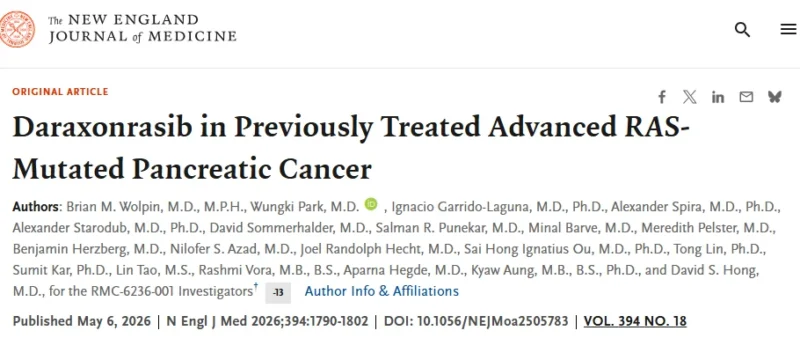
Title: Daraxonrasib in Previously Treated Advanced RAS-Mutated Pancreatic Cancer
Authors: Brian M. Wolpin, Wungki Park, Ignacio Garrido-Laguna, Alexander Spira, Alexander Starodub, David Sommerhalder, Salman R. Punekar, Minal Barve, Meredith Pelster, Benjamin Herzberg, Nilofer S. Azad, Joel Randolph Hecht, Sai Hong Ignatius Ou, Tong Lin, Sumit Kar, Lin Tao, Rashmi Vora, Aparna Hegde, Kyaw Aung, David S. Hong
Read the Full Article.
Other articles featuring Tejas Patil and Benjamin Herzberg on OncoDaily.