Shaheenah Dawood, Consultant Medical Oncologist at Mediclinic Middle East, shared a posts on LinkedIn:
“I read with interest the FDA objections to SERENA-6. Here are my comments:
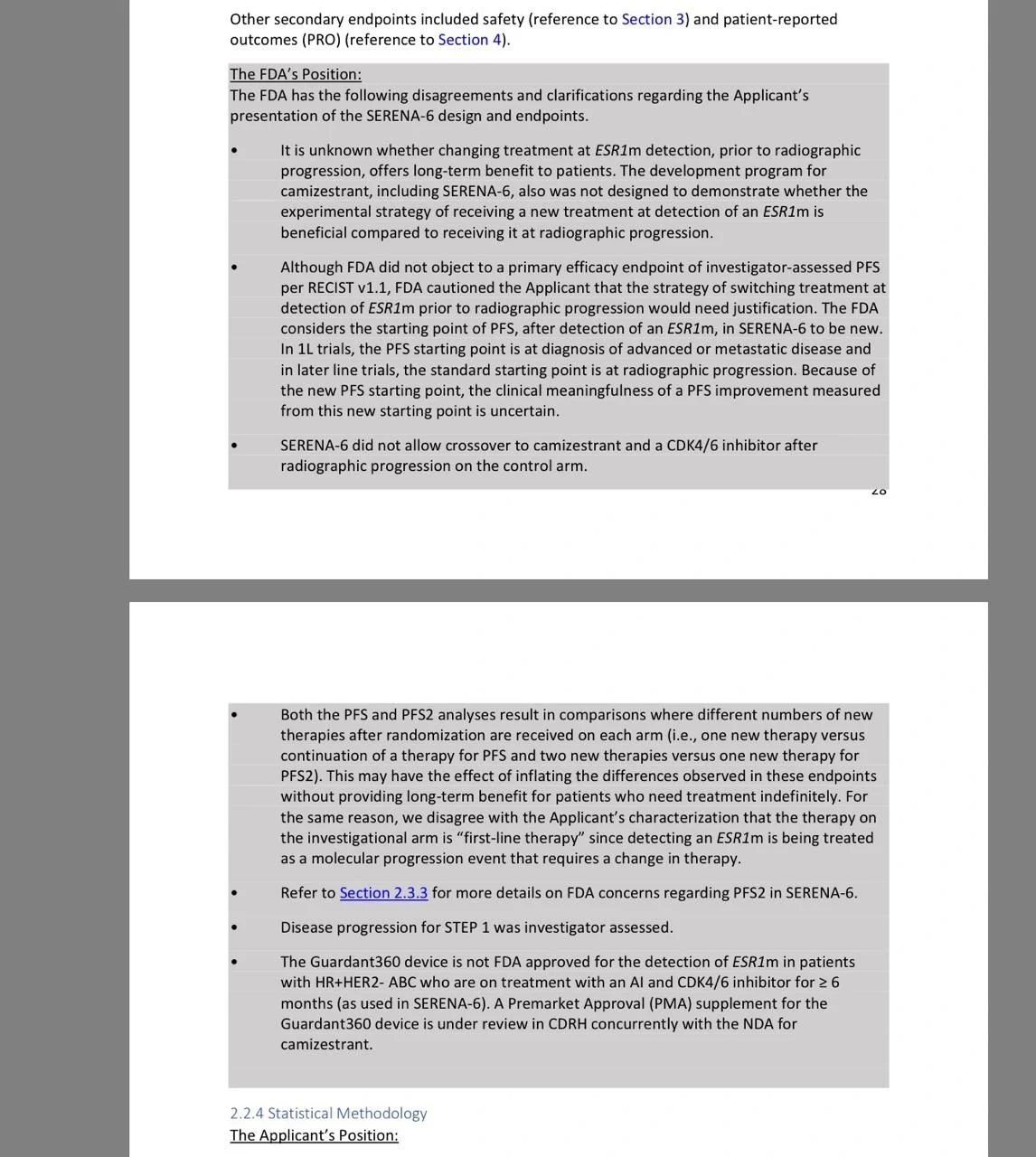
1. ‘It is unknown whether changing treatment at ESR1m detection, prior to radiographic progression, offers long-term benefit to patients.’
I am genuinely surprised by this statement. A significant prolongation in progression-free survival should be benefit enough, particularly when 100% of enrolled patients harboured the very mutation used to guide the treatment switch. The biology worked exactly as hypothesised.
2. ‘The FDA considers the starting point of PFS, after detection of an ESR1m, in SERENA-6 to be new… Because of the clinical meaningfulness of a PFS improvement measured from this new starting point is uncertain.’
Again, very surprised. The PADA-1 and SERENA-6 investigators should be commended for developing a new PFS definition, not penalised for it. Biomarker-triggered endpoints are the wave of the future – one that allows us to intervene earlier and give patients a real prognostic advantage.
3. ‘SERENA-6 did not allow crossover to camizestrant and a CDK4/6 inhibitor after radiographic progression on the control arm.’
I am tired of hearing this argument. Fact is Oral SERDs were not standard of care at the time of trial design, crossover simply was not a realistic option to mandate. More importantly, the entire premise of SERENA-6 is that we act before radiographic progression. PFS1 is the more meaningful endpoint here.
4. ‘The FDA remains uncertain as to whether the intended patients would benefit from the proposed experimental strategy of receiving a new treatment (i.e., camizestrant) at detection of an ESR1m compared to receiving it at radiographic progression as SERENA-6 was not designed to assess this and FDA is not aware of any external data to support
this either.’
I disagree. The ESR1 mutation is a real-time signal of emerging resistance. If we wait for radiological progression, we will lose a significant proportion of patients who could have benefited from earlier intervention. Why do we need to wait?
5. ‘The FDA does not agree that exploratory analyses – including chemotherapy/ADC-free survival, time to first subsequent therapy, and time to second subsequent therapy, provide evidence of clinical benefit.’
How can these not matter to patients? Chemotherapy-free survival alone speaks directly to quality of life and treatment burden. Dismissing these endpoints risks losing the patient-centred narrative entirely.
6. ‘FDA remains uncertain regarding the clinical meaningfulness of SERENA-6 results because of immature OS results that may not achieve statistical significance.’
Achieving overall survival significance is always challenging in this subgroup, where a disease is managed across multiple sequential lines over many years. Do we really need it to change clinical practice? For me, OS alone should not be driving this decision.
It is time to embrace novel trial designs that truly exemplify precision medicine – ones that act on molecular signals and ultimately benefit patients by not only improving prognostic outcomes but also quality of life!”
AstraZeneca’s Camizestrant Faces FDA ODAC Review In ESR1-Mutated HR+/HER2− Breast Cancer