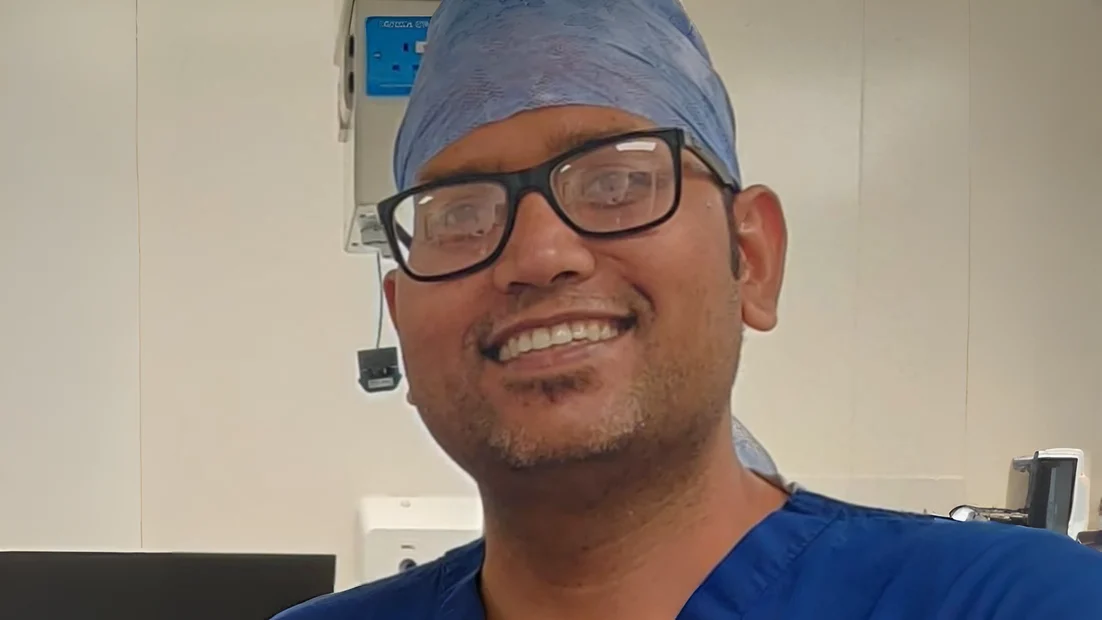
Sanjay Yadav, Oncoplastic Breast Surgeon, Assistant Professor at Netaji Subhash Chandra Bose Government Medical College, shared a post on LinkedIn:
“Robotic-quality breast cancer surgery on a bicycle budget? Yes, it’s possible.
Standard of care should not mean a standard of privilege. Globally, Sentinel Lymph Node Biopsy (SLNB) relies heavily on dual-tracer methods using radioisotopes (Technetium-99m) or Indocyanine Green (ICG). While highly effective, these require massive capital investments, specialized cameras, or nuclear medicine infrastructure, resources that are virtually non-existent in low-and-middle-income countries (LMICs).
Over the last few years, our team has validated and pioneered a highly effective, low-cost dual-dye technique using Fluorescein Sodium (FS) + Methylene Blue Dye (MBD) under simple blue LED light.
Our published research tells the story of this evolution:
Validation in cN0 Axilla: We proved its efficacy as a potential solution for resource-poor settings, establishing excellent localization rates (Breast Cancer Res Treat).
Meta-Analysis: We performed a systematic review and meta-analysis confirming the high diagnostic accuracy of FS-guided SLNB, validating it on a macro level․
The Learning Curve: Our latest data outlines the precise learning curve required for mastering this dual-dye technique, proving it is highly reproducible and scalable for any surgeon, anywhere @Indian Journal of Surgical Oncology).
Post-NACT Application: We extended its utility to evaluate SLN identification rates and false-negative thresholds in patients post-neoadjuvant chemotherapy.
Global health equity is not about waiting for expensive infrastructure to trickle down; it’s about reverse innovation. By substituting a $2,000 ICG camera with a $5 blue LED torch and accessible dyes, we achieve the exact same oncological safety profile at a fraction of the cost.”
Proceed to the video attached to the post.
Dato-DXd Plus Durvalumab Shows Durable First-Line Activity in Advanced TNBC