
The phase Ib/II BEGONIA study provides one of the most detailed early clinical datasets for combining a TROP2-directed antibody-drug conjugate with immune checkpoint blockade in first-line unresectable locally advanced or metastatic triple-negative breast cancer. In Arms 7 and 8 of the study, datopotamab deruxtecan (Dato-DXd) plus durvalumab produced high confirmed response rates, durable responses, and a manageable safety profile in patients with advanced TNBC, including activity across PD-L1 subgroups (Schmid et al., 2026).
These findings are clinically relevant because first-line treatment for metastatic TNBC remains strongly influenced by PD-L1 expression, while outcomes remain limited for many patients. The BEGONIA data suggest that pairing an ADC with PD-L1 blockade may be a promising strategy to deepen and prolong responses, although randomized phase III trials are needed to define the exact contribution of each drug and compare this regimen with current standards.
Why This Combination Matters In Metastatic TNBC
Triple-negative breast cancer lacks estrogen receptor, progesterone receptor, and HER2 overexpression. It accounts for approximately 15–20% of all breast cancer cases and remains one of the most aggressive breast cancer subtypes, with a higher risk of metastasis and poorer outcomes than hormone receptor-positive or HER2-positive disease (Garrido-Castro et al., 2019; Zagami & Carey, 2022).
In the metastatic setting, treatment has historically relied on chemotherapy, with the addition of immune checkpoint inhibitors for selected patients with PD-L1-positive tumors. However, median progression-free survival with chemotherapy with or without PD-(L)1 inhibitors has generally remained in the range of 6–10 months, and many patients do not receive second-line therapy after progression (Schmid et al., 2020; Cortes et al., 2020; Punie et al., 2025).
Dato-DXd is designed to target TROP2, a cell-surface antigen frequently expressed in TNBC. The drug combines a TROP2-directed antibody with a topoisomerase I inhibitor payload through a tumor-selective cleavable linker. The rationale for combining Dato-DXd with durvalumab is based on the possibility that ADC-mediated tumor cell death may enhance antitumor immune priming and make tumors more responsive to checkpoint blockade (Okajima et al., 2021; Schmid et al., 2026).
Study Design And Treatment
BEGONIA is a multicenter, open-label, phase Ib/II platform study evaluating durvalumab in combination with multiple novel therapies as first-line treatment for patients with unresectable locally advanced or metastatic TNBC.
Arms 7 and 8 specifically assessed Dato-DXd plus durvalumab. Patients received Dato-DXd 6 mg/kg intravenously every 3 weeks plus durvalumab 1120 mg intravenously every 3 weeks. Arm 7 enrolled patients regardless of tumor PD-L1 expression, while Arm 8 enrolled patients with PD-L1-high tumors based on local immunohistochemistry testing (Schmid et al., 2026).
Between May 2021 and May 2022, 62 patients received Dato-DXd plus durvalumab in Arm 7. Between June 2023 and May 2024, 33 patients received the same combination in Arm 8. At the data cutoff of November 29, 2024, median study follow-up was 35.0 months in Arm 7 and 10.7 months in Arm 8.
Baseline Patient Characteristics
Patients in both arms had unresectable locally advanced or metastatic TNBC and had received no prior systemic treatment for locally advanced or metastatic disease. Prior treatment for early-stage TNBC was allowed if recurrence occurred after the required treatment-free interval.
The median age was 53 years in Arm 7 and 47 years in Arm 8. Visceral metastases were present in 64.5% of patients in Arm 7 and 63.6% in Arm 8. Central nervous system metastases were reported in 3.2% and 9.1%, respectively. In Arm 7, central retrospective testing showed that most patients had PD-L1-low disease, with 54 of 62 patients classified as PD-L1 TAP <10% by SP263 central testing. Arm 8, by design, required locally defined PD-L1-high disease for enrollment (Schmid et al., 2026).
Antitumor Activity In Arm 7
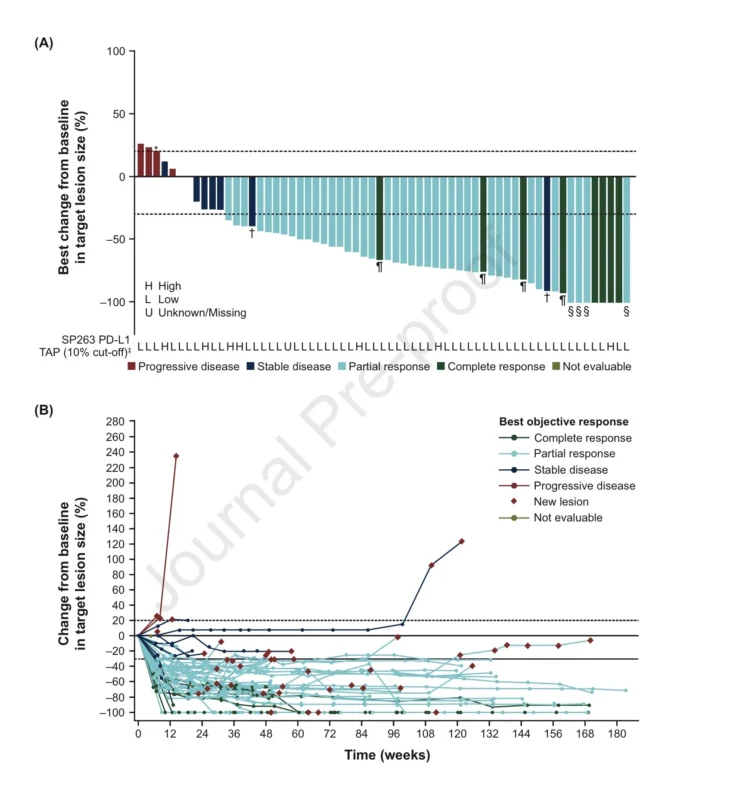
Arm 7 provides the most mature dataset, with a median follow-up of 35.0 months. All 62 treated patients were evaluable for response.
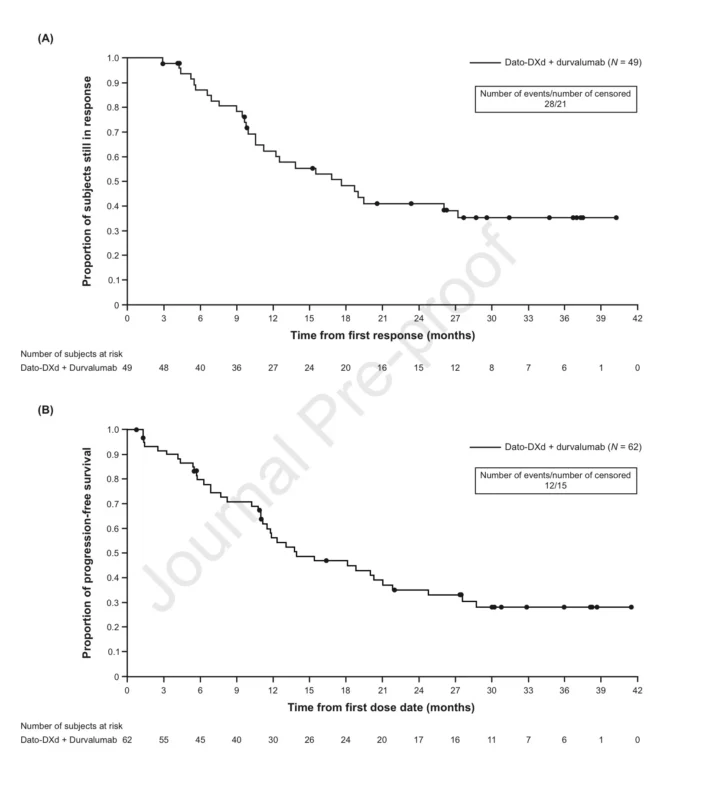
The investigator-assessed confirmed objective response rate was 79.0%. Complete responses were observed in 8 patients (12.9%), while partial responses were observed in 41 patients (66.1%). Median duration of response was 17.6 months, showing that responses were not only frequent but also durable (Schmid et al., 2026).
Median progression-free survival was 14.0 months. The reported PFS rates were 79.8% at 6 months, 56.3% at 12 months, 46.9% at 18 months, and 35.2% at 24 months. Median overall survival was not reached at the time of analysis.
A clinically important finding was that responses were observed regardless of centrally assessed PD-L1 status. In Arm 7, investigator-assessed cORR was 71.4% in patients with PD-L1 TAP ≥10% tumors and 79.6% in patients with PD-L1 TAP <10% tumors. This finding is exploratory because the PD-L1-high subgroup was small, but it supports further evaluation of Dato-DXd plus durvalumab beyond strictly PD-L1-selected populations.
Antitumor Activity In Arm 8
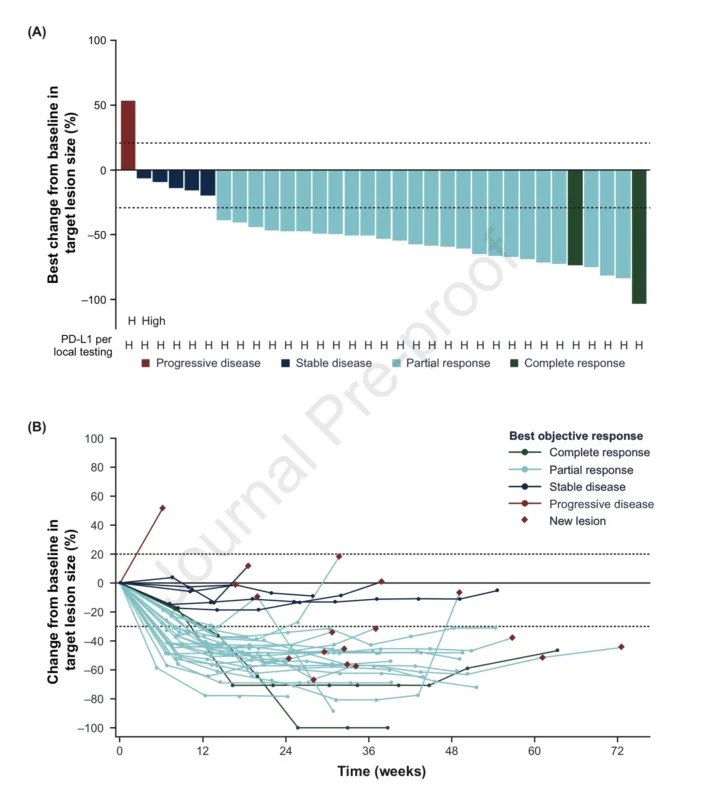
Arm 8 was designed to provide additional evidence in patients with PD-L1-high tumors by local testing. All 33 patients were evaluable for response.
The investigator-assessed confirmed objective response rate was 81.8%. Complete responses were reported in 2 patients (6.1%), and partial responses were reported in 25 patients (75.8%). Median duration of response and median progression-free survival were immature because of the shorter median follow-up, with only 10.7 months of overall study follow-up and 8.3 months among censored patients (Schmid et al., 2026).
Interestingly, retrospective central PD-L1 testing again showed responses across PD-L1 categories. The cORR was 87.5% in patients with PD-L1 TAP ≥10% tumors and 82.6% in patients with PD-L1 TAP <10% tumors. The authors noted that discordance between local and central PD-L1 assessment may reflect differences in assay sensitivity, tissue sampling, and pathologist interpretation, which are known issues in TNBC PD-L1 testing.
Safety Profile
The safety profile of Dato-DXd plus durvalumab was described as manageable, with no new safety signals compared with prior experience with the individual agents.
Adverse events occurred in all treated patients in both arms. In Arm 7, the median treatment duration was 11.2 months for Dato-DXd and 11.5 months for durvalumab. In Arm 8, median treatment duration was 7.6 months and 8.3 months, respectively.
The most common adverse events were stomatitis and nausea. Stomatitis occurred in 69.4% of patients in Arm 7 and 81.8% in Arm 8. Nausea occurred in 67.7% and 54.5%, respectively. Alopecia, constipation, fatigue, rash, vomiting, dry eye, decreased appetite, arthralgia, increased amylase, and hypothyroidism were also among the common reported events (Schmid et al., 2026).
Grade 3 or higher adverse events occurred in 59.7% of patients in Arm 7 and 36.4% in Arm 8. The most common grade 3 or higher events were increased amylase and stomatitis in Arm 7, and increased amylase in Arm 8. The authors noted that the high rate of amylase increase should be interpreted cautiously because CTCAE version 4.03 relies on numerical laboratory thresholds and may not distinguish asymptomatic laboratory abnormalities from clinically significant events as clearly as later CTCAE versions.
Diarrhea and neutropenia were relatively uncommon and mostly low grade. Any-grade diarrhea occurred in 16.1% of patients in Arm 7 and 6.1% in Arm 8. Any-grade neutropenia occurred in 4.8% of patients in Arm 7 and in no patients in Arm 8.
Dato-DXd-Specific Safety Events
Several adverse events of special interest were monitored for Dato-DXd, including oral mucositis/stomatitis, ocular surface events, and interstitial lung disease or pneumonitis.
Oral mucositis or stomatitis was reported in 74.2% of patients in Arm 7 and 84.8% in Arm 8. Most events were low grade. Grade 3 or higher oral mucositis/stomatitis occurred in 16.1% of patients in Arm 7 and in no patients in Arm 8. Dose reductions due to oral mucositis/stomatitis occurred in 24.2% of patients in Arm 7 and 9.1% in Arm 8. Only one patient in Arm 7 discontinued Dato-DXd due to oral mucositis/stomatitis (Schmid et al., 2026).
Ocular surface events occurred in 51.6% of patients in Arm 7 and 45.5% in Arm 8. These were mostly low grade. Grade 3 ocular surface events occurred in 8.1% of patients in Arm 7 and 3.0% in Arm 8. The most common ocular surface event was dry eye in Arm 7 and blurred vision in Arm 8.
Adjudicated drug-related ILD or pneumonitis occurred in 3 patients (4.8%) in Arm 7 and 1 patient (3.0%) in Arm 8. All adjudicated drug-related ILD/pneumonitis events were low grade. These events led to Dato-DXd discontinuation in two patients in Arm 7 and one patient in Arm 8.
Immune-Mediated Adverse Events
Immune-mediated adverse events were reported in 32.3% of patients in Arm 7 and 33.3% in Arm 8. Most were grade 1 or 2. One grade 3 hepatic event occurred in Arm 7. The most common immune-mediated events were hypothyroid events, reported in 23% of patients in Arm 7 and 24% in Arm 8 (Schmid et al., 2026).
This safety profile is important because the regimen combines an ADC with immune checkpoint blockade, raising the possibility of overlapping toxicity. In this study, however, no new safety concerns emerged, and ILD/pneumonitis rates remained low and manageable.
How These Results Fit Into The TNBC Landscape
The BEGONIA results add to growing interest in ADC-immunotherapy combinations in metastatic TNBC. The authors compared the data cautiously with other recent studies, emphasizing that cross-trial comparisons are limited by differences in study design, eligibility criteria, patient populations, PD-L1 definitions, and follow-up.
In ASCENT-04/KEYNOTE-D19, sacituzumab govitecan plus pembrolizumab in previously untreated PD-L1-high advanced TNBC produced an ORR of 59.7%, median duration of response of 16.5 months, and median PFS of 11.2 months. In ASCENT-03, sacituzumab govitecan monotherapy in patients not eligible for PD-(L)1 inhibitors produced an ORR of 48%, median duration of response of 12.2 months, and median PFS of 9.7 months. In TROPION-Breast02, Dato-DXd monotherapy improved PFS and OS versus chemotherapy in patients with advanced TNBC for whom immunotherapy was not an option, with median PFS of 10.8 months, median OS of 23.7 months, ORR of 62.5%, and median duration of response of 12.3 months (Dent et al., 2026; Cortes et al., 2025; Schmid et al., 2026).
Within this context, the BEGONIA Arm 7 data, including 79.0% cORR, 17.6-month median DoR, and 14.0-month median PFS, represent a strong early signal. However, the absence of a randomized control arm means the regimen still requires phase III validation.
Ongoing Phase III Development
Several ongoing trials are expected to clarify the role of Dato-DXd plus durvalumab in TNBC.
TROPION-Breast05 is evaluating first-line Dato-DXd with or without durvalumab versus chemotherapy plus pembrolizumab in patients with PD-L1-high locally recurrent inoperable or metastatic TNBC. This study is especially important because it may help determine the added contribution of durvalumab to Dato-DXd.
DIAMOND is evaluating Dato-DXd plus durvalumab versus Dato-DXd monotherapy in PD-L1-negative metastatic TNBC. This will be important for understanding whether checkpoint blockade adds benefit in tumors traditionally considered less likely to respond to immunotherapy.
TROPION-Breast03 is studying Dato-DXd with or without durvalumab in patients with stage I–III TNBC who have residual invasive disease after neoadjuvant therapy. TROPION-Breast04 is evaluating neoadjuvant Dato-DXd plus durvalumab followed by adjuvant durvalumab, with or without chemotherapy, versus pembrolizumab plus chemotherapy followed by adjuvant pembrolizumab in treatment-naïve TNBC or hormone receptor-low/HER2-negative breast cancer (Schmid et al., 2026).
Together, these studies will help define whether Dato-DXd plus durvalumab becomes a major strategy in both metastatic and early TNBC.
Clinical Meaning
The BEGONIA Arms 7 and 8 results suggest that Dato-DXd plus durvalumab can produce high response rates and durable disease control as first-line treatment for unresectable locally advanced or metastatic TNBC. The activity observed in both PD-L1-high and PD-L1-low tumors by central testing is especially important, because PD-L1-low disease remains a key area of unmet need.
The data also support the broader concept that ADCs may be effective partners for immune checkpoint inhibitors. Unlike conventional chemotherapy, ADCs may deliver potent cytotoxic therapy directly to tumor cells while potentially promoting immunogenic cell death and immune activation. This biological rationale remains under investigation, but the clinical signal in BEGONIA is strong enough to justify ongoing phase III trials.
Limitations
The main limitation is that Arms 7 and 8 were non-randomized phase Ib/II cohorts. The sample size was limited, especially in Arm 8, and follow-up was shorter in Arm 8 than Arm 7. The study also excluded patients with recurrent TNBC who had prior immunotherapy or short treatment-free intervals, which may limit generalizability.
The study was not designed to determine whether the benefit came mainly from Dato-DXd, durvalumab, or the combination. This question is central and will require randomized data. Differences in local and central PD-L1 testing also complicate interpretation of PD-L1 subgroup activity.
Conclusion
The BEGONIA Arms 7 and 8 analysis shows that first-line Dato-DXd plus durvalumab has substantial and durable antitumor activity in unresectable locally advanced or metastatic TNBC. In Arm 7, the combination produced a 79.0% confirmed objective response rate, 17.6-month median duration of response, and 14.0-month median progression-free survival after long follow-up. In Arm 8, the response rate was 81.8%, although survival endpoints were immature.
The safety profile was manageable, with stomatitis, nausea, and ocular surface events among the most common toxicities, and low-grade adjudicated ILD/pneumonitis reported in a small proportion of patients.
These findings support continued phase III evaluation of Dato-DXd plus durvalumab and reinforce the growing role of ADC-immunotherapy combinations in the treatment of metastatic triple-negative breast cancer.