





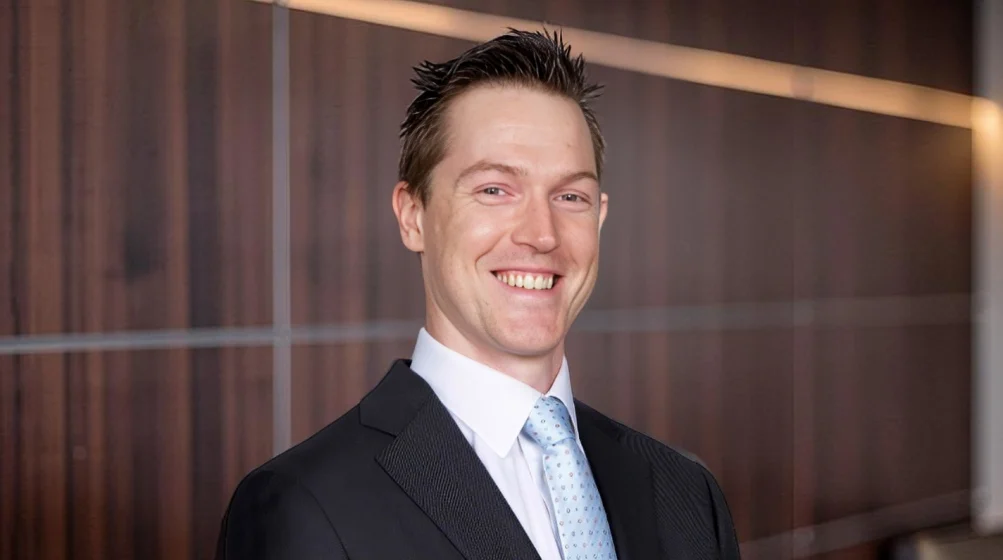
Samuel Stevens, Common Sense Oncology Fellow in Cancer Policy at Queen’s University and VMO – Medical Oncologist at NSW Health, shared a post on LinkedIn:
“Australian oncologist perspectives on time toxicity
In our new paper in JNCI Cancer Spectrum, we explored Australian oncologists’ perspectives on the time burdens (‘time toxicity’) of palliative systemic cancer treatment using a sequential mixed-methods approach. We conducted semi-structured interviews with 15 oncologists, which informed the development of a national survey of 108 oncologists.
Across both interviews and survey responses, clinicians consistently recognised that patients’ time is valuable, particularly when prognosis is limited. However, many also expressed uncertainty about how much these time burdens matter to patients themselves. This is an important gap. Emerging research with patients suggests that people with cancer also think deeply about how treatment uses their time.
The takeaway:
If clinicians already recognise time as meaningful-and patients value it too-then we should be discussing the time costs of treatment more explicitly during shared decision-making. We already have some tools to do this, but more work needs to be done to work out how best to communicate the time demands with our patients.
A huge thank you to the Aussie clinicians who participated in interviews and surveys!
We are also grateful to MOGA, COSA, AGITG, and Friends of the Sydney Cancer Survivorship Centre for helping circulate the study, the ACORD protocol development workshop for supporting the study design, and NHMRC for research funding.”
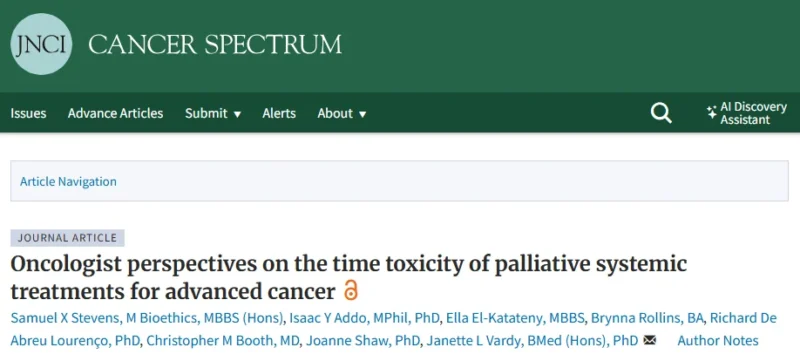
Title: Oncologist perspectives on the time toxicity of palliative systemic treatments for advanced cancer
Authors: Samuel Stevens, Isaac Addo, Ella El-Katateny, Brynna Rollins, Richard Lourenço, Christopher Booth, Joanne Shaw, Janette Vardy
Read the Full Article.
Other articles from JNCI Cancer Spectrum on OncoDaily.