





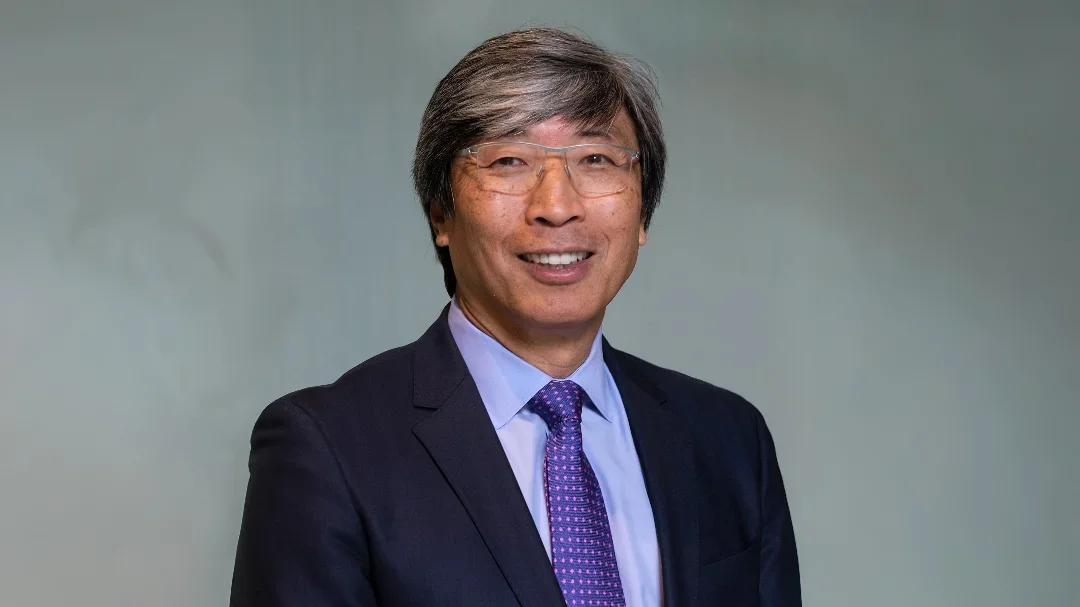
Patrick Soon-Shiong, Chairman of Chan Soon-Shiong Family Foundation, Executive Chairman at ImmunityBio, and Executive Chairman of the Los Angeles Times, shared David McKenzie’s, Attorney and Bladder Cancer Patient Advocate, post on X, adding:
“The story is heartbreaking.
Our clinicians and urologists swore an oath to ‘do no harm’. Cancer is a war against time. Our clinic hears those stories daily… now 15,000 pleas. Every American should read this story and I hope our health care policy makers and the new FDA administration reads this story too.
The clinicians at the recently held FDA workshop on this subject used the painful word that they ‘struggle’ with this and also with the 14-year neglected shortage of BCG. Is it tenable that is possible that this life saving BCG shortage can be fixed with a stroke of a pen.
It is not acceptable that America is perhaps the only developed nation that forces our doctors to ration life-saving drugs such as BCG when all other nations have no such issues. Shortage of life-saving BCG has persisted now for 14-years and our clinicians are forced to ration this drug, yet all other developed nations have solved the problem with strain agnostic BCG supply.
Our IL-15 superagonist is given in combination with BCG. Thus, patients face a dual hurdle. One, access to the IL-15 therapy with stories such as David’s with a diagnosis of high-grade papillary disease alone and a second hurdle, of access to BCG… that is in great shortage.
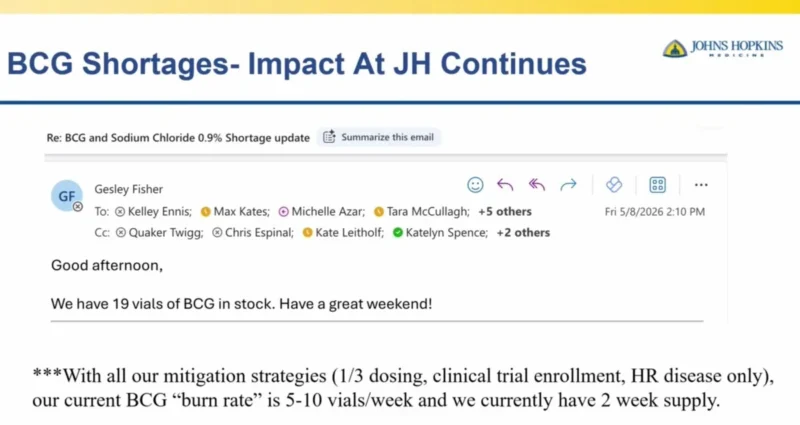
But what was mind-blowing to me when asked by the FDA, that he would be forced to send patients away to other clinics because he had no BCG and shared this slide image below with the FDA regulators in the room and the clinicians who all shared similar experiences. The speaker closed his talk by saying he just received this email from his staff stating:
‘Good afternoon, We have 19 vials of BCG in stock. Have a great weekend!’
‘With all our mitigation strategies (1/3 dosing, clinical trial enrollment, HR disease only), our current BCG ‘burn rate’ is 5-10 vials/week and we currently have a 2 week supply.’
In response to questions about this email, the speaker said he now has to decide who gets BCG at the next clinic visit. This should not be. This cannot be. Especially in the richest nation in the world who spends more in healthcare with some of the worst outcomes.
Yet American patients and their doctors face this bureaucratic rut at the cost of lives lost.
As I said, cancer is a war against time and we as physicians swore to do no harm.
Policy makers should hear from the patients themselves.”
Quoting David McKenzie’s post:
“Same Clone, Different Code.
The FDA’s own experts just demolished the regulatory fiction that kept me from my drug.
In March I wrote about what I called the Bladder Preservation Tax – the toll extracted from cancer patients by the distance between settled science and regulatory action. I am a fifty-one-year-old attorney in North Carolina, seven consecutive cystoscopies clear, alive with my bladder intact because of an immunotherapy called Anktiva – the first meaningful improvement to BCG, the intravesical immunotherapy that has been the standard of care for bladder cancer, in nearly fifty years – and a two-month guerrilla campaign against my own insurer to obtain it. I described the insurance denials, the appeals, the Orwellian phone calls, the two-floor elevator ride from the urologist who prescribed the drug to the oncology department that was the only place financially capable of administering it. I described a system that rewards intermediaries for complexity and punishes patients for biology.
On May 18, the FDA held a workshop that proved my case more efficiently than I ever could. On May 19, the agency accepted ImmunityBio’s application to approve the drug for patients with my exact disease – and gave itself until January 6, 2027 to decide. I have thoughts about that timeline.
The workshop was titled, with the bureaucratic poetry only a federal agency can muster, ‘Contemporary Issues in Non-Muscle Invasive Bladder Cancer Trial Design and Interpretation.’ What it actually was, to anyone paying attention, was the FDA’s own invited witnesses testifying against the FDA’s own regulatory position. The panelists – thought leaders in the field, the physicians who actually treat this disease – told the agency three things, each more damaging than the last to the distinction the FDA has maintained since Anktiva’s original approval in April 2024.
First, they told the FDA that carcinoma in situ and papillary disease arise from the same cancer-inducing clone. They are not two diseases. They are two phenotypic expressions of one disease – CIS being the flat form, papillary being the raised, grape-like form that may simply represent a further growth phase from CIS that was never identified. Same clone. Same biology. Same disease. The regulatory line the FDA has drawn between them is not a scientific boundary. It is an administrative convenience that became an administrative prison for approximately 80,000 Americans diagnosed with papillary bladder cancer each year.
Second, they revealed a statistic that should embarrass every stakeholder in this system: only approximately 6% of urologists in the United States use the blue-light cystoscopy that can reliably detect CIS when it coexists with papillary tumors. Six percent. For two years, insurers across the country have denied thousands of patients coverage based on a diagnostic distinction that 94% of the physicians in the relevant specialty do not have the equipment to make. I was told I had papillary disease ‘without CIS.’ The honest clinical statement, according to the FDA’s own panelists, is that I had papillary disease without anyone having looked properly for CIS. These are not the same thing. One is a diagnosis. The other is an artifact of underfunded urology practices and a reimbursement system that doesn’t pay for the better scope.
Third – and this is the one that should end the debate – the FDA asked its panelists what they actually do when they identify a patient with papillary disease alone. The answer, delivered without hedging, was: we prescribe off-label the therapies the FDA has already approved for CIS and papillary disease. Because the FDA has never approved anything for papillary alone. Several panelists stated that once they find high-grade papillary, they do not even bother to look for CIS, because its presence or absence does not change their treatment decision. The real-world standard of care has already outrun the regulatory framework by two years and counting. The FDA is not being asked to approve something novel. It is being asked to ratify what is already happening at the bedside, in practices across the country, every day – off-label, without reimbursement certainty, and over the objections of insurance companies quoting a billing code distinction that the physicians treating the disease have already abandoned.
The day after that workshop, ImmunityBio announced that the FDA had accepted its supplemental biologics license application for review. The agency assigned a decision deadline – known in regulatory jargon as a PDUFA date – of January 6, 2027. In plain English: the FDA has given itself roughly seven more months. During those seven months, approximately 80,000 more Americans will be diagnosed with papillary NMIBC. The NCCN – a panel of some thirty thought leaders from NCI-designated comprehensive cancer centers – already voted in March 2026 to designate Anktiva plus BCG as a Category 2A guideline for papillary disease alone. The clinical data are published in the New England Journal of Medicine and The Journal of Urology. The three-year numbers from the QUILT-3.032 trial show 96% disease-specific survival, greater than 80% bladder preservation, and near-95% progression-free survival at twelve months. The clinical consensus is not emerging. It has emerged. What remains is paperwork.
Journalist Mindy Kitei made the point with admirable precision: the January 6 deadline is a ceiling, not a floor. The FDA has the discretion to act before it. It has exercised that discretion before when the evidentiary case was overwhelming. I would submit – as a patient, as an advocate, and as an attorney who has spent a career reading evidentiary records – that the evidentiary case here is as overwhelming as it gets. The agency’s own witnesses said so, on the record, the day before it accepted the application.
I owe a debt of gratitude to Dr. Patrick Soon-Shiong and to ImmunityBio for this drug and for the relentless persistence required to drag it through a regulatory apparatus that does not make persistence easy. ImmunityBio received a Refusal to File letter in May 2025. A lesser company – or a more rationally self-interested one – might have walked away, run a five-year randomized trial the FDA seemed to want, and let the patients absorb the delay. ImmunityBio did not walk away. It submitted additional data. It engaged the agency. It showed up at the workshop. Dr. Soon-Shiong, who attended the May 18 session, has been vocal, public, and unrelenting in pressing the case that bladder cancer patients deserve access to this drug now, not on a bureaucratic timetable calibrated to a distinction his science has rendered meaningless. These are not rent-seekers. These are the people who took the risk – scientific, financial, and reputational – that the system is supposed to reward and mostly doesn’t.
I wrote in March about the intermediaries who profit from the complexity of this system- the insurers who have industrialized denial, the hospital billing architectures that relocate patients between floors to satisfy a ledger, the regulatory apparatus that cannot always distinguish between protecting patients and protecting the administrative status quo. I called them rent-seekers, and I used that term with its full Ricardian weight. I do not need to reprise the argument here. The May 18 workshop made it for me. When the FDA’s own panelists confirm that 94% of urologists cannot make the diagnostic distinction on which the entire reimbursement architecture rests, the toll booth is visible to everyone.
Let me be plain about what those two months of insurance warfare felt like, because the policy language can sanitize it. It was despair. Not the poetic kind. The clinical kind – the kind where you lie awake calculating whether your bladder will be removed because a claims adjuster in a cubicle has overruled a board-certified urologist on the question of medical necessity. I am an attorney. I have twenty-two years of litigation instincts and a dispositional inability to accept no for an answer. I won. But ‘winning’ should not require a law degree, a combative temperament, a patient girlfriend, and enough disposable rage to treat an insurance appeals process as a second practice. Most patients do not have those resources. Most patients comply with the denial letter. I think about them constantly.
The FDA convened the witnesses. The witnesses testified. The clinical evidence is published. The expert consensus is recorded. The application is accepted. 80,000 patients a year are waiting.
The evidence is in. Act.”
Other articles featuring Patrick Soon-Shiong on OncoDaily.