Olubukola Ayodele, Breast Cancer Lead at University Hospitals of Leicester NHS Trust, shared a post on LinkedIn:
“ESMO Breast 2026 is almost here, and the momentum in breast cancer research is hard to ignore.
This year’s “trials to watch” reflect not just incremental progress, but a shift in how we think about treatment intensity, precision, and patient experience.
Here are the themes that stand out to me:
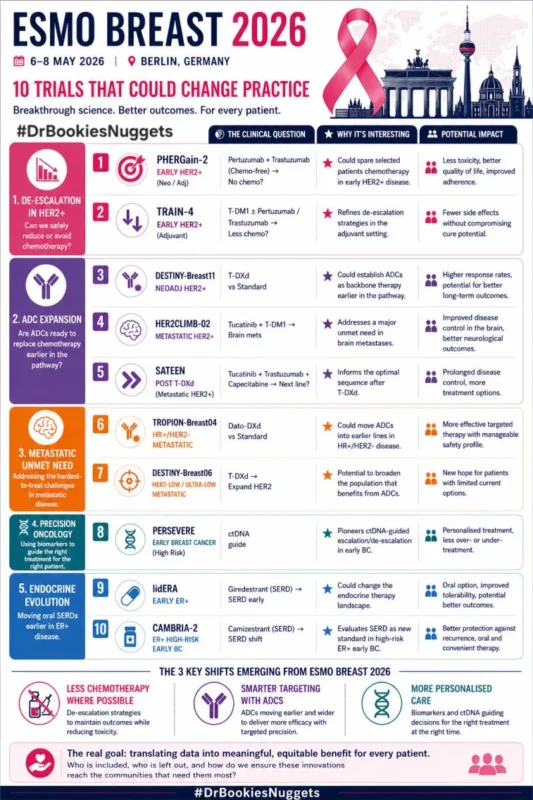
First, the question we have all been asking in HER2-positive disease:
Can we safely reduce or even avoid chemotherapy?
Trials like PHERGain-2 and TRAIN-4 push this boundary further. If carefully selected patients can achieve excellent outcomes with less or no chemotherapy, that is not just practice changing, it is life changing. Reduced toxicity, preserved quality of life, and potentially better adherence.
Second, the continued rise of antibody-drug conjugates (ADCs).
Studies such as DESTINY-Breast11, TROPION-Breast04, and DESTINY-Breast06 are not simply comparing drugs, they are redefining where ADCs sit in the treatment pathway. The key question is no longer ‘do they work?’ but ‘should they replace chemotherapy earlier?’ If the answer is yes, we may be entering a new standard where targeted delivery consistently outperforms traditional cytotoxics.
Third, tackling areas of unmet need in metastatic disease.
HER2CLIMB-02 focuses on brain metastases, a space where progress has historically been limited. Similarly, SATEEN explores sequencing after T-DXd, which is increasingly relevant as more patients receive ADCs earlier. These are practical questions clinicians face daily, and the answers could directly influence real-world decision making.
Fourth, precision oncology in its truest sense.
The PERSEVERE trial, using ctDNA to guide treatment, represents a move towards escalation and de-escalation based on molecular risk rather than broad clinicopathological features. If successful, this could spare low-risk patients unnecessary treatment while identifying those who truly need more.
Finally, the evolution of endocrine therapy.
Trials like lidERA and CAMBRIA-2 bring oral SERDs earlier into the disease course. The question is whether we are ready to shift away from longstanding standards in ER-positive disease. If these agents demonstrate clear benefit, the ripple effect across early breast cancer management could be significant.
Across all these studies, three shifts are clear:
- Less chemotherapy where possible,
- Smarter targeting with ADCs, and
- More personalised care through biomarkers.
The real test, however, is not just statistical significance. It is whether these advances translate into meaningful, equitable benefit for all patients. As we interpret these results, we must keep asking: who is included, who is left out, and how do we ensure these innovations reach the communities that need them most?
Looking forward to the discussions, the data, and hopefully, practice-changing insights.”
Top 10 Breast Cancer Abstracts To Watch At ESMO Breast Cancer 2026