Matthew Oberley, Chief Clinical Officer at Caris Life Sciences, shared Jack Shuang Hou’s, Scientific Director at Jtests and CordDx, post on LinkedIn, adding:
“This is spot on.
The success of the AI required WES and WTS. Our board-certified Pathologists oversee the tool. Diagnosis is a fundamental (and the original) predictive biomarker.”
Quoting Jack Shuang Hou’s post on LinkedIn:
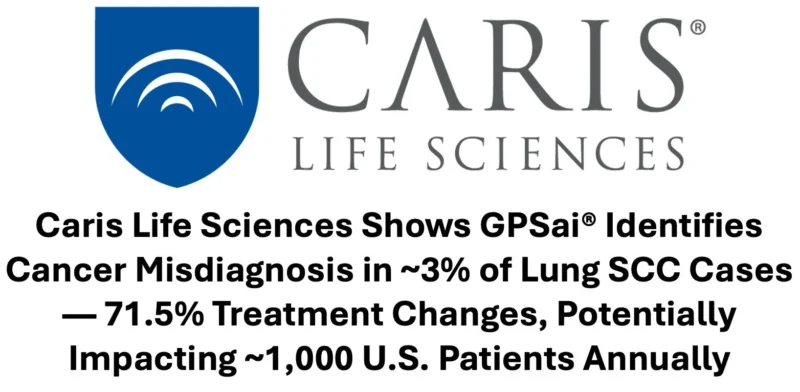
“Caris Life Sciences Shows GPSai Identifies Cancer Misdiagnosis in ~3% of Lung SCC Cases – 71.5% Treatment Changes, Potentially Impacting ~1,000 U.S. Patients Annually
A powerful example of AI directly improving clinical decision-making:
Caris Life Sciences published new data in JAMA Network Open demonstrating that its GPSai algorithm can detect and correct cancer misdiagnoses, with meaningful downstream impact on treatment.
Key findings
1. Misdiagnosis detection at scale
- Study of 3,958 lung SCC cases
- 123 cases (~3.1%) reclassified as metastases from other origins
2. Major clinical impact
- 71.5% of reclassified patients (88 cases) – Required changes to first-line therapy
3. Real-world implications
- Lung SCC = ~21% of U.S. lung cancers
- Estimated ~1,000 patients/year potentially misdiagnosed
4. AI + molecular profiling synergy
- GPSai integrated with WES/WTS-based profiling
- Enhances tissue-of-origin accuracy + treatment selection
Leadership insight
Matthew Oberley, MD, PhD – Senior Vice President, Chief Clinical Officer and Pathologist-in-Chief, Caris Life Sciences: “Caris GPSai has overturned 3,857 diagnoses… ensuring patients receive the most appropriate care.”
Why this matters
- Diagnosis is still a bottleneck
Even in advanced oncology – misclassification persists - Treatment depends on origin
Wrong diagnosis = wrong therapy pathway - AI is becoming a second diagnostic layer
Not replacing pathology leads to augmenting decision confidence - Precision medicine is evolving
From mutation detection to full disease reclassification
My takeaway
- AI is shifting oncology from “classification” to “reclassification”
Correcting errors may be as impactful as discovering new drugs - Multi-omics + AI is the real differentiator
Sequencing alone isn’t enough – interpretation layer is key - Clinical adoption will hinge on outcome impact
71.5% therapy change = clear value proposition for payers + providers
Bottom line: Caris Life Sciences is demonstrating that AI in diagnostics isn’t just incremental – it can fundamentally change diagnosis, treatment, and patient outcomes at scale.
Other articles featuring Matthew Oberley on OncoDaily.