






Mamtha Balla, Transplant Oncology-ID fellow at MD Anderson Cancer Center and Hematology oncology Fellow at The University of Toledo, shared a post on X:
“Acute Myeloid Leukemia (AML) – Boards/ITE Power Thread
(Follow ASCO/ASH/NCCN for latest updates)
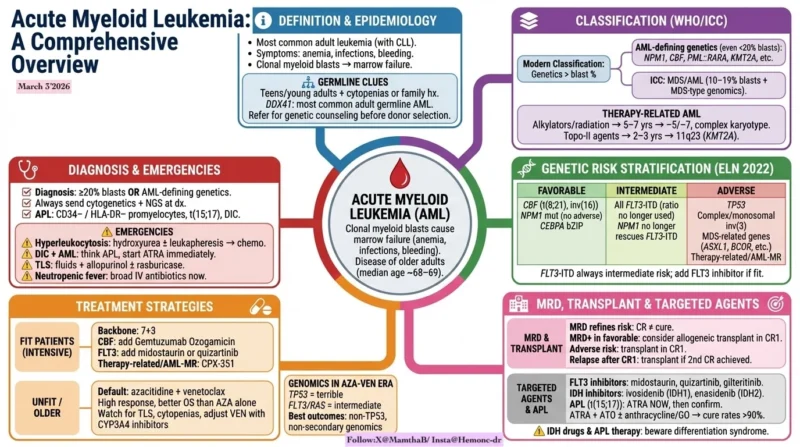
1. Clonal myeloid blasts → marrow failure (anemia, infections, bleeding). Disease of older adults (median ~68–69). AML + CLL = most common adult leukemias.
2. Therapy‑related AML (t‑AML)
- Alkylators/radiation → 5–7 yrs → −5/−7, complex karyotype.
- Topo‑II (etoposide/anthracyclines) → 2–3 yrs → 11q23 (KMT2A).
Topo‑2 → 2–3 yrs → chr 11
3. Modern AML classification (WHO/ICC)
- Genetics > blast %. NPM1, CBF, PML::RARA, KMT2A, NUP98, MECOM, etc can define AML even <20% blasts. →ICC adds MDS/AML (10–19% blasts + MDS‑type genomics).
4. Germline AML clues
- Teens/young adults + cytopenias or family hx → think inherited.
- DDX41 = most common adult germline AML; often older, cytopenias, hypocellular marrow → refer for genetic counseling before choosing donor.
5. AML emergencies (boards love these)
- Hyperleukocytosis/leukostasis → hydroxyurea ± leukapheresis → then chemo.
- DIC + AML → think APL → start ATRA immediately.
- TLS (esp VEN) → fluids + allopurinol ± rasburicase.
- Neutropenic fever → broad IV abx NOW.
6. Diagnostic core
- AML = ≥20% blasts OR AML‑defining genetics (e.g., inv(16), NPM1).
- APL: CD34− / HLA‑DR− promyelocytes, t(15;17), DIC.
Always send cytogenetics + NGS at dx.
7. ELN 2022 – memorize this grid
- Favorable: CBF (t(8;21), inv(16)), NPM1 mut (no adverse), CEBPA bZIP.
- Intermediate: all FLT3‑ITD (ratio no longer used).
- Adverse: TP53, complex/monosomal, inv(3), MDS‑related genes (ASXL1, BCOR, EZH2, RUNX1, SF3B1, SRSF2, STAG2, U2AF1, ZRSR2), therapy‑related/AML‑MR.
8. Risk shift pearl
- FLT3‑ITD = always intermediate risk now.
- No more allelic ratio games. NPM1 no longer “rescues” FLT3‑ITD into favorable. You still add a FLT3 inhibitor if fit.
9. Fit patients (intensive)
- Backbone = 7+3 (never daunorubicin 45 mg/m²).
- CBF → add Gemtuzumab Ozogamicin (best in favorable).
- FLT3 (ITD or TKD) → add midostaurin; FLT3‑ITD only → quizartinib option.
- Therapy‑related / AML‑MR (esp 60–75) → CPX‑351.
10. Unfit / older AML
- Default = azacitidine + venetoclax.
- High response rate, better OS than AZA alone.
Watch: TLS (ramp up, cytoreduce first), profound cytopenias → do marrow after C1, then build in VEN breaks; reduce VEN with strong CYP3A4 inhibitors (azoles).
Genomics in AZA‑VEN era
- TP53 = terrible regardless of regimen.
- Signaling mutations (FLT3/RAS) = intermediate.
- Best outcomes = non‑TP53, non‑secondary genomics.
- ELN was built for intensive chemo, less predictive with AZA‑VEN.
MRD = the real boss
- CR ≠ cure. MRD (flow ~10⁻⁴, PCR 10⁻⁵) refines risk.
- “Favorable + MRD+” → NOT truly favorable → think allogeneic transplant in CR1, especially NPM1‑mut MRD+.
Who gets allo‑SCT in CR1?
- Adverse risk.
- Most intermediate risk.
- Any favorable‑risk with MRD+.
- Relapse after CR1 → if 2nd CR achieved, go to transplant.
Targeted agents: know this mini‑table
- FLT3: midostaurin (new dx ITD/TKD), quizartinib (new dx ITD only), gilteritinib (relapsed ITD/TKD).
- IDH: ivosidenib (IDH1), enasidenib (IDH2).
- IDH drugs and APL therapy = differentiation → beware differentiation syndrome → steroids early.
APL – guaranteed exam hit
- t(15;17) PML::RARA, CD34− / HLA‑DR−, DIC.
Management rule: ATRA NOW, then confirm.
- Treat coagulopathy (fibrinogen >100–150, platelets >30–50k).
- ATRA + ATO ± anthracycline/GO → cure rates >90%.
Ultra‑compressed AML hooks
NPM1 = Nice prognosis.
TP53 = Terrible.
CBF = Good + GO + HiDAC.
FLT3‑ITD = intermediate; ratio retired; add FLT3 inhibitor.
Unfit = AZA‑VEN.
MRD+ = transplant.
APL = ATRA ASAP.”
Other articles featuring Mamtha Balla on OncoDaily.