






Lindsey B. Cotton, Chief Strategy Officer at tensorblack, shared a post on LinkedIn:
“ASCO 2026 isn’t about new drugs— It’s about redefining how we use them.
One of the more exciting shifts emerging across this year’s expected lung cancer data is how much the conversation has evolved beyond initial efficacy.
The focus now is increasingly on:
- durability
- CNS control
- sequencing
- molecular refinement
- and identifying which patients truly benefit from treatment escalation
That evolution is reflected across both NSCLC and SCLC.
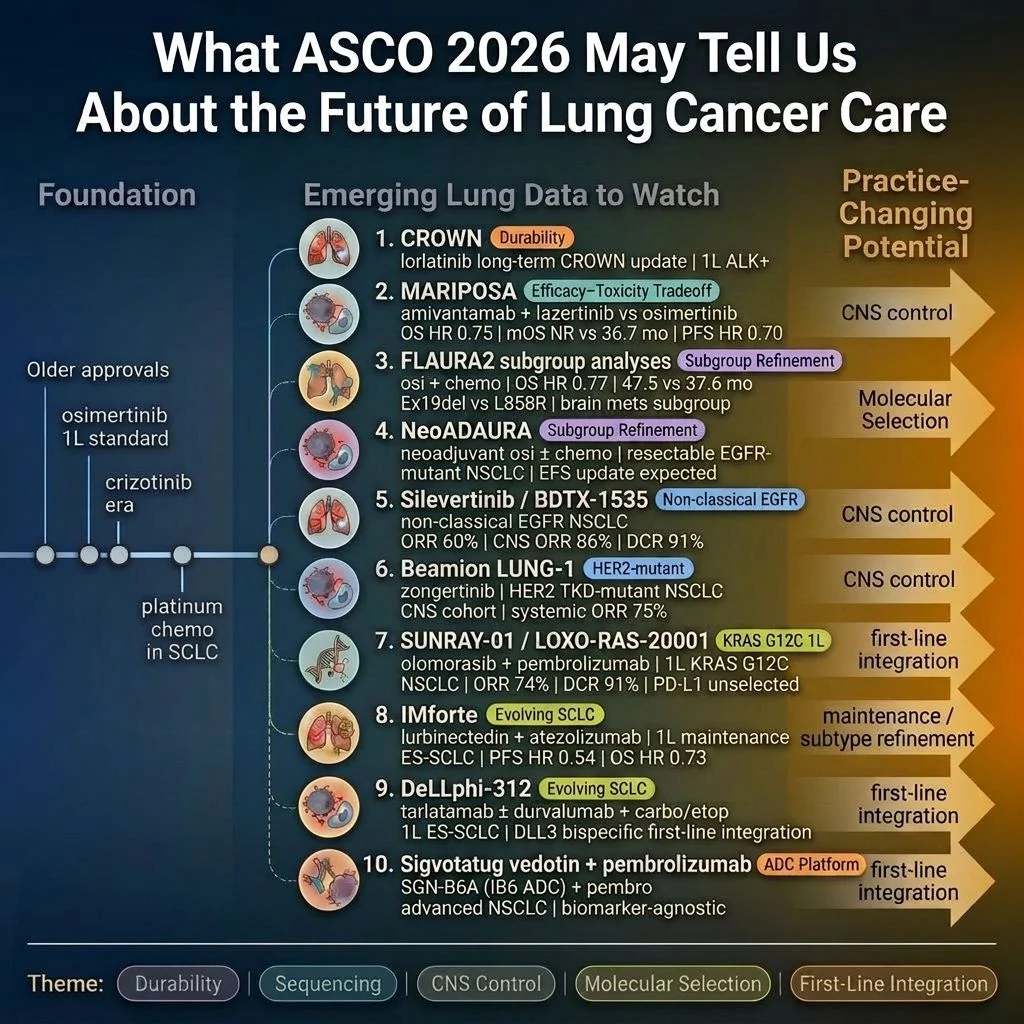
Long-term follow-up from studies like CROWN continues to reshape expectations around durability in ALK-positive disease. MARIPOSA and FLAURA2 are further pushing the frontline EGFR conversation beyond response rates alone and into longer-term strategy, sequencing, and survival optimization.
At the same time, newer HER2- and KRAS-directed approaches continue to expand the scope of actionable biology in lung cancer, while several emerging SCLC strategies suggest the field may finally be moving toward a more biologically stratified era after years of limited progress.
Taken together, these studies feel less like isolated datasets and more like evidence of a broader transition in thoracic oncology.
Treatment decisions are becoming increasingly individualized:
- by mutation,
- CNS involvement,
- prior therapy,
- resistance pattern,
- and clinical context.
That progress is exciting, but it also introduces a growing degree of complexity into real-world oncology care.
Not because clinicians lack expertise—but because the volume of molecular, imaging, sequencing, and longitudinal treatment information continues to expand rapidly.
That is where AI and clinical intelligence platforms may ultimately become most useful:
not as replacements for clinical judgment, but as infrastructure to help support increasingly complex precision oncology workflows.
The science remains the most important story.
But one of the defining challenges moving forward may be how health systems operationalize this level of precision consistently across everyday patient care.
Meanwhile- no the ultimate goal is winning for our patients.
Excited for ASCO 2026 to connect and collaborate with my peers and colleagues in this space.”
More posts about ASCO 2026