






Kefah Mokbel, Chair of Breast Cancer Surgery at London Breast Institute and Honorary Professor of Medicine at Cardiff University School of Medicine, shared a post on LinkedIn:
“TP53 Mutation Predicts Shorter CDK4/6 Inhibitor Benefit in ER+/HER2− Breast Cancer – A Real-World Genomic Signal
A new study published in Breast Cancer Research adds important real-world evidence to the growing case for integrating tumour genomics into treatment planning for ER-positive/HER2-negative breast cancer.
Using the Japanese C-CAT cohort (n = 1,668) of metastatic breast cancer patients, complemented by METABRIC (n = 1,355) for survival and gene set enrichment analysis, the authors examined whether TP53 mutational status influences clinical benefit from CDK4/6 inhibitors and immune checkpoint inhibitors (ICIs).
Key findings:
- TP53 mutation was associated with significantly shorter CDK4/6i treatment duration, with consistent trends across both abemaciclib and palbociclib.
- In contrast, TP53 status had no impact on ICI treatment duration – suggesting differential biological dependency.
- GSEA revealed TP53-mutated tumours were enriched for proliferation and immune response pathways, whereas wild-type tumours were enriched for oestrogen response signalling – providing a mechanistic basis for the divergent treatment responses.
- The AYA (15–39 years) subgroup had the highest TP53 mutation prevalence and the shortest treatment durations overall, although formal interaction testing between TP53 status and age group did not reach significance.
Clinical implications:
These data reinforce the need to interpret real-world endpoints such as treatment duration through both a genomic and an age-stratified lens. They also raise the question of whether TP53-mutated ER+/HER2− tumours warrant earlier consideration of alternative or escalated strategies – particularly given the limited durability of CDK4/6 inhibition in this subset.
As we move further into the era of NGS-guided management in HR+/HER2− metastatic disease, TP53 may join ESR1, PIK3CA, and AKT1 as a clinically actionable biomarker informing sequencing decisions.”
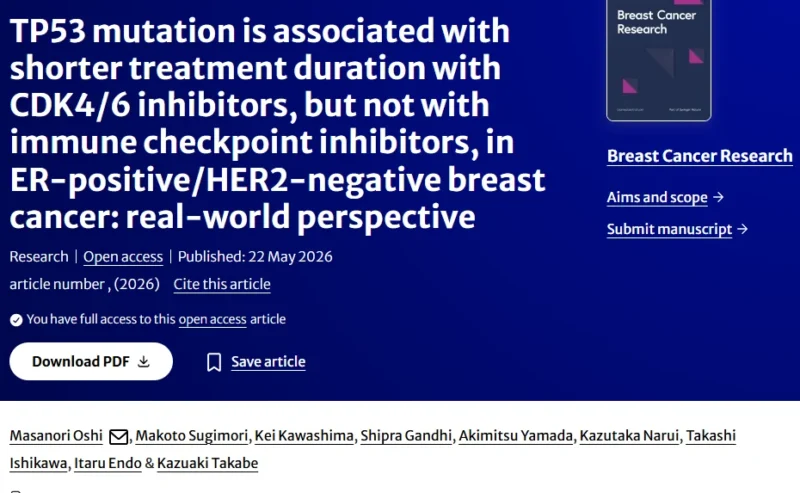
Title: TP53 mutation is associated with shorter treatment duration with CDK4/6 inhibitors, but not with immune checkpoint inhibitors, in ER-positive/HER2-negative breast cancer: real-world perspective
Authors: Masanori Oshi, Makoto Sugimori, Kei Kawashima, Shipra Gandhi, Akimitsu Yamada, Kazutaka Narui, Takashi Ishikawa, Itaru Endo, Kazuaki Takabe
Read the Full Article.
Other articles featuring Kefah Mokbel on OncoDaily.