Kefah Mokbel, Chair of Breast Cancer Surgery at London Breast Institute and Honorary Professor of Medicine at Cardiff University School of Medicine, shared a post on LinkedIn:
“Chemo-Free Neoadjuvant Therapy in HR+/HER2+ Early Breast Cancer: 5-Year Results from WSG TP-II
The final 5-year survival analysis of the WSG TP-II trial (Gluz et al., JCO 2026) offers compelling evidence that less can indeed be more in HR+/HER2+ early breast cancer.
In this randomised phase II trial, 207 patients received 12 weeks of neoadjuvant dual HER2 blockade (trastuzumab + pertuzumab) combined with either endocrine therapy (ET) or weekly paclitaxel, followed by pCR-guided adjuvant treatment.
Key 5-year outcomes:
- Overall survival: 100% (ET arm) vs 97.9% (paclitaxel arm)
- Event-free survival (including DCIS): 92.1% vs 94.8%
- Invasive disease-free survival: 97.7% vs 79.8%
Despite a markedly lower pCR rate in the ET arm (23.7% vs 56.4%), long-term survival was excellent in both groups – a powerful reminder that pCR is not the sole determinant of outcome in HR+/HER2+ disease, where endocrine-driven biology continues to exert prognostic influence well beyond the neoadjuvant window.
Why this matters clinically:
- A chemotherapy-free neoadjuvant pathway is feasible and safe in selected patients with HR+/HER2+ eBC
- pCR-guided adjuvant escalation provides a rational safety net for non-responders
- De-escalation strategies may meaningfully reduce toxicity without compromising long-term outcomes
- The data strengthen the case for biomarker-driven patient selection – and for re-examining the role of pCR as a surrogate endpoint in luminal HER2+ disease
WSG TP-II adds to a growing body of evidence supporting thoughtful de-escalation in HER2-positive breast cancer, complementing signals from APT, ATEMPT, and PHERGain. The next frontier: identifying which patients can safely skip chemotherapy altogether.
My Commentary
WSG TP-II is encouraging but warrants careful interpretation. In a selected HR+/HER2+ population (largely cT1–cT2, cN0–cN1), neoadjuvant endocrine therapy + dual HER2 blockade delivered excellent 5-year outcomes – but only because non-responders received standard adjuvant chemotherapy. This is pCR-guided de-escalation, not chemotherapy omission.
Key caveats:
- Sample size: 207 patients – hypothesis-generating, not practice-defining.
- Patient selection: high-risk presentations (large tumours, heavy nodal burden, inflammatory disease) were excluded; extrapolation to cT3–T4 or cN2–3 disease is not supported.
- pCR gap: roughly three-quarters of ET-treated patients ultimately required chemotherapy anyway – the strategy delays rather than eliminates it for most.
A promising proof of concept – but phase III confirmation and biomarker-driven selection will be needed before chemotherapy-free neoadjuvant therapy becomes a default pathway in HR+/HER2+ early breast cancer.”
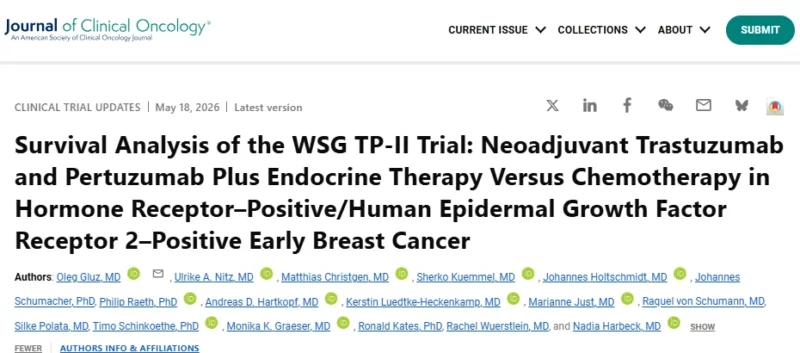
Title: Survival Analysis of the WSG TP-II Trial: Neoadjuvant Trastuzumab and Pertuzumab Plus Endocrine Therapy Versus Chemotherapy in Hormone Receptor–Positive/Human Epidermal Growth Factor Receptor 2–Positive Early Breast Cancer
Authors: Oleg Gluz, Ulrike A. Nitz, Matthias Christgen, Sherko Kuemmel, Johannes Holtschmidt, Johannes Schumacher, Philip Raeth, Andreas D. Hartkopf, Kerstin Luedtke-Heckenkamp, Marianne Just, Raquel von Schumann, Silke Polata, Timo Schinkoethe, Monika K. Graeser, Ronald Kates, Rachel Wuerstlein, Nadia Harbeck
Read the Full Article.
OLIGOMA Trial: SBRT Extends PFS in Oligometastatic Breast Cancer