
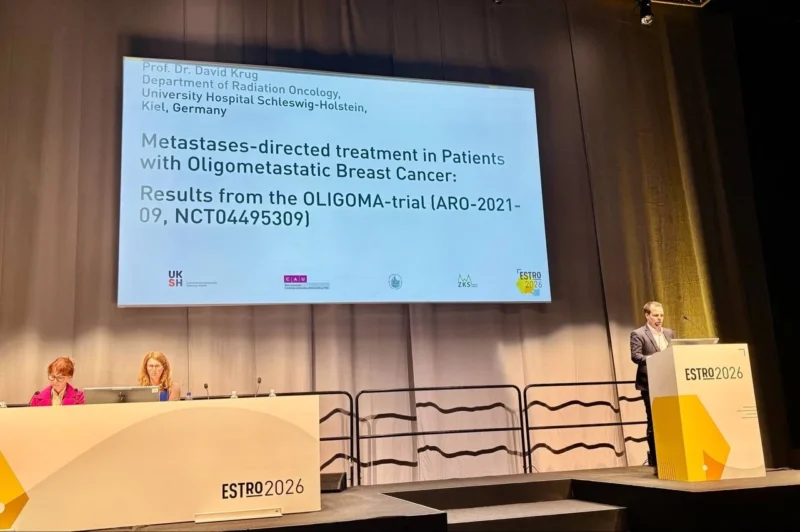
The OLIGOMA trial presented at ESTRO 2026 brings new attention to one of the most debated questions in metastatic breast cancer: can treating limited metastatic sites with stereotactic body radiotherapy improve outcomes beyond local tumor control?
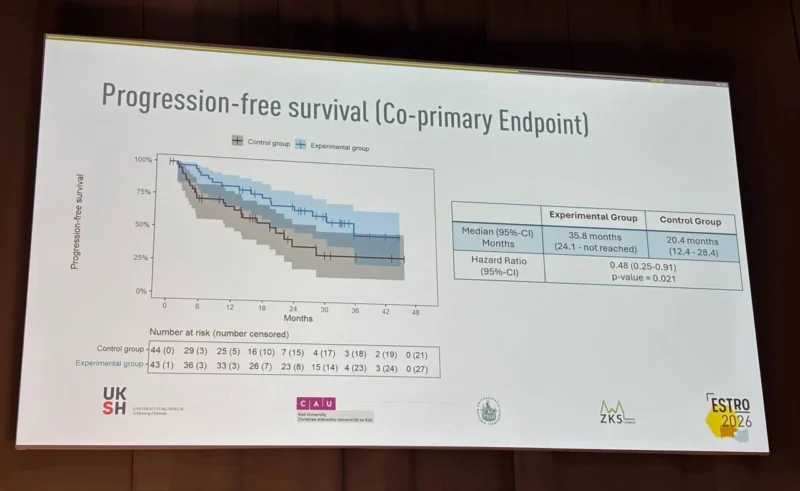
In this small randomized controlled trial, patients with oligometastatic breast cancer who received metastasis-directed stereotactic body radiotherapy (SBRT) in addition to standard systemic therapy had a substantially longer progression-free survival compared with patients treated with standard therapy alone. The reported median progression-free survival was approximately 36 months with SBRT plus standard therapy versus approximately 21 months with standard therapy alone, corresponding to a hazard ratio of 0.48.
Why OLIGOMA Matters
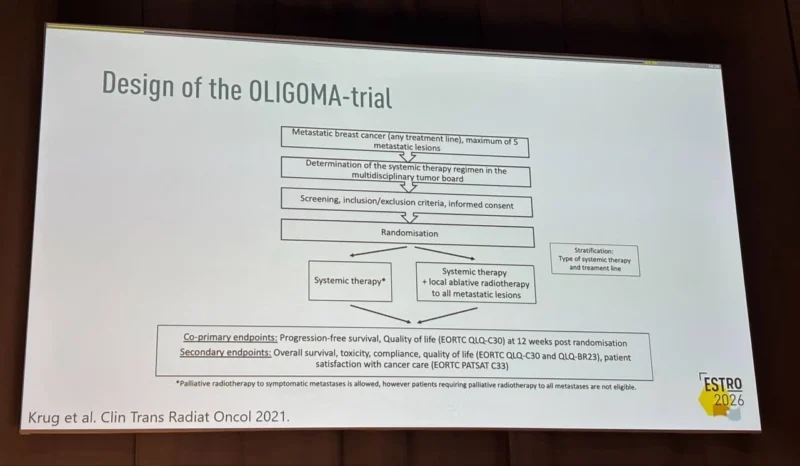
Oligometastatic breast cancer describes a state in which the cancer has spread, but only to a limited number of metastatic sites. In OLIGOMA trial, patients had one to five metastases, making them potential candidates for aggressive local treatment of all visible disease.
This concept has gained momentum in several solid tumors, including prostate and lung cancer, where metastasis-directed therapy has shown meaningful clinical signals. Breast cancer, however, has been more challenging. Prior data have been mixed, and the role of SBRT in improving systemic disease control has remained uncertain.
The OLIGOMA trial results therefore stand out because they suggest that, in carefully selected patients, local treatment of metastatic lesions may delay progression without a major short-term quality-of-life penalty.
Study Design
The trial enrolled 87 patients across 31 hospitals in Germany and Austria between March 2021 and April 2024. Patients were randomized to receive either standard systemic therapy alone or standard therapy plus SBRT directed at all known metastatic lesions.
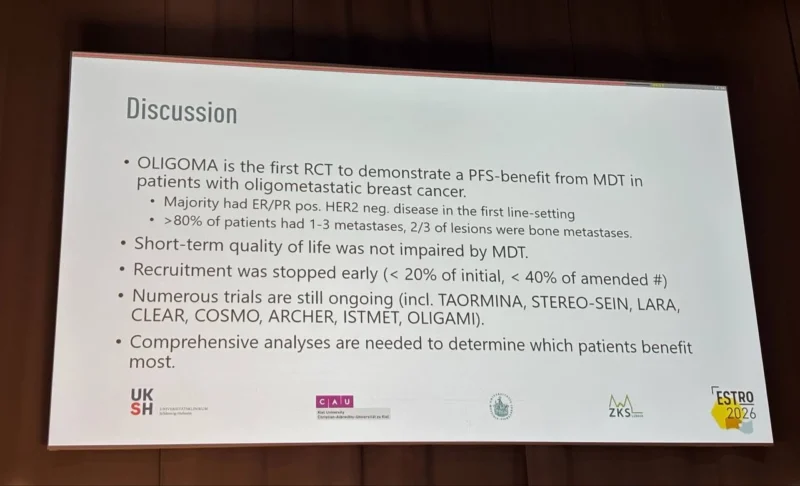
The trial had originally been planned as a larger study, but it was stopped early because of slow recruitment. According to Prof. David Krug, recruitment was affected partly because many patients either had too many metastatic sites by the time metastatic disease was detected or wanted to receive radiotherapy outside the trial rather than risk randomization to standard therapy alone.
This early closure is important when interpreting the results. The signal is strong, but the sample size remains limited.
Key Results
Patients treated with SBRT plus standard therapy had longer progression-free survival than those receiving standard treatment alone. The slide presented at ESTRO 2026 reported median PFS of 35.8 months in the experimental group versus 20.4 months in the control group, with a hazard ratio of 0.48 and a p value of 0.021.
The ESTRO release reported a very similar result, with median PFS of 36.2 months versus 20.6 months. Taken together, the result represents an improvement of roughly 15 months in median progression-free survival.
Quality of life was also evaluated 12 weeks after radiotherapy using a standard questionnaire. The average deterioration in the radiotherapy group was around 2 points on a 0–100 scale, which was well below the prespecified 10-point margin. This suggests that adding SBRT did not produce a major short-term negative effect on quality of life.
Clinical Interpretation
The clinical implication is that SBRT may help selected patients with oligometastatic breast cancer live longer without disease progression when added to standard systemic therapy.
This does not mean that every patient with metastatic breast cancer should receive SBRT. The treatment is most relevant for patients with a limited number of metastatic lesions, good overall condition, and disease biology suggesting a realistic chance of durable control.
The result also does not yet prove an overall survival benefit. The trial was small, stopped early, and further randomized evidence is needed. Still, the magnitude of PFS improvement makes OLIGOMA trial an important study for multidisciplinary discussion.
Why Caution Is Still Needed
The trial’s small size remains the main limitation. With only 87 patients, subgroup analyses are limited, and the results need confirmation in larger studies. Oligometastatic breast cancer is also biologically heterogeneous. Hormone receptor status, HER2 status, disease-free interval, metastatic site, systemic therapy sensitivity, and number of lesions may all influence who benefits most from SBRT.
The other key point is that metastasis-directed therapy should not replace systemic therapy. In OLIGOMA trial, SBRT was added to standard drug treatment, not used instead of it.
Takeaway
The OLIGOMA trial provides a strong signal that metastasis-directed SBRT can extend progression-free survival in selected patients with oligometastatic breast cancer, with no major short-term quality-of-life deterioration reported.
For now, the results support individualized discussion in tumor boards rather than universal adoption. But the message from ESTRO 2026 is clear: in oligometastatic breast cancer, local treatment of metastatic disease may be more than just local control.