Kefah Mokbel, Chair of Breast Cancer Surgery at London Breast Institute and Honorary Professor of Medicine at Cardiff University School of Medicine, shared a post on LinkedIn:
“Ovarian Suppression Saves Lives in ER+ Early Breast Cancer: It Is no Longer Optional in the Right Patients
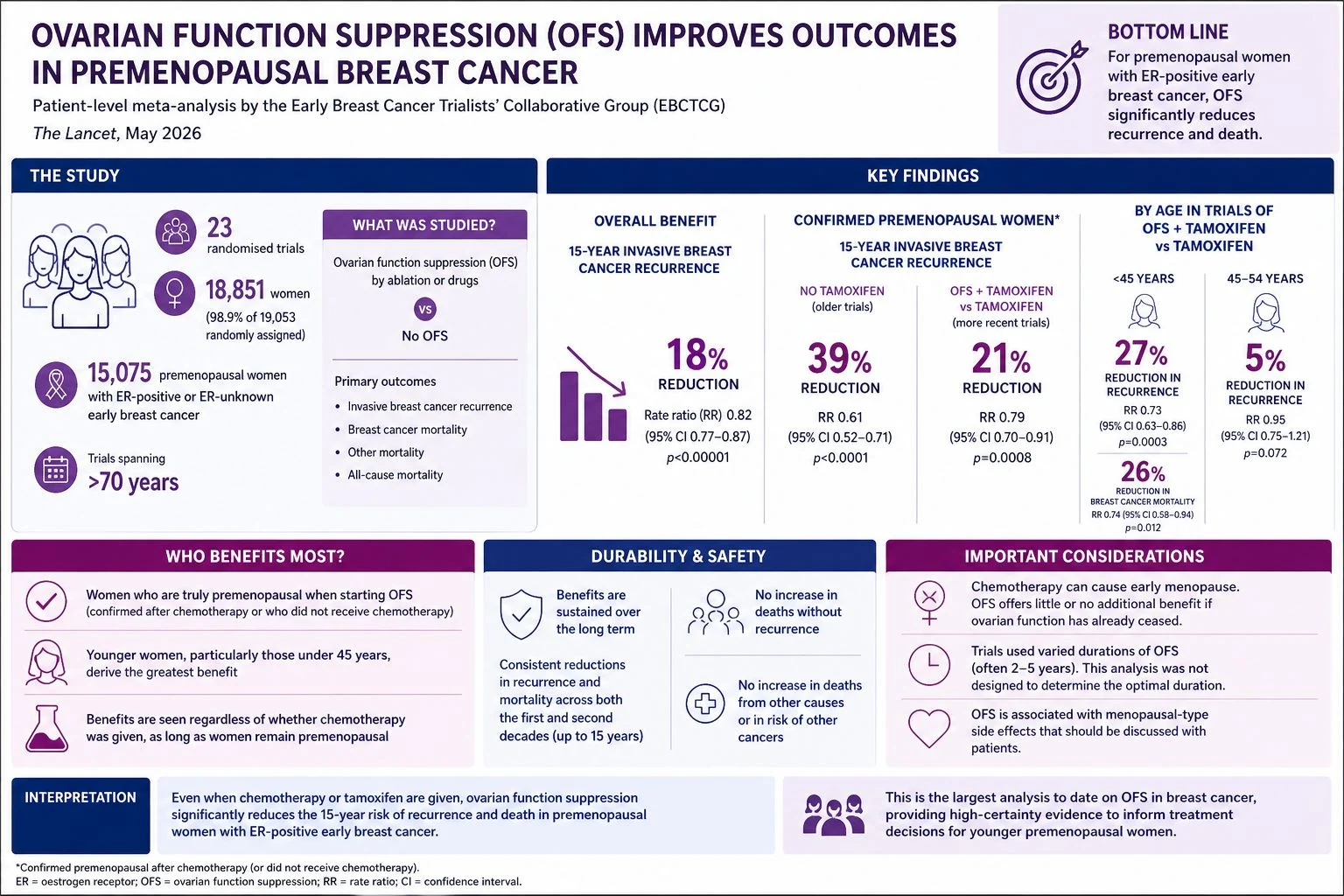
A landmark patient-level meta-analysis from the Early Breast Cancer Trialists’ Collaborative Group, published in The Lancet, provides some of the most definitive evidence we have on ovarian function suppression (OFS) in premenopausal breast cancer.
This is high-certainty evidence.
Data from 23 randomised trials, including 18,851 women (98.9% of all eligible patients), with 15,075 premenopausal women forming the core analysis.
What does the data show?
OFS significantly reduces breast cancer recurrence:
An 18% relative reduction overall
(RR 0.82, 95% CI 0.77–0.87; p<0.00001)
But the real insight lies in who benefits most.
Among women confirmed to be premenopausal:
- A 39% reduction in recurrence in trials without tamoxifen
(RR 0.61) - A 21% additional reduction when OFS is added to tamoxifen
(RR 0.79)
Age further sharpens the effect.
In women under 45:
- A 27% reduction in recurrence
(RR 0.73) - A 26% reduction in breast cancer mortality
(RR 0.74; p=0.012)
In contrast, women aged 45–54 showed little clear benefit (RR 0.95).
Importantly:
There was no increase in deaths without recurrence, and the benefit was consistent regardless of how OFS was delivered.
What is the key clinical message?
This is not simply about adding another treatment.
It is about using the right treatment in the right patient.
The benefit of OFS depends critically on true menopausal status. If ovarian function has already ceased — for example after chemotherapy — the benefit is minimal. If it remains active, the impact is substantial.
Bottom line
OFS is a biologically powerful and clinically effective intervention in premenopausal ER-positive early breast cancer.
The challenge is not whether to use it.
It is identifying who truly benefits.
The absolute benefit varies with baseline risk.
For women with lower-risk disease — such as small, low-grade tumours — the incremental gain from OFS is likely modest, and must be weighed carefully against toxicity, quality of life, and long-term effects.
For younger, higher-risk, clearly premenopausal women, the benefit is substantial and potentially life-saving.
This is not about giving more treatment.
It is about giving the right treatment to the right patient.”
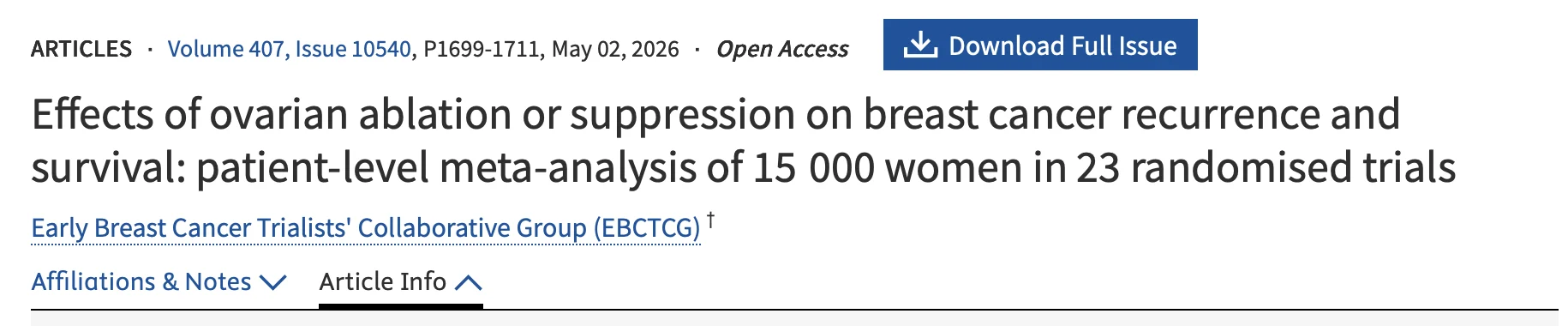
Title: Effects of ovarian ablation or suppression on breast cancer recurrence and survival: patient-level meta-analysis of 15 000 women in 23 randomised trials
Authors: Early Breast Cancer Trialists’ Collaborative Group
Read the Full Article on The Lancet
More posts featuring Kefah Mokbel.