






Jemma Arakelyan, Chief Executive Officer at The Institute of Cancer and Crisis (ICC) and Medical Advisor at Immune Oncology Research Institute, shared a post on LinkedIn:
“When I first met Prof. Che, he looked at me and asked:
‘Why is Cisplatin still in clinical use? It’s so toxic.’
Cisplatin is like the grandfather of chemotherapy, and it’s a good friend to every medical oncologist. In fact, even clinical oncologists, who mainly do radiotherapy, can’t imagine working without it. Somehow, with time, we learned how to handle side effects and never questioned why we still use it.
Along with Dr. Robert Peter Gale and Dr. Herbert Loong, we wrote an article that not only defends Cisplatin but also asks a tough follow-up question:
Are we using it because it’s elegant, or because we have nothing better?
After more than fifty years of research and countless published papers, why is there still nothing better than this simple molecule?
Our take: In today’s global oncology landscape, Cisplatin is still irreplaceable.
Not because it’s perfect.
But for several major cancers like testicular, ovarian, head and neck, and bladder, the mix of effectiveness, accessibility, and years of clinical experience still stands out.
But we want you to oppose us.
Disagree? Think carboplatin, oxaliplatin, ADCs, or IOs have already won? (Promising as they are, how accessible are these ADC plus IO combinations for bladder cancer patients?)
Tell us why. Challenge the data. That’s the whole point. We want to start a discussion.”
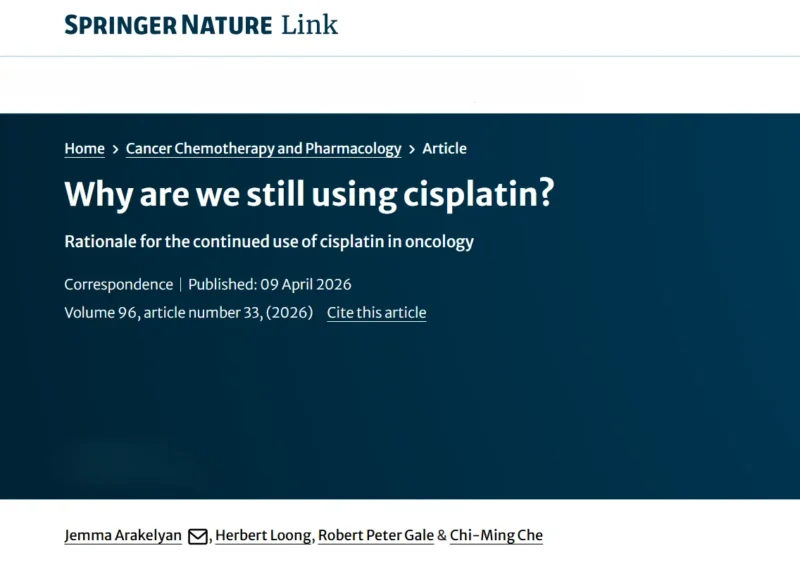
Title: Why are we still using cisplatin?
Authors: Jemma Arakelyan, Herbert Loong, Robert Peter Gale, Chi-Ming Che.
Other articles featuring Jemma Arakelyan, Herbert Loong and Robert Peter Gale on OncoDaily.