






Gustavo Monnerat, Deputy Editor at The Lancet, shared a post on LinkedIn:
“AI can make scientific images clearer. It can also get a paper retracted.
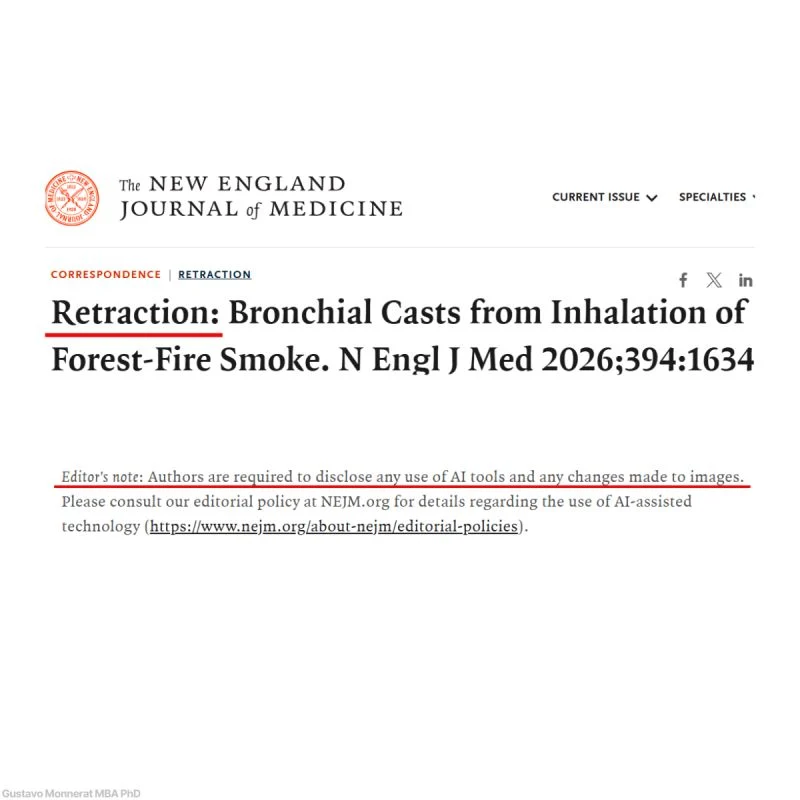
NEJM published a retraction for an article after the authors said they had used an AI tool to edit the image.
The authors stated that they were unaware of the journal’s AI policies. NEJM’s editor’s note reminded authors that AI use and image changes must be disclosed.
This is a editorial case with a very practical lesson: AI use in manuscripts is not automatically a problem. Undisclosed or poorly documented AI use is.
5 rules every author should follow before using AI in a manuscript:
- Read the journal policy before submission. AI rules are not identical across journals or publishers.
- Disclose AI use explicitly. Do not hide AI-assisted writing, editing, translation, figure preparation, coding, or analysis.
- Put AI in the Methods when it affects the research process. If AI contributed to screening, measurement, analysis, diagnosis, image interpretation, or model development, it belongs in the methods, not only in a generic disclosure.
- Treat scientific images as evidence, not illustrations. Moving a ruler, scale bar, lesion, label, band, cell, or object can change interpretation.
- Preserve provenance. Keep raw files, prompts, edited versions, and a record of every change.
What AI uses should journals allow, require disclosure for, or forbid entirely in scientific and medical research?”
Other articles featuring Gustavo Monnerat on OncoDaily.