George Kumar, Senior Director at AstraZeneca, shared on LinkedIn:
“Why do only half of triple-negative breast cancer (TNBC) patients respond well to chemotherapy — and can we see the answer at single-cell resolution?
TNBC is one of the most aggressive breast cancer subtypes, and chemotherapy remains the backbone of treatment. Yet only about half of patients achieve a good clinical outcome. A new study set out to understand why, starting from where it matters most: treatment-naive tumors, before any therapy reshapes the biology.
The scale is striking. Using pretreatment samples from patients who went on to receive neoadjuvant chemotherapy, the team profiled 427,857 cells from 101 patients by single-cell transcriptomics, paired with spatial transcriptomics across 44 patients.
What they found reframes how we think about chemo response in TNBC:
- Four patient-level tumor subtypes (archetypes), defined by cancer-cell gene expression
- 13 metaprograms capturing the heterogeneity that lives within a single tumor
- A microenvironment built from 49 immune and stromal cell states, many reprogrammed away from what normal breast tissue looks like
- Eight cellular communities (ecotypes), defined by which cancer and microenvironment cells co-occur and how they organize in space
The most important twist
Much of the field has centered on T cells. This work points elsewhere. Macrophage subtypes, along with cancer-cell programs for interferon signaling, HLA expression, and cell-cycle activity, were the features associated with a good response to neoadjuvant chemotherapy.
The takeaway for anyone working in diagnostics and translational oncology
Response prediction in TNBC may depend less on a single lineage and more on the cellular community a tumor assembles — and where those cells sit relative to one another. That’s a spatial, systems-level view of response, and it’s exactly the kind of biology that next-generation biomarkers will need to capture.”
Title: Ecotypes of triple-negative breast cancer in response to chemotherapy
Authors: Yun Yan, Yiyun Lin, Tapsi Kumar, Shanshan Bai, Aatish Thennavan, Jianzhuo Li, Emi Sei, Tuan Tran, Min Hu, Mitchell Rao, Chenling Tang, Siyuan He, Anna Casasent, Elizabeth Ravenberg, Gaiane Margishvili Rauch, Alyson R. Clayborn, Debu Tripathy, Alastair Thompson, Bora Lim, Lei Huo, Stacy Moulder, Clinton Yam, Nicholas Navin
Read the full article.
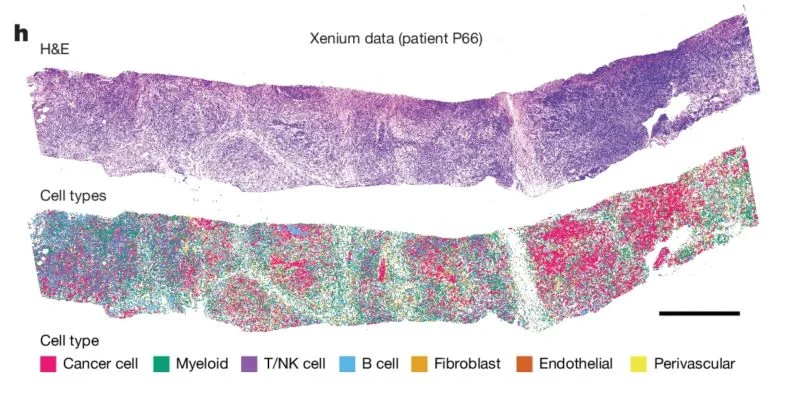
Figure Courtesy: Nature. Nicholas Navin. UT MD Anderson Cancer Center, Houston, TX, USA
You can also read:
Tumor-Derived Extracellular Vesicles Reveal Hidden MBC Risk