






Daniel Flora, Medical Oncologist and Hematologist at St. Elizabeth Healthcare, shared on LinkedIn:
“How much of a chance of cure does there need to be before we consider a cancer treatment curative in intent?
A recent study in JNCCN surveyed 195 oncology clinicians at MD Anderson. Interestingly, the median threshold among physicians was 20%.
I’ve really had to rethink this over the past decade as an oncologist who treats a lot of melanoma. Ten years ago, I rarely used the words curative intent when treating patients with stage IV melanoma. Today, I use them quite frequently.
I wonder whether we sometimes confuse the probability of achieving a goal with the goal itself.
Personally, I go into every case hoping to find a way to cure that patient, regardless of the statistics. That doesn’t mean every treatment I recommend has a realistic chance of cure. But it’s how I’ve chosen to approach things.
I’d really like to hear how other oncologists think about this.”
Daniel Flora also shared on Substack:
“Prognosis conversations in cancer care are hard. And contrary to what you might think, they don’t get any easier with experience.
Over the years, I’ve generally avoided telling a patient at one of our first visits that their cancer is incurable or that their treatment is palliative. I’ve never used the word terminal in my conversations with patients.
A lot of that comes from how many times I’ve been wrong before. I’ve seen patients live much longer than I expected, and I’ve seen treatments work far better than the statistics would have suggested.
I still talk openly with my patients about prognosis. It’s important for patients to understand the likelihood of cure and the limitations of our treatments. But I’ve become much more careful about presenting an outcome as certain before I’ve had a chance to get to know the patient or see how their cancer responds to treatment.
The longer I practice oncology, the more comfortable I’ve become acknowledging how much I don’t know.

What exactly is curative intent?
In oncology, we generally categorize cancer treatment into two broad categories: curative intent and palliative intent.
It’s something we document in our medical records, review at tumor boards and talk about with our patients when we’re deciding on a treatment.
I’ve used these terms throughout my career, but over the past several years, I’ve found myself thinking a little differently about them.
How much of a chance of cure does there need to be before I consider a treatment curative in intent? And do other oncologists think about this the same way I do?
Curative intent means we are treating a patient’s cancer with the goal of eliminating it permanently. Palliative intent generally means we are trying to control the cancer, prolong life and/or improve quality of life without an expectation of cure.
These distinctions influence a great deal of what we do in oncology. We may be willing to accept more toxicity or administer more intensive treatment when there is a reasonable possibility of cure. When our primary goal is disease control, we may be more inclined to reduce doses or take treatment breaks to preserve quality of life.
A recent study published in the Journal of the National Comprehensive Cancer Network surveyed 195 oncology clinicians at MD Anderson Cancer Center about the minimum probability of cure they would need to consider a treatment curative in intent.
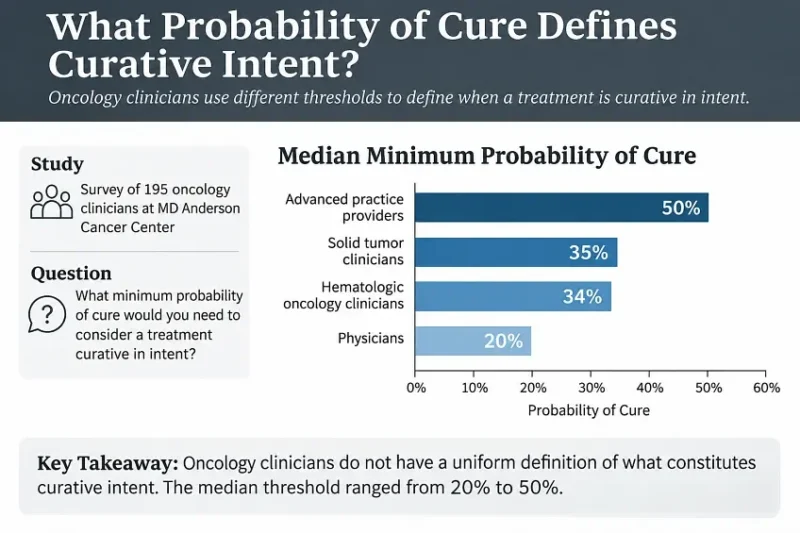
While this was a survey at a single cancer center, I find these differences interesting, but also a little concerning.
Two oncology clinicians could be treating the same type of cancer, using the same treatment, with the same estimated probability of cure, and describe their treatment intent differently.
I wonder how many of our patients realize that.
Is curative intent a probability or a goal?
This is where I struggle a bit. If I’m treating a patient with a 90% chance of cure, few would question my designation of curative intent. What about 30%? Or 10%? Or 5%?
At what point does my intent change?
If I’m administering a treatment that has a medically credible possibility of curing someone’s cancer, does that probability need to exceed a certain percentage before I can describe that as my intent?
I wonder whether we sometimes confuse the probability of achieving a goal with the goal itself.
And I think there’s a separate question here about whether the treatment is worth pursuing. A small chance of cure with relatively little toxicity may be a very reasonable option for a patient. A much higher chance of cure with substantial toxicity may be something another patient chooses to forgo.
How melanoma has changed my perspective
As an oncologist who treats a lot of melanoma, I’ve really had to rethink this over the past decade. Ten years ago, I rarely used the words curative intent when treating patients with stage IV melanoma. Today, I use them quite frequently.
I have patients who come back to see me once or twice a year who previously had extensive metastatic melanoma. They’ve been off treatment for years and continue to have no evidence of active cancer. Are they cured? For some, I suspect they are. For others, only time will tell.
When I initially started treating these patients, I had very little ability to predict who would have these kinds of outcomes. But knowing what we know today, should we still describe all treatment for metastatic melanoma as palliative in intent?
As our treatments improve, I suspect we’re going to be having this conversation more frequently across other types of cancer.
Who gets to decide what probability is meaningful?
A 5% chance of cure may be incredibly meaningful to one of my patients. Another patient may feel that even a 30% chance of cure is insufficient given how difficult the treatment might be and what they value most in their life. Neither patient is wrong.
Early in my career, I was laser-focused on ensuring that every cancer patient received the treatment with the highest statistical chance of success. It took years of conversations with patients to appreciate how much more goes into that decision. How difficult is the treatment? How long will it last? What are the potential long-term side effects? What other options are available?
I’ve also learned to ask better questions in clinic: What are you hoping for? What’s most important to you right now? What does a good day look like for you?
I’ve learned quite a bit about taking care of people with cancer simply by asking these questions and giving patients the time to answer them.
The limitations of our language
The authors of that study raised some important concerns about setting the threshold for curative intent too low.
If a patient hears the words curative intent and walks away from our visit believing they are likely to be cured, when in reality that probability is very small, I haven’t done a good job communicating with that patient.
These conversations influence how people spend their time, the decisions they make with their families and how they plan for their future.
But I have similar concerns about the term palliative intent.
I’ve often wondered what goes through a patient’s mind when they first hear those words. Do they understand that we may have treatments that could allow them to live well for many years?
Perhaps we just need to spend a little more time explaining what we mean.
I can tell a patient that there is a possibility of cure while being very open about how small that possibility may be. I can also explain that while we lack evidence that a treatment can cure their cancer, there is still quite a bit we can do to help them live longer and live well.
And palliative care can be an incredibly valuable resource for patients and their families throughout all of this, regardless of our treatment intent.
Curative until proven otherwise
Personally, I go into every case hoping to find a way to cure that patient. Regardless of the statistics. I’m sure that sounds unreasonable to some, but it’s how I’ve chosen to approach things.
That doesn’t mean every treatment I administer is curative in intent. There are many situations where we simply lack evidence that our available treatments can cure a patient’s cancer. And sometimes the best thing I can do for a patient is recommend less treatment or no further cancer treatment at all. My desire to cure someone should never take precedence over what that patient wants for their life.
But I’ve been fortunate enough to practice oncology during a period of remarkable scientific progress. I’ve watched cancers that we once considered uniformly incurable become potentially curable for some of my patients.
It’s one of the things I love about oncology, and one of the reasons I try to remain open to what’s possible.
I’d really like to hear from patients
Has your oncologist ever discussed the intent of your cancer treatment with you? Were you given an estimate of the likelihood of cure? What did it mean to you when you heard the words curative or palliative intent?
I’d really appreciate hearing from patients and caregivers about your experiences with these conversations. As much as we discuss these things among ourselves in oncology, I’d love to know how you think about them.
I suspect there is quite a bit we can learn from you.”
You can also read: