
Nicholas Sarlis, Chief Medical Officer of CLEARA Biotech BV, shared on LinkedIn:
“When an oncologist says a treatment has ‘curative intent,’ what does that actually mean?
If you ask two clinicians at the same cancer center, you might get wildly different answers.
A new study from researchers at UT MD Anderson Cancer Center, just published in the Journal of the National Comprehensive Cancer Network (NCCN), (JNCCN), reveals a striking communication gap in cancer care: oncology clinicians have highly varied definitions of ‘curative intent’ treatment.
Researchers surveyed 195 medical oncology physicians and advanced practice providers (APPs) to find out the lowest probability of cure needed for them to label a treatment ‘curative.’
The results might surprise you.
The Findings:
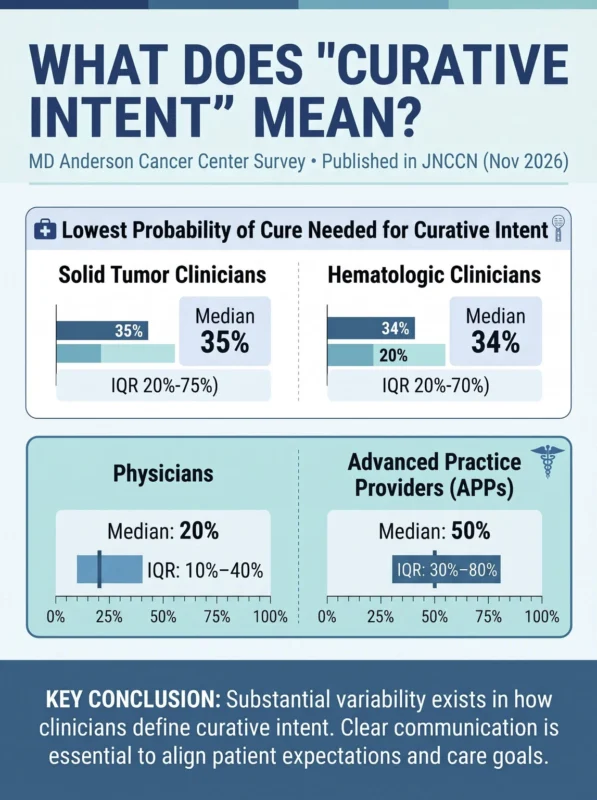
- Solid Tumor vs. Hematologic Oncology: Nearly identical medians – 35% (IQR: 20%–75%) for solid tumor clinicians vs. 34% (IQR: 20%–70%) for hematologic oncology clinicians.
- The Biggest Divide Was by Role: Physicians reported a median threshold of just a 20% chance of cure (IQR: 10%–40%), while APPs required a median 50% chance of cure (IQR: 30%–80%) to consider a treatment curative in intent (P < 0.001).
Why This Matters: In oncology, treatment intent is typically treated as a binary operational definition, i.e., curative or palliative. This is even though real-world cure probabilities span a spectrum from 0% to 100%.
As the authors note: ‘Our study identified substantial variability in how clinicians translate a probability of cure into a dichotomous cancer treatment intent.’
- When clinicians use the same label to describe vastly different odds, it directly impacts:
- treatment intensity
- patient expectations, and, importantly
- when critical conversations around advance care planning happen.
For the HCPs reading this post – Over to you: In your practice, how do you define ‘curative intent’ – and how do you translate those percentages into clear expectations for patients and families?
Drop your thoughts in the comments!
Read the full JNCCN study here.
Coverage via Cancer Therapy Advisor.”
You may also be interested in:
- Narjust Florez: Redefining What “Curative Intent” Can Look Like After Surgery
- Curative Oligometastatic Radiotherapy: A New Approach to Defining Treatment Intent