
Highlighting the critical role of Caris GPSai in improving cancer care
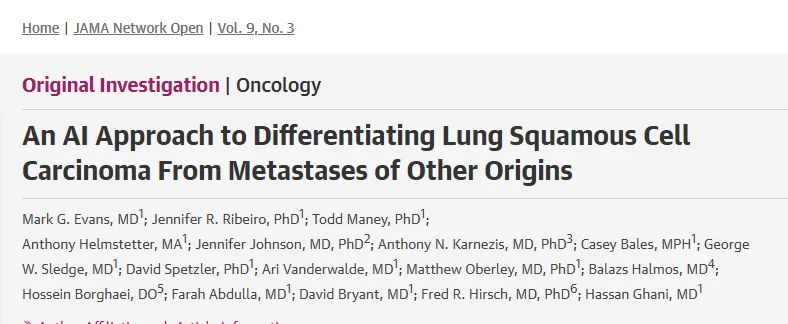
Caris Life Sciences (NASDAQ: CAI), a leading, patient-centric, next-generation AI TechBio company and precision medicine pioneer, published a study in JAMA Network Open, titled ‘An AI Approach to Differentiating Lung Squamous Cell Carcinoma From Metastases of Other Origins.’
This study builds on the body of evidence showing the superiority of Caris’ proprietary and world-leading GPSai algorithm over traditional diagnostic procedures in correctly diagnosing cancer types. This paper demonstrates that by including AI algorithms as part of routine comprehensive molecular profiling, clinicians can uncover clinically significant misdiagnoses in cases labeled as lung squamous cell carcinoma (SCC), influencing treatment decisions and patient outcomes.
The study comprised 3,958 lung cancer cases submitted to Caris with a diagnosis of SCC. Caris GPSai identified 123 of the 3,958 cases were metastases from other primary sites, including cutaneous, urothelial, head and neck and thymic cancers.
The clinical impact of reclassification underscores the power of precision medicine. The study identified 88 patients (71.5%) who had guideline-preferred first-line systemic therapy change recommendations, alerting clinicians that a change in their patients’ treatments would achieve better outcomes. According to the CDC website, lung SCC accounts for roughly 21% of all lung cancer cases in the United States. Applying study-specific stats to the wider CDC data for lung cancer in the United States suggests that approximately 1,000 cases each year may be potential misdiagnoses.
‘Caris GPSai has overturned 3,857 diagnoses across the spectrum of cancer since January of 2024,’ said Matthew Oberley, MD, PhD, Senior Vice President, Chief Clinical Officer and Pathologist-in-Chief at Caris. ‘By integrating AI-driven tissue‑of‑origin predictions with comprehensive molecular profiling and pathology, we can give clinicians greater diagnostic confidence and ensure patients receive the most appropriate care.’
These misdiagnoses carry direct and life-altering clinical consequences, as treatment recommendations and prognostic expectations differ significantly across cancer types. By embedding Caris GPSai into Caris’ comprehensive molecular profiling, providers gain an additional layer of insight that can help patients get the healthcare they deserve. The GPSai algorithm is included as part of MI Cancer Seek and MI Tumor Seek at no additional cost. Caris received FDA approval in November 2024 for MI Cancer Seek. This tissue-based assay is the first and only simultaneous WES and WTS-based assay with FDA-approved companion diagnostic (CDx) indications for molecular profiling of solid tumors.
About Caris Life Sciences
Caris Life Sciences (Caris) is a leading, patient-centric, next-generation AI TechBio company and precision medicine pioneer actively developing and commercializing innovative solutions to transform healthcare. Through comprehensive molecular profiling (Whole Genome, Whole Exome and Whole Transcriptome Sequencing), advanced AI and machine learning, Caris has created the large-scale, multimodal clinico-genomic database and computing capability needed to analyze and further unravel the molecular complexity of disease. This convergence of next-generation sequencing, AI and machine learning technologies and high-performance computing provides a differentiated platform for developing the latest generation of advanced precision medicine diagnostic solutions for early detection, diagnosis, monitoring, therapy selection and drug development. Caris was founded with a vision to realize the potential of precision medicine to improve the human condition. Headquartered in Irving, Texas, Caris has offices in Phoenix, New York, Cambridge (MA), Tokyo, Japan and Basel, Switzerland. Caris or its distributor partners provide services in the U.S. and other international markets.
Title: An AI Approach to Differentiating Lung Squamous Cell Carcinoma From Metastases of Other Origins
Authors: Mark G. Evans, Jennifer R. Ribeiro, Todd Maney, Anthony Helmstetter, Jennifer Johnson, Anthony N. Karnezis, Casey Bales, George W. Sledge, David Spetzler, Ari Vanderwalde, Matthew Oberley, Balazs Halmos, Hossein Borghaei, Farah Abdulla, David Bryant, Fred R. Hirsch, Hassan Ghani
Read the Full Article.
Matthew Oberley: AI Approach Identifies Misdiagnosed Metastatic SCC in Lung Cancer Cases