





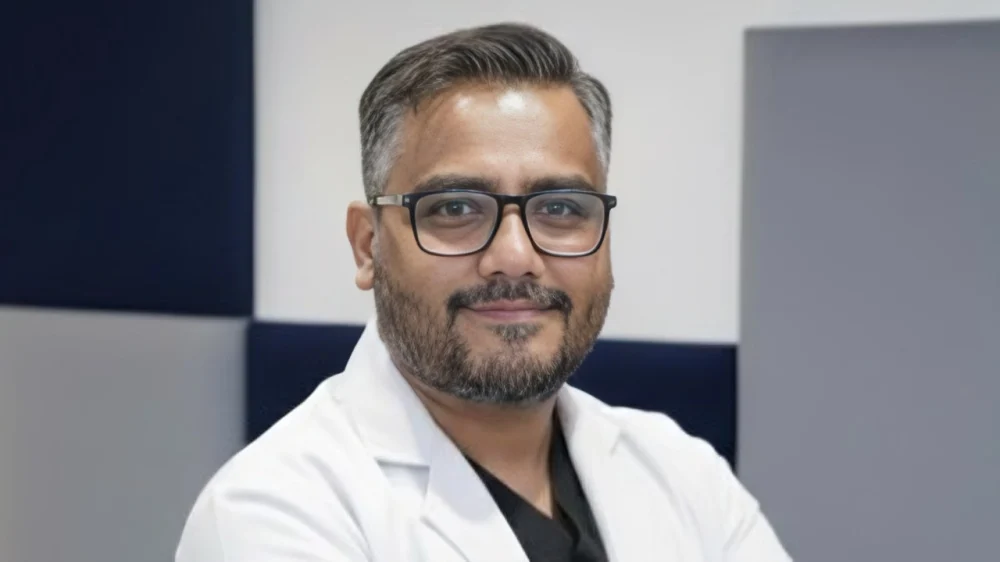
Bhavin Vadodariya, Lead Consultant of Head and Neck Surgical Oncology at SSO Cancer Centre, shared a post on LinkedIn:
“When an Incidental Diagnosis Becomes an Oncological Dilemma: Lessons from the Operating Table
One of the most underestimated challenges in head and neck oncology is not managing advanced cancer…
It is managing the unexpected cancer.
Over the years, I have encountered multiple cases where a patient undergoes a seemingly routine nasal polyp excision often for benign symptoms like nasal obstruction or discharge.
No red flags.
No preoperative suspicion.
And then, the histopathology report arrives:
Squamous Cell Carcinoma.
At that moment, the entire clinical scenario changes.
The surgery performed was not oncological.
Margins are uncertain or unassessed.
Tumor origin and extent remain ambiguous.
And the patient who walked in with a benign diagnosis is suddenly pushed into the complex world of cancer care.
This is where textbooks offer limited guidance.
Because the real question is not
‘What is the diagnosis?’
The real question is:
‘What is the right next step?’
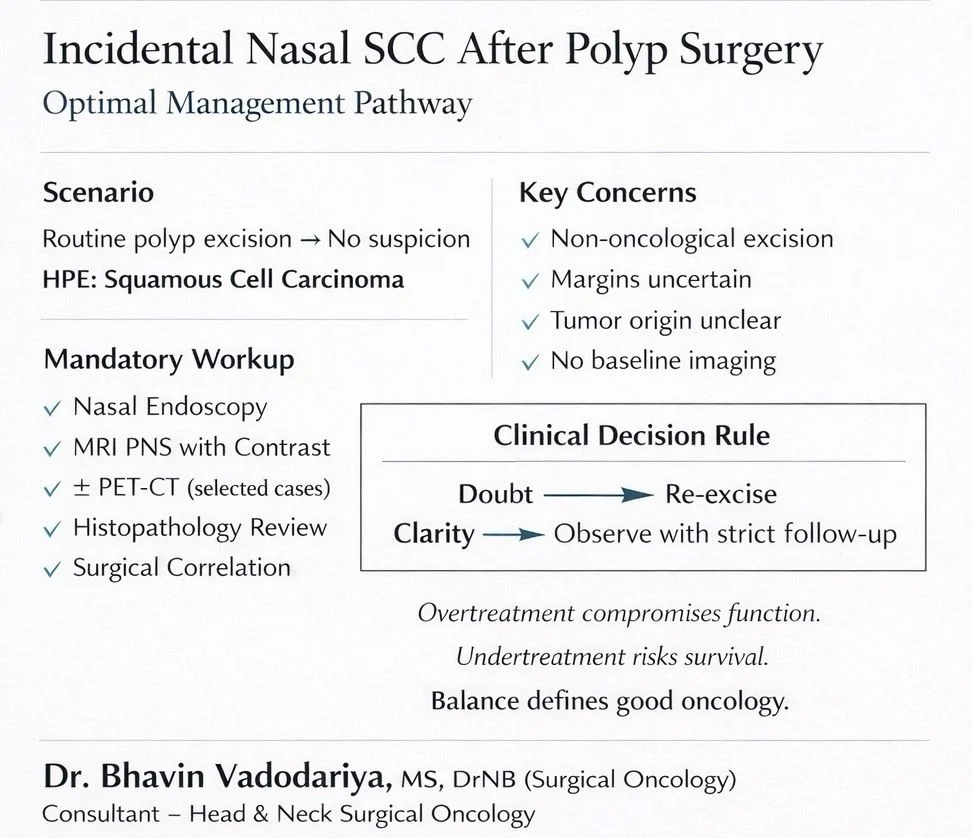
In my clinical practice, I have developed a structured yet flexible approach to such cases:
- Comprehensive nasal endoscopy to reassess the primary site
- MRI PNS with contrast ± PET-CT to rule out residual or occult disease
- Detailed histopathology review focusing on margins, grade, LVI, PNI
- Correlation with the initial surgical procedure and intraoperative findings
However, the true complexity arises in a subset of patients:
- Imaging is completely normal
- No visible residual disease
- Histology suggests low-risk features
Now comes the real surgical dilemma:
- Do we proceed with oncological re-excision?
- Or do we choose structured surveillance?
Early in my career, the instinct was to lean towards re-excision driven by the fear of missing residual disease.
But experience teaches nuance.
Not every cancer diagnosis mandates aggressive escalation.
And not every absence of disease guarantees safety.
Today, my decision making is guided by a principle refined through practice:
When there is uncertainty to Re-excise with oncological intent
When there is clarity to Observe, but with uncompromising follow-up
Because both extremes carry consequences:
Overtreatment can lead to avoidable morbidity impacting nasal function, cosmesis, and quality of life.
Undertreatment, on the other hand, risks delayed recurrence often at a stage where salvage becomes more complex.
In such scenarios, clinical judgment outweighs protocols.
And this is where the role of a seasoned consultant truly begins not just in performing surgery, but in making decisions that balance oncological safety with functional preservation.
One of the most important lessons I’ve learned:
The success of a cancer surgeon is not defined only by the ability to operate… but by the wisdom to choose when not to.
Dr. Bhavin Vadodariya
Lead Consultant – Head and Neck Surgical Oncology
www.drbhavinvadodariya.com, SSO Cancer Centre, Ahmedabad.”
More posts featuring Bhavin Vadodariya.