Bhavin Vadodariya, Consultant Surgical Oncologist at SSO Cancer Hospital and Clinics, PSM Hospital, and Shankus Hospitals, shared a post on LinkedIn:
“Not Every Oral Cancer Needs a Flap A Real Case.
A 37-year-old male presented with a 4*3 cm ulcerative lesion in the upper gingivobuccal sulcus, buccal mucosa.
Background: Grade 2 OSMF, mouth opening ~2 fingers.
His priority was very clear:
- No reduction in mouth opening. No visible scars in any part of body so he can conceal whether he has undergone surgery.
Intraoperative findings
- Depth ~4 mm.
- Base: buccinator muscle.
- Final defect: ~5 × 5 cm (upper alveolus – RMT region).
- Margins: negative on frozen section.
Now the key question: Flap vs function.
Reconstruction strategy
- Buccal fat pad (vascular base).
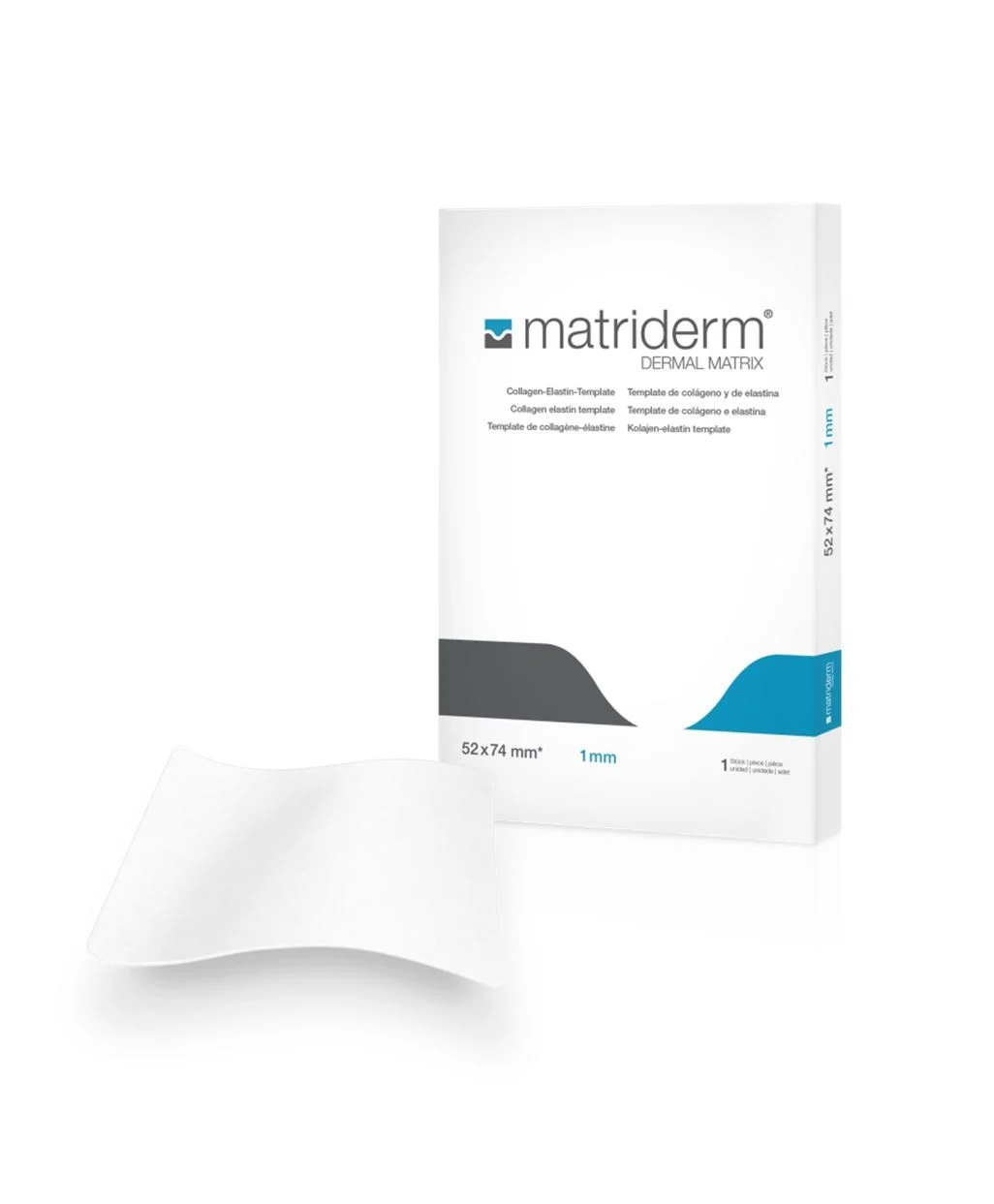
- Overlaid with Matriderm.
- Secured with Vicryl + Jelonet bolster.
A hybrid, function-first reconstruction.
Outcome (4 weeks)
- Complete mucosalization.
- No contracture.
- Mouth opening preserved.
- No external scars.
Exactly what the patient asked for.
So where do dermal matrices fit?
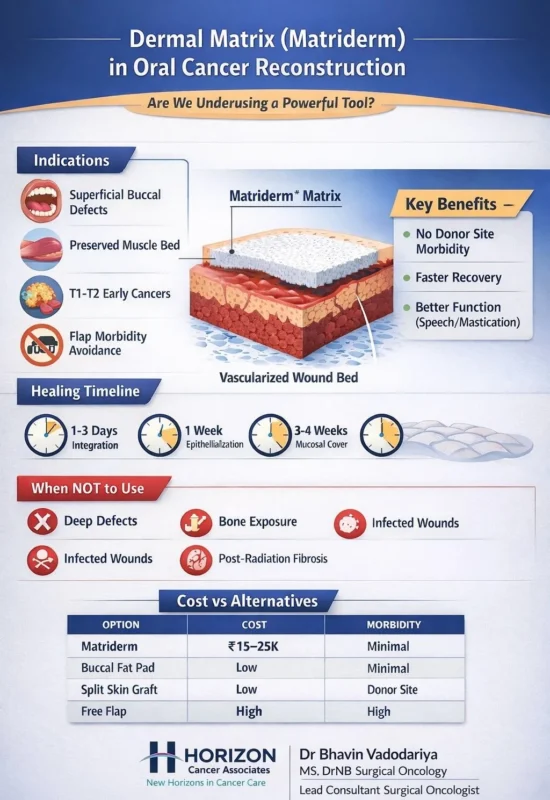
In superficial buccal mucosa defects with preserved muscle bed, dermal matrices like Matriderm offer a strong middle ground between primary closure and flap reconstruction.
Where it works best
- T1-T2 superficial defects.
- No bone exposure / no through-and-through loss.
- When flap morbidity can be avoided.
Why it works.
A collagen–elastin scaffold that promotes:
- Neovascularization.
- Fibroblast ingrowth.
- Rapid epithelialization.
Result: Faster, more predictable healing with less contracture vs secondary intention.
Clinical advantages
- No donor-site morbidity.
- Reduced OT time.
- Good functional outcomes (speech, mastication).
- Particularly useful in OSMF / borderline cases.
When NOT to use
- Deep defects.
- Bone exposure.
- Irradiated / infected beds.
In these situations, flaps still win. Matriderm (~₹15–25k) can avoid unnecessary free flaps (₹2.5–4L+) in selected patients.
We often jump from ‘closure’ – ‘flap.’
But there is a missing middle layer in oral reconstruction and dermal matrices occupy it elegantly.
Better selection = better surgery.
The real skill is not just doing a flap. It’s knowing when NOT to do one.
Would you have chosen a flap in this case?”
Other articles about Oral Cancer on OncoDaily.