






Achyut Saroj, Founder, Consultant, and Author at AwareOnc, KOL Engagement and Medical Affairs Liaison at Tatva Health, shared a post on LinkedIn:
“Seeing the Invisible Through the Johari Window and HelioLiver Test: The Present and Future of Liver Cancer Surveillance
How do we detect what we can’t see? In the world of Hepatocellular Carcinoma (HCC) surveillance, clinicians have long relied on morphological imaging. But as our patient populations change, with rising rates of MASLD/MASH and obesity, our traditional eyes (ultrasound) are hitting a diagnostic wall.
We can explain this shift through the lens of the Johari Window analysis, a framework that reveals how a blood-based comprehensive multi-analyte surveillance test, such as HelioLiver, is shrinking the Blind Spot of liver cancer detection.
1. The Open Area: Actionable Detection
This is where biology and technology align. The tumor is present and visible on both a HelioLiver multi-analyte test and standard imaging. In the CLiMB trial, HelioLiver identified more cases in this actionable area than ultrasound alone, boasting an overall sensitivity of 47.8%.
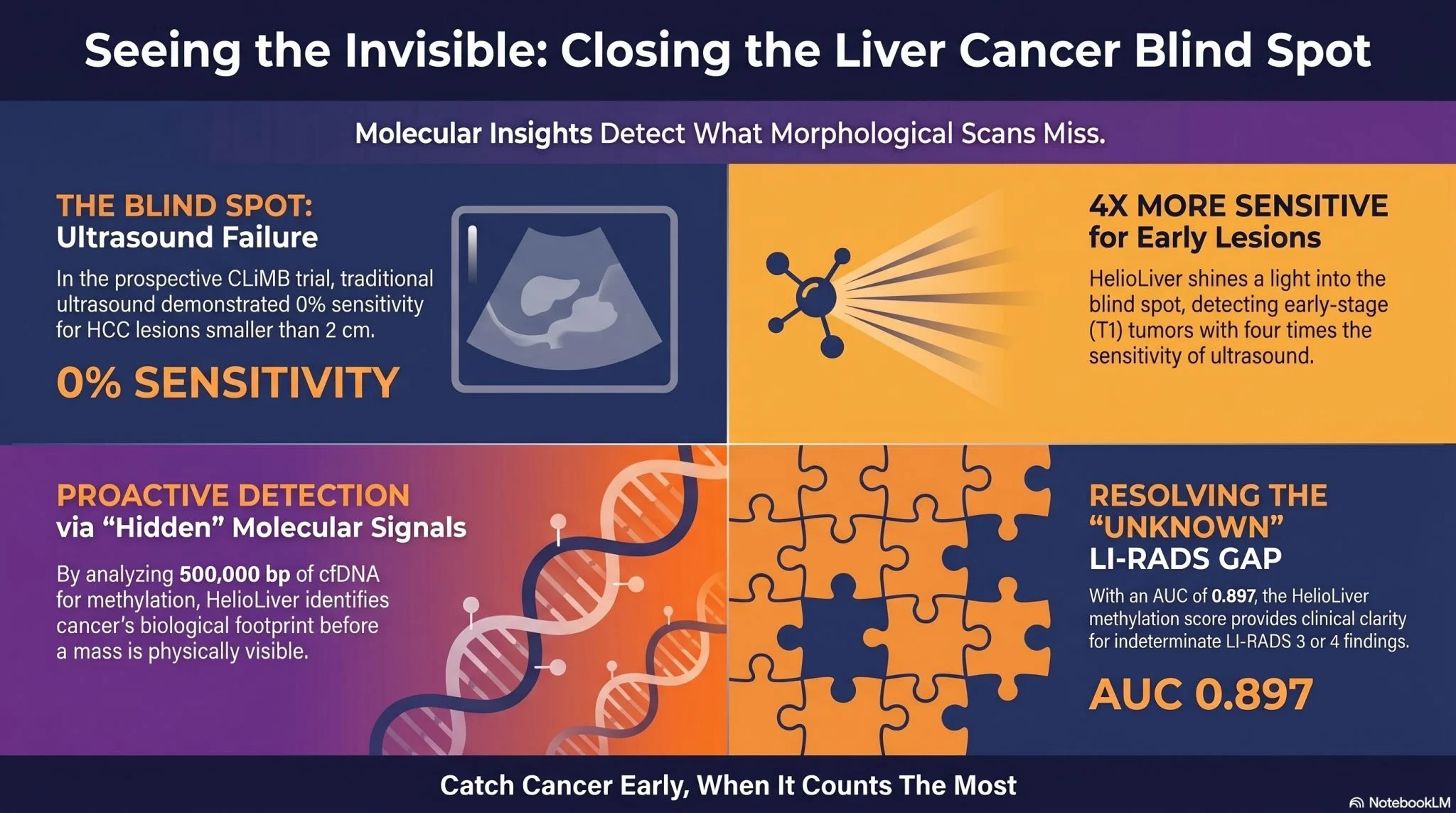
2. The Blind Spot: The Ultrasound Failure
This is the quadrant of known to biology, unknown to the clinician. High BMI and liver scarring increasingly compromise abdominal ultrasound.
The Data: In the fully prospective CLiMB trial, ultrasound demonstrated 0% sensitivity for HCClesions smaller than 2 cm.
The Solution: HelioLiver is 4X more sensitive to very early-stage (T1) lesions, effectively illuminating the blind spot created by physical imaging barriers.
3. The Hidden Area: Proactive Molecular Signals
Before a tumor reaches the threshold for detection on a scan, it leaves a biological footprint. DNAmethylation is an early step in hepatocarcinogenesis. By analyzing approximately 500,000 bp of cfDNA, HelioLiver identifies these hidden molecular signals.
This provides a lead-time advantage, allowing clinicians to act before a mass even appears on a morphological scan.
4. The Unknown: Resolving Indeterminacy
We’ve all seen the LIRADS 3 or 4 findings lesions that leave us in a cycle of watchful waiting because their true nature is Unknown.
HelioLiver’s AI-generated methylation score (with a 0.75 threshold) acts as a molecular barometer for tumor aggressiveness, with an AUC of 0.897.
Clinical Clarity: This score helps move patients from uncertainty to immediate curative intervention or prioritized transplant listing.
The Bottom Line for HCPs and Patients:
Surveillance is about understanding the molecular environment. By moving from morphological search to proactive multi-analyte detection, we can catch cancer early, when it matters most.”
More posts featuring Achyut Saroj.