Achyut Saroj, Founder, Consultant, and Author at AwareOnc, KOL Engagement and Medical Affairs Liaison at Tatva Health, shared a post on LinkedIn:
“Why Diagnostic Sensitivity is Not the Answer Your Patient is Looking For?
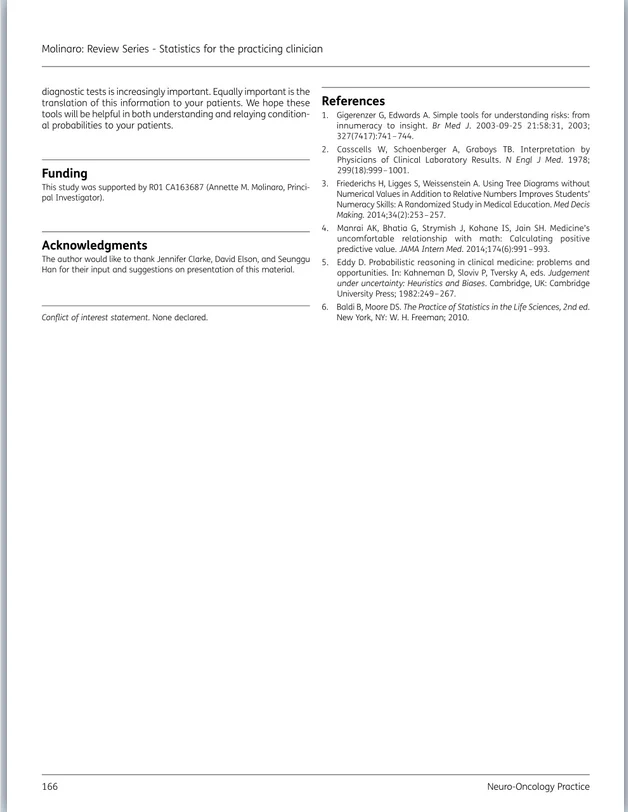
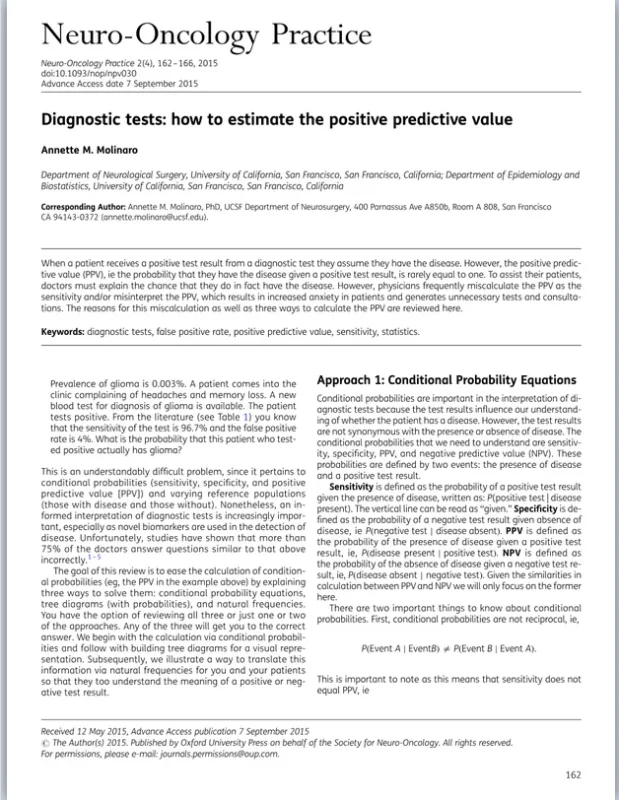
Research indicates that more than 75% of physicians incorrectly answer questions regarding the interpretation of diagnostictests.
When a patient receives a positive result, they often assume they have the disease, but the probability that they actually do, the Positive Predictive Value (PPV), is rarely equal to 100%.
To provide better care and reduce unnecessary patientanxiety, we must master these four pillars of diagnostic statistics:
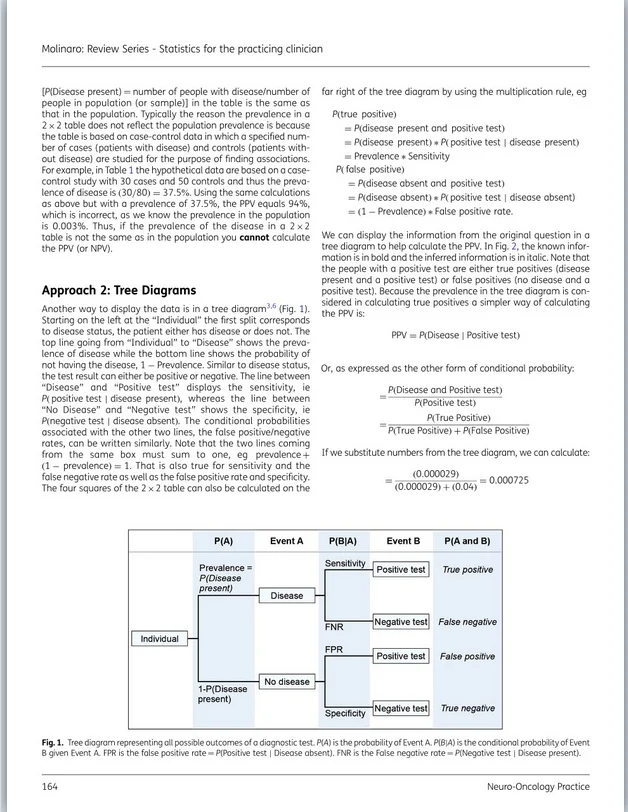
Sensitivity: The probability of a positive test result given that the disease is present.
Specificity: The probability of a negative test result given that the disease is absent.
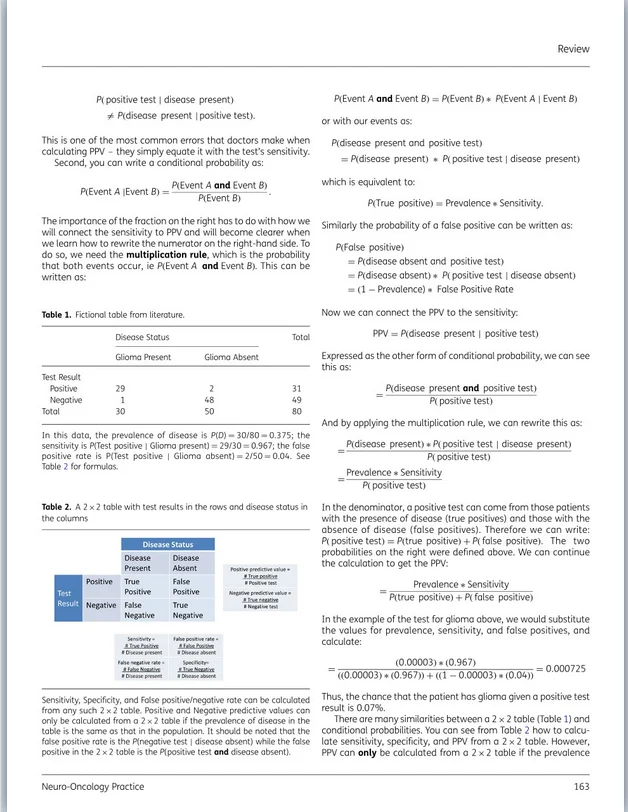
PPV: The probability that the disease is present given a positive test result.
NPV: The probability that the disease is absent given a negative test result.
Why Sensitivity ≠ PPV
One of the most frequent clinical errors is equating a test’s sensitivity with its PPV. Conditional probabilities are not reciprocal. Sensitivity tells you how well the test identifies sick people, but it does not tell you if a specific positive testing patient is actually sick.
Specificity and the False Positive Rate
These two values are complementary and must always sum to 1 (or 100%). If a test has a specificity of 96%, it means 96% of healthy people test negative, leaving a 4% False Positive Rate.
The Power of Disease Prevalence (Incidence Rate)
The interpretation of any test is dictated by the prevalence of the disease in the population. In rare diseases, even tests with high sensitivity and specificity will produce a “vast majority” of false positives.
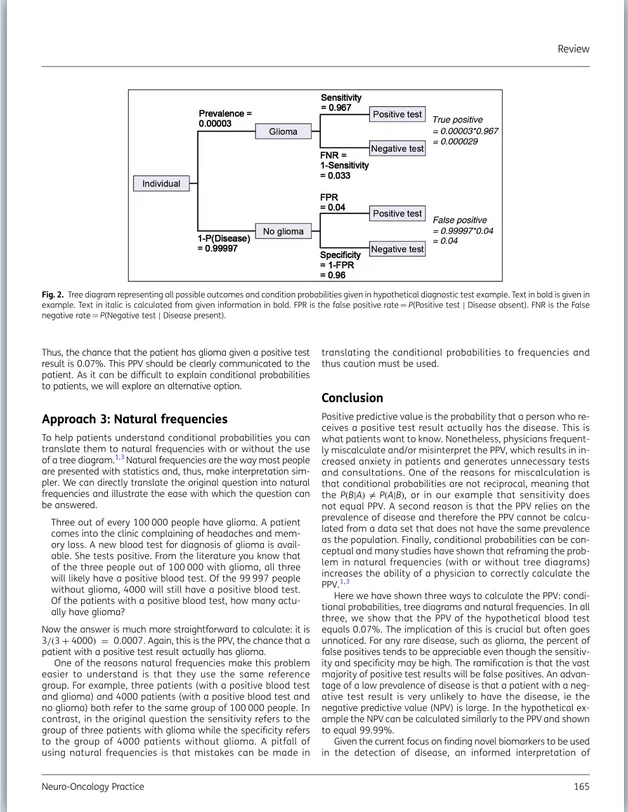
For example, consider a blood test for glioma (0.003% prevalence) with 96.7% sensitivity and a 4% false-positive rate.
In a group of 100,000 people, only 3 will have the disease and test positive.
However, 4,000 healthy people will also test positive.
The resulting PPV is only 0.07%, meaning 99.93% of positive results are false alarms.
Conversely, a low prevalence significantly increases the Negative Predictive Value (NPV), making a negative result highly reliable.
Clinical Tip: To help patients understand these complex risks, try using Natural Frequencies (e.g., “3 out of 4,003 positive results are true cases”) rather than abstract percentages.”
Other articles featuring Achyut Saroj on OncoDaily.