






Aadil Najeed, Senior Resident of Government Medical College Srinagar, shared a post on LinkedIn:
“Low Dose Radiotherapy (LDRT) in Plantar Fasciitis – An underused yet evidence-backed option
Plantar fasciitis is one of the most common causes of chronic heel pain — and while most patients respond to NSAIDs, orthotics, physiotherapy or injections… a subset remains refractory.
This is where LDRT finds its role.
What do major guidelines and groups suggest?
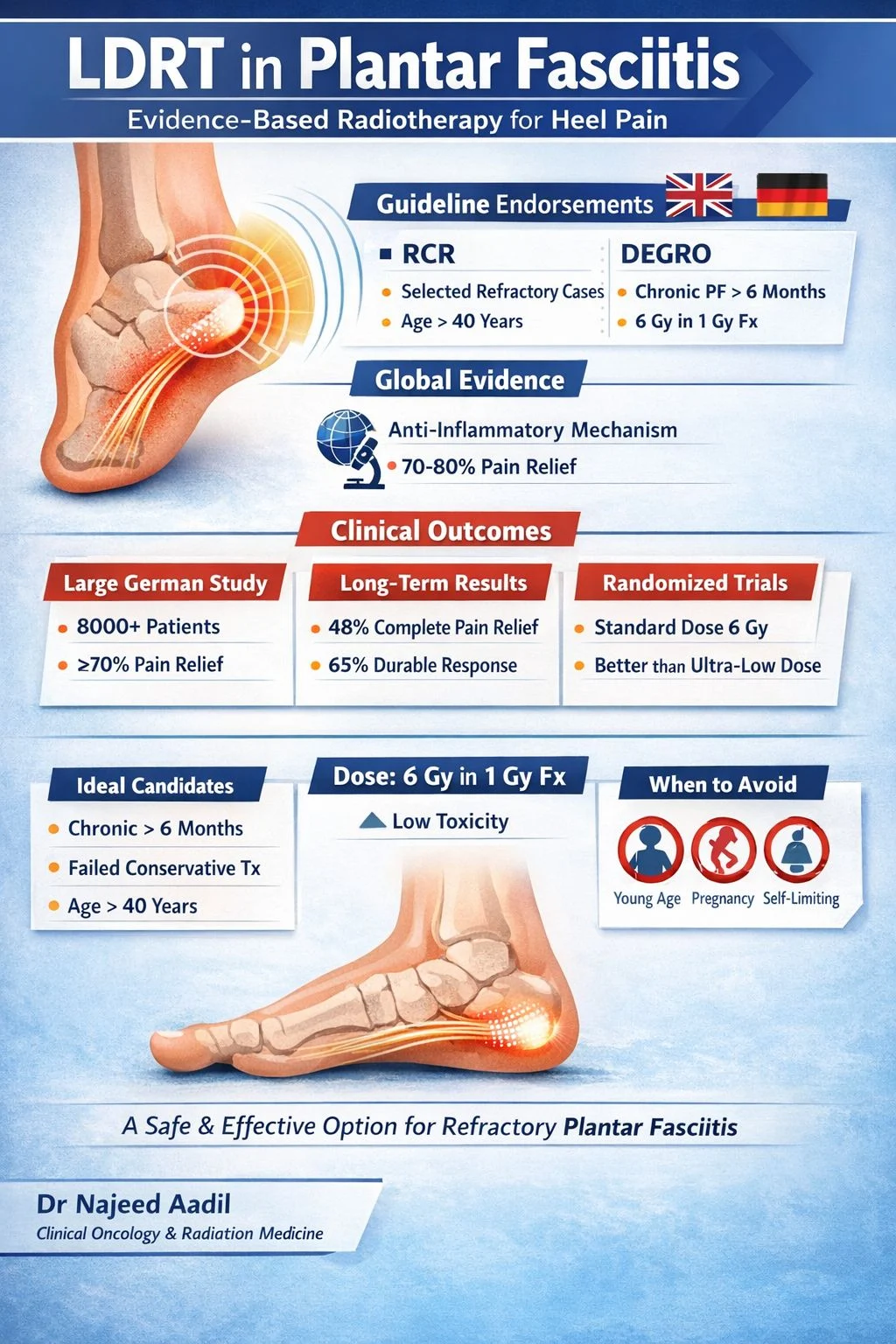
RCR (Royal College of Radiologists)
- Supports RT for benign conditions in **selected refractory cases**
- Emphasis on careful patient selection (typically >40 yrs)
German DEGRO guidelines
- Among the strongest proponents globally
- Recommend LDRT for **chronic plantar fasciitis (>6 months, failed conservative therapy)**
- Standard regimen: **~6 Gy in 1 Gy fractions, 2–3/week**
International data (IORBC and published literature)
- Consistent evidence of **anti-inflammatory mechanism**
- Macrophage modulation and cytokine suppression drive symptom relief
What does the evidence show?
- Large German series (~8000 patients)
• Pain relief ≥70%
• Durable response ~65%
• Minimal to no significant toxicity - Retrospective and long-term data
• Complete pain relief ~48%
• >50% improvement in additional ~20%
• Long-lasting benefit (years) - Randomized trials (DEGRO group)
• Standard dose (6 Gy) superior to ultra-low dose (placebo-like arm)
Why does it work?
- Anti-inflammatory effect (not cytotoxic)
- Downregulation of leukocyte adhesion and cytokines
- Particularly effective in chronic degenerative inflammation
Practical takeaways
- Ideal candidate
• Chronic symptoms >6 months
• Failed conservative therapy
• Age >40 years - Dose and technique
• 6 Gy in 1 Gy fractions (most commonly used)
• Orthovoltage / megavoltage both acceptable - Safety
• Extremely low toxicity
• Negligible carcinogenic risk in appropriate age group
When to avoid
- Young patients
- Pregnancy
- Early/self-limiting disease
Bottom line
LDRT is not first-line — but in carefully selected patients, it offers a **highly effective, low-toxicity, evidence-supported option** that is often overlooked outside Europe.
Time to reconsider LDRT in benign inflammatory conditions?”
More posts featuring Aadil Najeed.